
Catalogue Search | MBRL


Are you sure you want to remove the book from the shelf?

{{itemTitle}}
76
result(s) for
"Keymer, Tom"
Sort by:

Jane Austen and the Jurassic
The town was a hotbed of Puritan revolution in the 1640s, when it withstood, at much human cost on both sides, a failed eight-week siege by Royalist forces. For artists of the Romantic period, the surrounding coastline offered lessons in sublime evocation that were best exploited by Austen’s exact contemporary J. M. W. Turner, whose watercolour of c.1834, now in the Cincinnati Art Museum, is one of several to show humanity dwarfed and struggling, indeed almost overwhelmed, by the immensity and power of elemental forces.1 [ Image Omitted ] Yet it’s not only to experience oceanic sublimity, or to glimpse what in Austen’s day was already being called “the abyss of time” (Playfair, qtd. in Heringman, Deep Time 242), that visitors have been drawn to Lyme. A wartime postcard sent by the artist Duncan Grant to another Bloomsbury insider, Virginia Woolf’s sister Vanessa Bell, shows the prime candidate for the episode, a precipitous flight of steps cut between two levels of the Cobb’s inner wall. The family’s lodgings are adequate but inconvenient and none too clean, and some of the furniture needs repair: “I have written to Mr Pyne [the landlord], on the subject of the broken Lid;—it was valued by Anning here, we were told, at five shillings”—which, Austen adds, “appeared to us beyond the value of all the Furniture in the room together.”
Journal Article

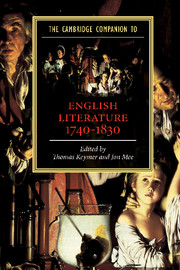
The Cambridge Companion to English Literature, 1740–1830
This 2004 volume offers an introduction to British literature that challenges the traditional divide between eighteenth-century and Romantic studies. Contributors explore the development of literary genres and modes through a period of rapid change. They show how literature was shaped by historical factors including the development of the book trade, the rise of literary criticism and the expansion of commercial society and empire. The first part of the volume focuses on broad themes including taste and aesthetics, national identity and empire, and key cultural trends such as sensibility and the gothic. The second part pays close attention to the work of individual writers including Sterne, Blake, Barbauld and Austen, and to the role of literary schools such as the Lake and Cockney schools. The wide scope of the collection, juxtaposing canonical authors with those now gaining new attention from scholars, makes it essential reading for students of eighteenth-century literature and Romanticism.
eBook

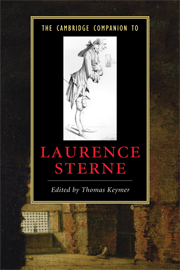
The Cambridge Companion to Laurence Sterne
Best known today for the innovative satire and experimental narrative of Tristram Shandy (1759–67), Laurence Sterne was no less famous in his time for A Sentimental Journey (1768) and for his controversial sermons. Sterne spent much of his life as an obscure clergyman in rural Yorkshire. But he brilliantly exploited the sensation achieved with the first instalment of Tristram Shandy to become, by his death in 1768, a fashionable celebrity across Europe. In this Companion, specially commissioned essays by leading scholars provide an authoritative and accessible guide to Sterne's writings in their historical and cultural context. Exploring key issues in his work, including sentimentalism, national identity, gender, print culture and visual culture, as well as his subsequent influence on a range of important literary movements and modes, the book offers a comprehensive new account of Sterne's life and work.
eBook


Sterne, tristram, yorick
Sterne, Tristram, Yorick: Tercentenary Essays on Laurence Sterne derives from the Laurence Sterne Tercentenary Conference held at Royal Holloway, University of London, on July 8-11, 2013.It was attended by some eighty scholars from fourteen countries; the conference heard more than sixty papers.
eBook