
Catalogue Search | MBRL


Are you sure you want to remove the book from the shelf?

{{itemTitle}}
109
result(s) for
"Kinder, Donald R."
Sort by:


Ethnocentrism as a Short-Term Force in the 2008 American Presidential Election
Faced with a choice between John McCain and Barack Obama, voters in 2008 were swayed by the familiar play of factors—party identification, policy preferences, and economic conditions—but also, we find, by ethnocentrism, a deep-seated psychological predisposition that partitions the world into ingroups and outgroups—into \"us\" and \"them.\" The effect of ethnocentrism was significant and substantial, and it appeared over and above the effects due to partisanship, economic conditions, policy stances, political engagement, and several varieties of conservatism. Two features of Obama were primarily responsible for triggering ethnocentrism in 2008: his race and his imagined Muslim faith. As such, we demonstrate that ethnocentrism was much more important in 2008 than in the four presidential elections immediately preceding 2008, and we show that it was much more important in the actual contest between Senator McCain and Senator Obama than in a hypothetical contest between Senator McCain and Senator Clinton.
Journal Article


Terror and Ethnocentrism: Foundations of American Support for the War on Terrorism
The events of 9/11 set in motion a massive reordering of U.S. policy. We propose that the American public's response to this redirection in policy derives, in part, from ethnocentrism. Ethnocentrism—“prejudice, broadly conceived”—refers to the commonplace human tendency to partition the social world into virtuous ingroups and nefarious outgroups. Support for the war on terrorism, undertaken against a strange and shadowy enemy, should hold special appeal for Americans with an ethnocentric turn of mind. To see if this is so, we analyze the panel component of the 2000–2002 National Election Study. We find that ethnocentrism powerfully underwrites support for the war on terrorism, across a variety of tests and specifications, and the strength of the relationship between ethnocentrism and opinion is influenced in part by the extraordinary events of 9/11. Ethnocentrism is easily found among Americans, but its relevance and potency for politics depends, we suggest, upon circumstance.
Journal Article

Politics and the Life Cycle
The study of politics and the life cycle began with a rather single-minded focus on childhood and the family--on the idea, as Tocqueville famously put it, that the entire person could be \"seen in the cradle of the child.\" Politics does begin in childhood, and parents do influence their offspring, but change takes place over the entire span of life. I take up the early emergence of partisanship and essentialism, the formation of generations, politically consequential transitions in adulthood, and the rising of politics and its final decline.
Journal Article
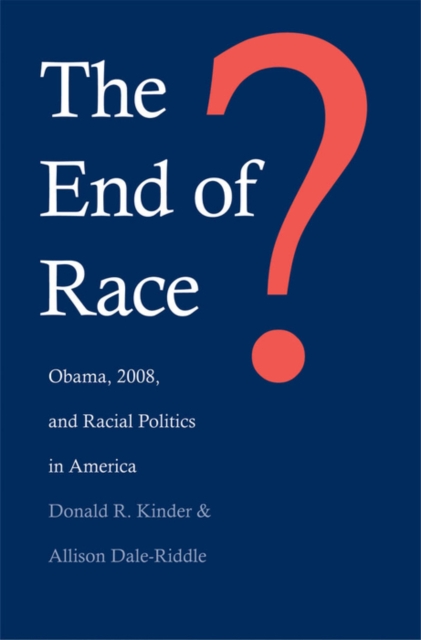
The end of race? : Obama, 2008, and racial politics in America
How did race affect the election that gave America its first African American president? This book offers some fascinating, and perhaps controversial, findings. Donald R. Kinder and Allison Dale-Riddle assert that racism was in fact an important factor in 2008, and that if not for racism, Barack Obama would have won in a landslide. On the way to this conclusion, they make several other important arguments.In an analysis of the nomination battle between Obama and Hillary Clinton, they show why racial identity matters more in electoral politics than gender identity. Comparing the 2008 election with that of 1960, they find that religion played much the same role in the earlier campaign that race played in 08. And they argue that racial resentmenta modern form of racism that has superseded the old-fashioned biological varietyis a potent political force.
eBook
Making Sense of Issues Through Media Frames: Understanding the Kosovo Crisis
How do people make sense of politics? Integrating empirical results in communication studies on framing with models of comprehension in cognitive psychology, we argue that people understand complicated event sequences by organizing information in a manner that conforms to the structure of a good story. To test this claim, we carried out a pair of experiments. In each, we presented people with news reports on the 1999 Kosovo crisis that were framed in story form, either to promote or prevent U.S. intervention. Consistent with expectations, we found that framing news about the crisis as a story affected what people remembered, how they structured what they remembered, and the opinions they expressed on the actions government should take.
Journal Article
The End of Race?
How did race affect the election that gave America its first African American president? This book offers some fascinating, and perhaps controversial, findings. Donald R. Kinder and Allison Dale-Riddle assert that racism was in fact an important factor in 2008, and that if not for racism, Barack Obama would have won in a landslide. On the way to this conclusion, they make several other important arguments. In an analysis of the nomination battle between Obama and Hillary Clinton, they show why racial identity matters more in electoral politics than gender identity. Comparing the 2008 election with that of 1960, they find that religion played much the same role in the earlier campaign that race played in '08. And they argue that racial resentment-a modern form of racism that has superseded the old-fashioned biological variety-is a potent political force.
eBook
Exploring the Racial Divide: Blacks, Whites, and Opinion on National Policy
Black and white Americans disagree consistently and often substantially in their views on national policy. This racial divide is most pronounced on policies that intrude conspicuously on the fortunes of blacks and whites, but it is also apparent on a wide array of social welfare issues where race is less obviously in play. Our analysis takes up the question of why blacks and whites differ so markedly, distinguishing among four alternative interpretations: one centers attention on underlying differences of class, another on political principles, a third on social identity, and the fourth on audience. Our results are complicated but coherent. We discuss their implications for the meaning of group interest, speculate on the conditions under which the racial divide might close (or widen) in the foreseeable future, and suggest why we should not wish racial differences in opinion to disappear.
Journal Article

Prejudice and Politics Re-Examined The Political Significance of Implicit Racial Bias
As part of a general inquiry into mental mechanisms that operate outside conscious awareness, experimental psychology has recently established the presence and importance of “implicit attitudes.” The purpose of our paper is to compare the roles played by implicit and explicit prejudice in politics. Relying on two national surveys of the American electorate that included standard measures of implicit and explicit prejudice, we provide a systematic comparison of prejudice’s political effects: for the candidates Americans choose, the policies they favor, the assessments they make of government performance, and the racialized information they absorb. We find that implicit and explicit prejudice provide radically different pictures of racial politics in America.
Journal Article