
Catalogue Search | MBRL


Are you sure you want to remove the book from the shelf?

{{itemTitle}}
242
result(s) for
"Kinealy, Christine"
Sort by:


Black Abolitionists in Ireland
The story of the anti-slavery movement in Ireland is little known, yet when Frederick Douglass visited the country in 1845, he described Irish abolitionists as the most ‘ardent’ that he had ever encountered. Moreover, their involvement proved to be an important factor in ending the slave trade, and later slavery, in both the British Empire and in America.
While Frederick Douglass remains the most renowned black abolitionist to visit Ireland, he was not the only one. This publication traces the stories of ten black abolitionists, including Douglass, who travelled to Ireland in the decades before the American Civil War, to win support for their cause. It opens with former slave, Olaudah Equiano, kidnapped as a boy from his home in Africa, and who was hosted by the United Irishmen in the 1790s; it closes with the redoubtable Sarah Parker Remond, who visited Ireland in 1859 and chose never to return to America. The stories of these ten men and women, and their interactions with Ireland, are diverse and remarkable.
eBook


Black Abolitionists in Ireland
Building on the narratives explored in volume one, this publication recovers the story of a further seven Black visitors to Ireland in the decades prior to the American Civil War.
eBook
Black Abolitionists in Ireland
Building on the narratives explored in volume one, this publication recovers the story of a further seven Black visitors to Ireland in the decades prior to the American Civil War.
This volume examines each of these seven activists and artists, and how their unique and diverse talents contributed to the movement to abolish enslavement and to the demand for Black equality. In an era that witnessed the rise of minstrelsy, they provided a powerful counter argument to the lie of Black inferiority. Moreover, their interactions with Irish abolitionists helped to build a strong transatlantic movement that had a global reach and impact. The lives explored are Ira Aldridge (the African Roscius), William Henry Lane (Master Juba), William P. Powell, Elizabeth Greenfield (the Black Swan), Reuben Nixon, James Watkins and William H. Day. Individually and collectively they demonstrated the agency and power of Black involvement in the search for social justice.
This book will be of value to students and scholars alike interested in modern European history and social and cultural history.
eBook
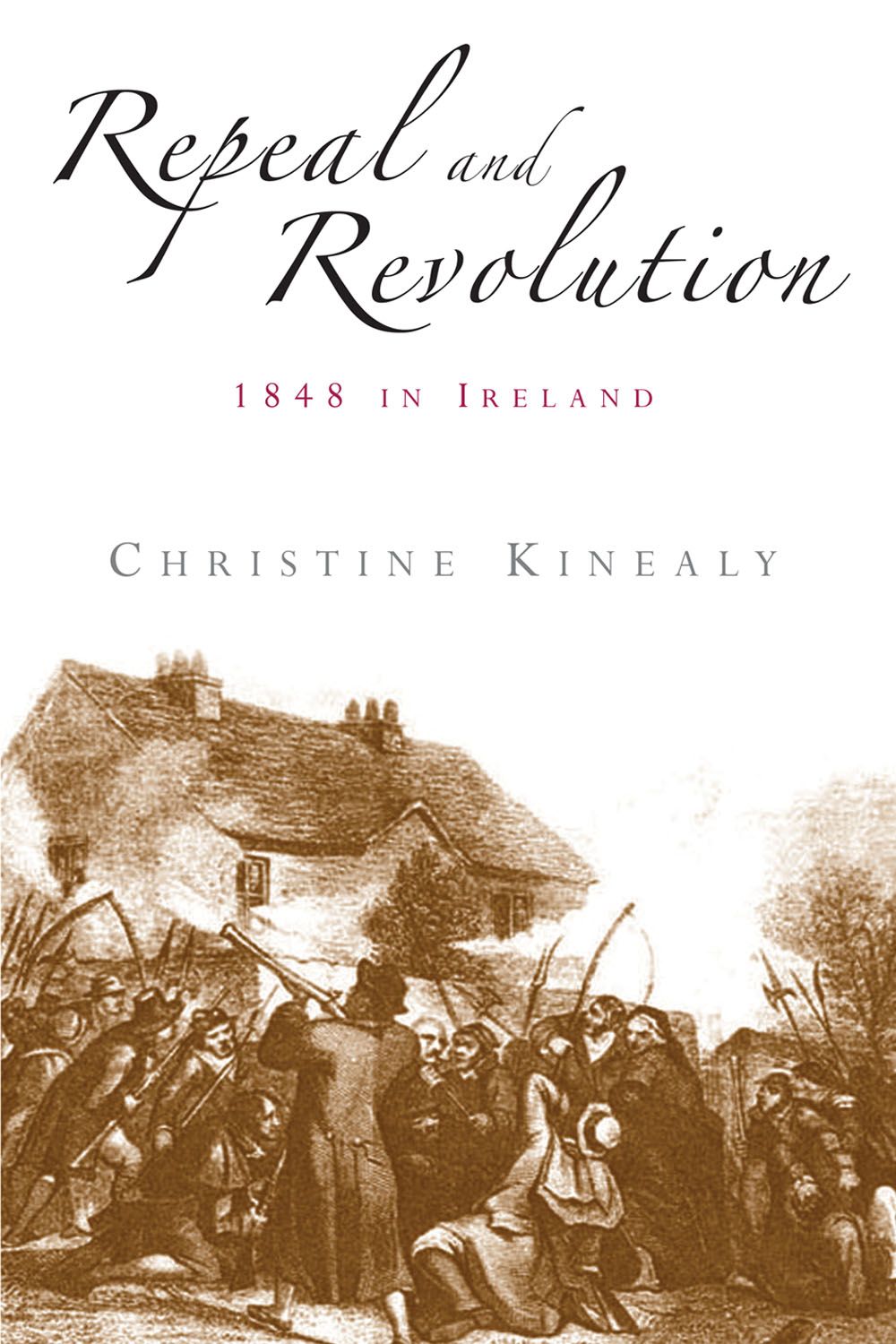
Repeal and revolution
Repeal and revolution. 1848 in Ireland examines the events that led up to the 1848 rising and examines the reasons for its failure. It places the rising in the context of political changes outside Ireland, especially the links between the Irish nationalists and radicals and republicans in Britain, France and north America. The book concludes that far from being foolish or pathetic, the men and women who led and supported the 1848 rising in Ireland were remarkable, both individually and collectively.This book argues that despite the failure of the July rising in Ireland, the events that let to it and followed played a crucial part in the development of modern Irish nationalismThis study will engage academics, students and enthusiasts of Irish studies and modern History
eBook

The Hidden Famine
Between 1845 and 1852, Ireland was devastated by the 'Great Hunger' – the most severe famine in modern European history. The view widely held by historians is that the impact of the Famine on the northern province of Ulster, in particular the largely Protestant city of Belfast, was minimal. In the first book on the Famine to focus specifically on Belfast, Christine Kinealy, one of Ireland’s leading historians of the period, and Gerard MacAtasney, challenge this view and offer a new interpretation.
Drawing on a wealth of original research, Kinealy and MacAtasney begin with an examination of society and social behaviour in Belfast prior to 1845. They then assess the official response to the crisis by the British government, the response by the Church in both England and Ireland, and the part played by the local administration in Ulster. The authors examine the impact of the cholera epidemic on Belfast in 1849-50, the city's recovery after the Famine, and the beginnings of open sectarianism among the business and landed classes of the province.
eBook
James Watkins (c. 1821-1880?)
James Watkins was unusual in that when he arrived in the United Kingdom in 1851, he was virtually unknown in the transatlantic abolitionist world. Despite having neither position nor patronage, once there, he toured the abolitionist circuit for over a decade, raised enough money to pay for the freedom of a number of other enslaved people, published a successful narrative that was reprinted at least twenty-one times, produced a book of poetry,
1
and was honoured with a carving of his head being displayed in a public place in England.
2
Few Black abolitionists received such recognition overseas during their lifetime. It is generally agreed that Watkins returned to the United States in the 1860s and died sometime after-both the date and the location are unknown, however. If the Fugitive Slave Act had not forced Watkins across the Atlantic, his life would have remained unremarkable, uncelebrated, and unknown.
Book Chapter
William Henry Lane (c. 1825-c. 1851)
William Henry Lane, also known as Master Juba, is generally accepted to be the father of tap dance-a fusion between traditional Irish and 'plantation' dance rhythms and movements.
1
During his lifetime, he achieved fame on both sides of the Atlantic, but his career was as brief as it was dazzling. Moreover, his final years mirrored his early years, with him living in poverty and obscurity. Yet, in addition to his contribution to modern dance, Master Juba remains important as he, almost single-handedly, challenged the authenticity and quality of White performers appearing in blackface and performing in minstrel shows.
2
In this way, he confronted racial stereotypes in a way that reinforced the words and actions of better-known Black abolitionists. As a consequence, Lane has carved a unique place in Black, transatlantic, and popular culture similar to other performers such as Ira Aldridge and Elizabeth Greenfield.
Book Chapter
Reuben Nixon (Dates Unknown)
The presence of large numbers of fugitive slaves in Ireland and Britain in the 1850s in the wake of the passage of the Fugitive Slave Act inevitably led to some accusations of fraud and duplicity. Unfortunately, in a small number of cases this proved to be true. One of the most devious and creative was a man who went variously by the names of Reuben Nixon, Charles Hill, William Love, and many others. His sustained deception led to the description 'an incorrigible liar' and 'an incorrigible imposter'.
1
Such instances of dishonesty may have been rare, but for Black exiles, such William and Ellen Craft, William Wells Brown, and others, who were struggling to survive financially and to build a transatlantic movement, such deviousness must have been disheartening. Who was this multi-named imposter and how did he convince audiences to accept him and his numerous stories?
2
Book Chapter