
Catalogue Search | MBRL


Are you sure you want to remove the book from the shelf?

{{itemTitle}}
21,631
result(s) for
"King, R. A."
Sort by:


Assembly mechanisms determining high species turnover in aquatic communities over regional and continental scales
Niche and neutral processes drive community assembly and metacommunity dynamics, but their relative importance might vary with the spatial scale. The contribution of niche processes is generally expected to increase with increasing spatial extent at a higher rate than that of neutral processes. However, the extent to what community composition is limited by dispersal (usually considered a neutral process) over increasing spatial scales might depend on the dispersal capacity of composing species. To investigate the mechanisms underlying the distribution and diversity of species known to have great powers of dispersal (hundreds of kilometres), we analysed the relative importance of niche processes and dispersal limitation in determining beta‐diversity patterns of aquatic plants and cladocerans over regional (up to 300 km) and continental (up to 3300 km) scales. Both taxonomic groups were surveyed in five different European regions and presented extremely high levels of beta‐diversity, both within and among regions. High beta‐diversity was primarily explained by species replacement (turnover) rather than differences in species richness (i.e. nestedness). Abiotic and biotic variables were the main drivers of community composition. Within some regions, small‐scale connectivity and the spatial configuration of sampled communities explained a significant, though smaller, fraction of compositional variation, particularly for aquatic plants. At continental scale (among regions), a significant fraction of compositional variation was explained by a combination of spatial effects (exclusive contribution of regions) and regionally‐structured environmental variables. Our results suggest that, although dispersal limitation might affect species composition in some regions, aquatic plant and cladoceran communities are not generally limited by dispersal at the regional scale (up to 300 km). Species sorting mediated by environmental variation might explain the high species turnover of aquatic plants and cladocerans at regional scale, while biogeographic processes enhanced by dispersal limitation among regions might determine the composition of regional biotas.
Journal Article


The Dimensional Yale–Brown Obsessive–Compulsive Scale (DY-BOCS): an instrument for assessing obsessive–compulsive symptom dimensions
Obsessive–compulsive disorder (OCD) encompasses a broad range of symptoms representing multiple domains. This complex phenotype can be summarized using a few consistent and temporally stable symptom dimensions. The objective of this study was to assess the psychometric properties of the Dimensional Yale–Brown Obsessive–Compulsive Scale (DY-BOCS). This scale measures the presence and severity of obsessive–compulsive (OC) symptoms within six distinct dimensions that combine thematically related obsessions and compulsions. The DY-BOCS includes portions to be used as a self-report instrument and portions to be used by expert raters, including global ratings of OC symptom severity and overall impairment. We assessed 137 patients with a Diagnostic and Statistical Manual-IV diagnosis of OCD, aged 6–69 years, from sites in the USA, Canada and Brazil. Estimates of the reliability and validity of both the expert and self-report versions of the DY-BOCS were calculated and stratified according to age (pediatric vs. adult subjects). The internal consistency of each of the six symptom dimensions and the global severity score were excellent. The inter-rater agreement was also excellent for all component scores. Self-report and expert ratings were highly intercorrelated. The global DY-BOCS score was highly correlated with the total Yale–Brown Obsessive–Compulsive Scale score (Pearson
r
=0.82,
P
<0.0001). Severity scores for individual symptom dimensions were largely independent of one another, only modestly correlated with the global ratings, and were also differentially related to ratings of depression, anxiety and tic severity. No major differences were observed when the results were stratified by age. These results indicate that the DY-BOCS is a reliable and valid instrument for assessing multiple aspects of OCD symptom severity in natural history, neuroimaging, treatment response and genetic studies when administered by expert clinicians or their highly trained staff.
Journal Article
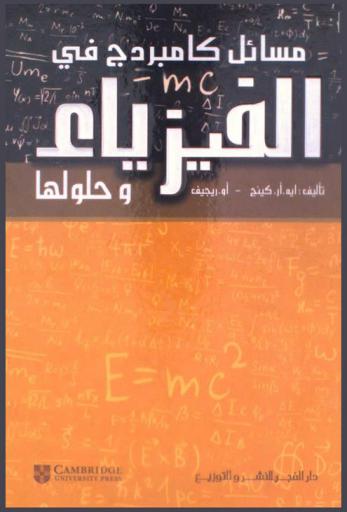
مسائل كامبردج في الفيزياء وحلولها : 500 مسألة وحلولها
هذا الكتاب يحتوي على 500 مسألة تغطي مجموعة كاملة من الفيزياء وتطبيقاتها التمهيدية، وكذلك الحلول لكل مسألة التي لا تلزم حساب التفاضل والتكامل، الطلاب غالبا ما يجدون صعوبة في حل المسائل العملية بعد عرض موضوع في الفصل، هذا الكتاب يسد هذه الفجوة بحيث أنه يحتوي على كل نوع من المسائل التي يحتمل أن تواجهها على هذا الكستوى، ذلك من خلال حل هذه التمارين والاستفادة من الحلول وينقسم الكتاب إلى قسمين : (الجزء الأول : يتضمن المسائل، إلى جانب ملخصات منفيدة للنتائج الرئيسية اللازمة لحلها - الجزء الثاني : يعطي حلول شاملة لكل مسألة، كثيرا ما يكون مصحوبا بتعليقات مدروسة.
Book

Do the interactions among natural enemies compromise the biological control of the whitefly Bemisia tabaci?
The whitefly Bemisia tabaci Gennadius (Hemiptera: Aleyrodidae) is a worldwide pest which has become one of the main pests in tomato crops. The predators Macrolophus pygmaeus (Rambur) and Nesidiocoris tenuis Reuter (Hemiptera: Miridae) and the parasitoid Eretmocerus mundus (Mercet) (Hymenoptera: Aphelinidae) have shown their efficacy at controlling B. tabaci populations when used as biological control agents. Intraguild predation (IGP) between natural enemies can affect their effectiveness at controlling pests. In the present study, the interaction of these three natural enemies and their effect on B. tabaci was studied on tomato plants by combining morphological observations and molecular analysis of trophic interactions. Under the conditions used in the present study, no IGP was detected between M. pygmaeus and N. tenuis by either counting dead predators or by PCR using prey-specific cytochrome c oxidase I primers. However, predation on B. tabaci decreased when they coexisted on the same plant, which could compromise the biological control of this pest. Although PCR analyses using E. mundus-specific primers showed predation on B. tabaci-parasitized nymphs in 27 % of M. pygmaeus and 17 % of N. tenuis, B. tabaci control was improved when both predators coexisted on the same plant with the parasitoid. The combined use of E. mundus and M. pygmaeus/N. tenuis is therefore recommended in order to improve B. tabaci control in conservation biological control strategies.
Journal Article

Plant Performance across Latitude: The Role of Plasticity and Local Adaptation in an Aquatic Plant
Geographic variation can lead to the evolution of different local varieties within a given species, therefore influencing its distribution and genetic structure. We investigated the contribution of plasticity and local adaptation to the performance of a common aquatic plant (Potamogeton pectinatus) in contrasting climates, using reciprocal transplants at three experimental sites across a latitudinal cline in Europe. Plants from 54 genets, originally collected from 14 populations situated within four climatic regions (subarctic, cold temperate, mild temperate, and mediterranean) were grown in three different localities within three of these regions (cold temperate, Norway; mild temperate, The Netherlands; mediterranean, Spain). Tuber production was highest for the mild-temperate genets, irrespective of locality where the genets were grown. Selection coefficients indicated that populations at the European center of the species distribution perform better than all other populations, at all sites. However, marginal populations showed changes in life-history traits, such as compressed life cycles in the north and true perenniality in the south, that may allow them to perform better locally, at the limits of their distribution range. Our results thus suggest that local adaptation may overlap spatially with center-periphery gradients in performance caused by genetic factors (such as genetic drift and inbreeding in range-marginal populations).
Journal Article

Time capsules of biodiversity: Future research directions for groundwater-dependent ecosystems of the Great Artesian Basin
The Great Artesian Basin of Australia represents one of the largest and deepest basins of freshwater on Earth. Thousands of springs fed by the Basin are scattered across Australia’s arid zone, often representing the sole sources of freshwater for thousands of kilometers. As “islands” in the desert, the springs support endemic fauna and flora that have undergone millions of years of evolution in almost total isolation. Here, we review the current body of knowledge surrounding Great Artesian Basin springs and their significance from ecological, evolutionary, and cultural perspectives using South Australian spring wetlands as a case study. We begin by identifying the status of these springs as critical sources of groundwater, the unique biodiversity they support, and their cultural significance to the Arabana people as Traditional Custodians of the land. We then summarize known threats to the springs and their biota, both exogenous and endogenous, and the potential impacts of such processes. Finally, considering the status of these at-risk habitats as time capsules of biodiversity, we discuss lessons that can be learnt from current conservation and management practices in South Australia. We propose key recommendations for improved biodiversity assessment and monitoring of Great Artesian Basin springs nationwide, including 1) enhanced legal protections for spring biota; 2) increased taxonomic funding and capacity; 3) improved biodiversity monitoring methods, and 4) opportunities for reciprocal knowledge-sharing with Aboriginal peoples when conducting biodiversity research.
Journal Article

Trophic relationships between predators, whiteflies and their parasitoids in tomato greenhouses: a molecular approach
The whiteflies Bemisia tabaci Gennadius and Trialeurodes vaporariorum (Westwood) (Hemiptera: Aleyrodidae) are two of the main pests in tomato crops. Their biological control in Mediterranean IPM systems is based on the predators Macrolophus pygmaeus (Rambur) and Nesidiocoris tenuis Reuter (Hemiptera: Miridae), as well as on the parasitoids Eretmocerus mundus (Mercet) and Encarsia pergandiella Howard (Hymenoptera: Aphelinidae). These natural enemies may interact with each other and their joint use could interfere with the biological control of those whitefly pests. Analysis of predator-prey interactions under field conditions is therefore essential in order to optimize whitefly control. Species-specific polymerase chain reaction (PCR)-primers were designed to detect DNA fragments of these whiteflies and parasitoids within both predator species in tomato greenhouses. We demonstrated that both predators feed on both whitefly species, as well as on both parasitoids under greenhouse conditions. Prey molecular detection was possible where prey abundance was very low or even where predation was not observed under a microscope. Whitefly DNA detection was positively correlated with adult whitefly abundance in the crop. However, a significant relationship was not observed between parasitoid DNA detection and the abundance of parasitoid pupae, even though the predation rate on parasitoids was high. This unidirectional intraguild predation (predators on parasitoids) could potentially reduce their combined impact on their joint prey/host. Prey molecular detection provided improved detection of prey consumption in greenhouse crops, as well as the possibility to identify which prey species were consumed by each predator species present in the greenhouse, offering a blueprint with wider applicability to other food webs.
Journal Article

The Good Life and Conceptions of Life in Early China and Graeco-Roman Antiquity
Chinese and Greek ethics remain influential in modern philosophy, yet it is unclear how they can be compared to one another. This volume, following its predecssor 'How should one live?' (DeGruyter 2011), is a contribution to comparative ethics, loosely centered on the concepts of life and the good life. Methods of comparing ethics are treated in three introductory chapters (R.A.H.King, Ralph Weber, G.E.R. Lloyd), followed by chapters on core issues in each of the traditions: human nature (David Wong, Guo Yi), ghosts (Paul Goldin), happiness (Christoph Harbsmeier), pleasure (Michael Nylan), qi (Elisabeth Hsu & Zhang Ruqing), cosmic life and individual life (Dennis Schilling), the concept of mind (William Charlton), knowledge and happiness (Jörg Hardy), filial piety (Richard Stalley), the soul (Hua-kuei Ho), and deliberation (Thomas Buchheim). The volume closes with three essays in comparison - Mencius and the Stoics (R.A.H. King), equanimity (Lee Yearley), autonomy and the good life (Lisa Raphals). An index locorum each for Chinese and Greco-Roman authors, and a general index complete the volume.
eBook