
Catalogue Search | MBRL


Are you sure you want to remove the book from the shelf?

{{itemTitle}}
109
result(s) for
"Kirkham, Victoria"
Sort by:


Dante's Beard?
Dante scholar Charles Singleton always wore a beard, which he kept full, clipped short and slightly pointed, giving him an elfin look. By contrast, Dante's countless portraits, have come to converge in a single individual, the Author as Afterworld traveler. Although some written sources, early modern vite all traceable to Giovanni Boccaccio's Trattatello in laude di Dante (begun in 1351), have asserted that he was known to wear a beard, why have painters from the Trecento into our own time preferred to depict him clean-shaven?
Journal Article


Laura Battiferra’s “Letter from Lentulus” and the Likeness of Christ in Renaissance Italy
Kirkham focuses on the \"Letter from Lentulus\" by poet Laura Battiferra degli Ammannati (1523-89) and the likeness of Christ in Renaissance Italy. Laura's ternario, surviving in a single late sixteenth-century manuscript transcribed by a Jesuit father, surfaces from oblivion to join Christ's portraits in their historical chain and opens a diorama on Catholic Reformation culture. Just before her \"Misteri della vita di Cristo,\" Laura sets into the manuscript her poems on the discovery of the True Cross and Santa Cristina. Immediately after that comes the \"Letter,\" the last of the poems in the Casanatense manuscript dedicated to Christ. Planned as her final book, this codex in its two-part division expresses both literary imitation and real life evolution. During this period she must have written her only surviving prose work, L'orazione sopra il Natale di Nostro Signore (Orison on the nativity of our Lord), an impassioned meditation that takes as its point of departure Loyola's Spiritual Exercises. Here, too, both in time and in tenor, belongs her contribution to the long history of the \"Letter from Lentulus,\" a quintessential relic of Catholic Reformation piety.
Journal Article

Laura Battiferra and Her Literary Circle: An Anthology
Internationally known during her lifetime, Laura Battiferra (1523-89) was a gifted and prolific poet in Renaissance Florence. The author of nearly 400 sonnets remarkable for their subtlety, intricate narrative structure, and learned allusions, Battiferra, who was married to the prominent sculptor and architect Bartolomeo Ammannati, traversed an elite literary and artistic network, circulating her verse in a complex and intellectually fecund exchange with some of the most illustrious figures in Italian history. In this bilingual anthology, Victoria Kirkham gathers Battiferra's most essential writing, including newly discovered poems, which provide modern readers with a valuable social chronicle of sixteenth-century Italy and the courtly culture of the Counter-Reformation.
eBook
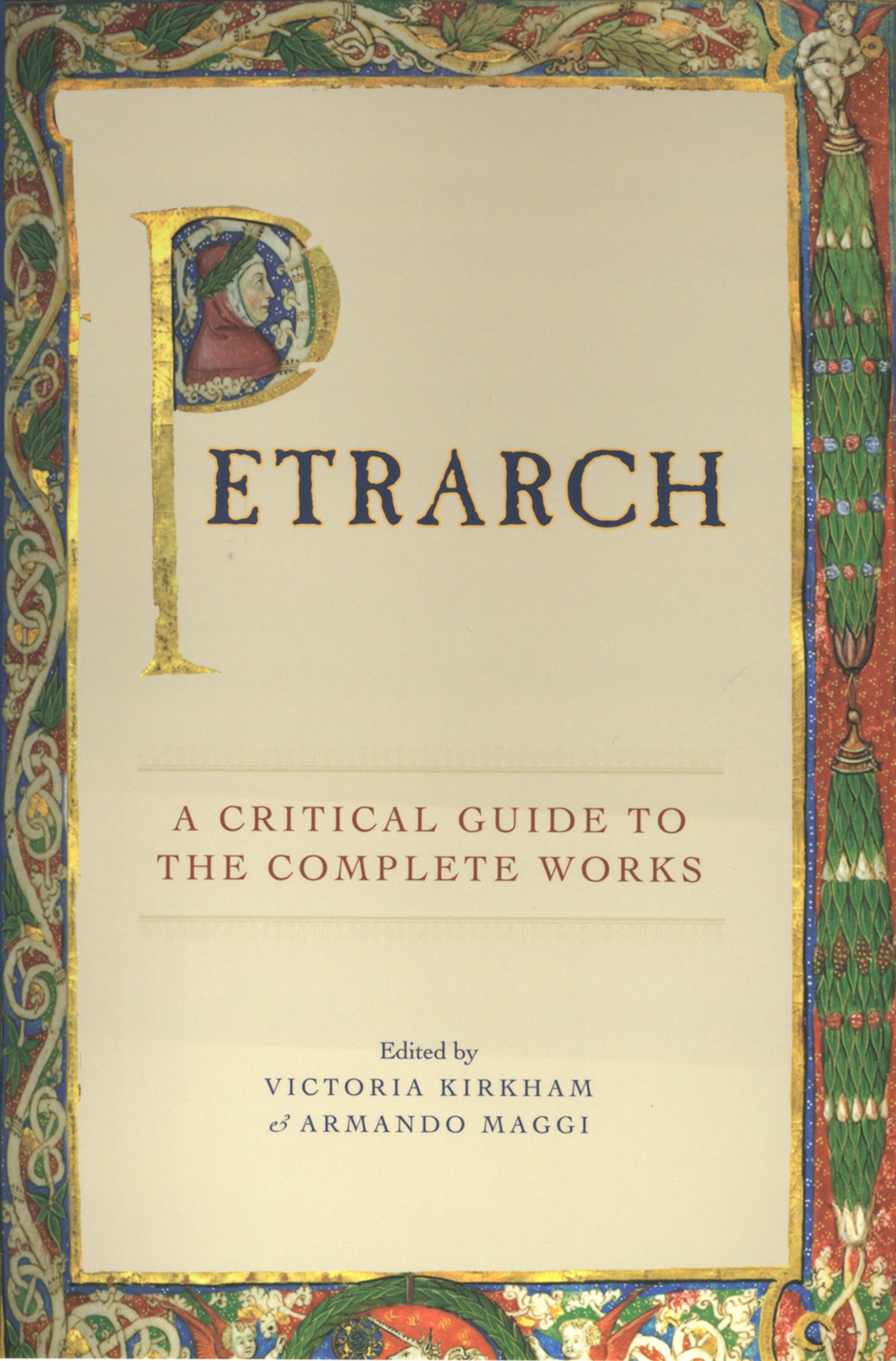
Petrarch
Although Francesco Petrarca (1304–1374) is best known today for his Italian poetry, he was also a philosopher, historian, orator, and one of the foremost classical scholars of his age. Petrarch: A Critical Guide to the Complete Works is the only comprehensive, single-volume source to which anyone—scholar, student, or general reader—can turn for information on each of Petrarch’s works, its place in the poet’s oeuvre, and a critical exposition of its defining features. A sophisticated but accessible handbook that illuminates Petrarch’s love of classical culture, his devout Christianity, his public celebrity, and his struggle for inner peace, this encyclopedic volume covers both Petrarch’s Italian and Latin writings and the various genres in which he excelled: poem, tract, dialogue, oration, and letter. A biographical introduction and chronology anchor the book, making Petrarch an invaluable resource for specialists in Italian, comparative literature, history, classics, religious studies, the Middle Ages, and the Renaissance.
eBook
\Contrapasso\: The Long Wait to Inferno 28
Since Niccolò Tommaseo (1837), \"contrapasso\" is understood not only to describe Bertran's eternal fate, but to define the principle governing punishment of sinners in all Inferno. [...]for Baro- lini both Bertran and his counterpart Sordello are examples of \"the uses to which a poet can put his poetry in the service of the state\".7 If Sordello moves through the Valley of Princes in epic company, his anti-type Bertran, mutando mutandis, is also grand, measured on an infernal scale.\\n29 When 28 returns in the Commedia, designating the canto whose opening coincides with Dante's entry into Eden, it once again asserts 'perfection.'
Journal Article
Laura Battiferra and her literary circle
Internationally known during her lifetime, Laura Battiferra (1523-89) was a gifted and prolific poet in Renaissance Florence. The author of nearly 400 sonnets remarkable for their subtlety, intricate narrative structure, and learned allusions, Battiferra, who was married to the prominent sculptor and architect Bartolomeo Ammannati, traversed an elite literary and artistic network, circulating her verse in a complex and intellectually fecund exchange with some of the most illustrious figures in Italian history. In this bilingual anthology, Victoria Kirkham gathers Battiferra's most essential writing, including newly discovered poems, which provide modern readers with a valuable social chronicle of sixteenth-century Italy and the courtly culture of the Counter-Reformation.
eBook


Watching Matilda
Certified fit to travel alone by Virgil at the close of Canto XXVII, Dante strolls eagerly into the Garden of Eden. This shady forest atop Mount Purgatory is the setting for his meeting with a stunningly beautiful maiden who appears all alone, laughing and singing, on the other side of a two-pronged rivulet. As she gathers flowers to weave a garland, she reminds him of Persephone; her glance recalls Venus, luminescent with love for Adonis. Dante, longing to step across the narrow stream, compares himself to Leander grounded on the shore of the Hellespont by storm-swollen breakers, just where once
Book Chapter