
Catalogue Search | MBRL


Are you sure you want to remove the book from the shelf?

{{itemTitle}}
32
result(s) for
"Kirkpatrick, Jerry"
Sort by:

Reply to Juliusz Jablecki the connection between advertising and objectivist epistemology
Kirkpatrick responds to `minor shortcomings' discussed in Juliusz Jablecki's review of In Defense of Advertising (`Defending Advertising'). The main issue is the need to delve deeply into the Objectivist ethics and epistemology in order to defend the very applied and concrete discipline of advertising. Kirkpatrick expands on this need and then briefly addresses additional minor complaints mentioned in the generally positive review. Reprinted by permission of The Journal of Ayn Rand Studies Foundation
Journal Article
Reply to Juliusz Jablecki, \Defending Advertising\ (Spring 2008): The Connection between Advertising and Objectivist Epistemology
Kirkpatrick responds to \"minor shortcomings\" discussed in Juliusz Jablecki's review of In Defense of Advertising (\"Defending Advertising\"). The main issue is the need to delve deeply into the Objectivist ethics and epistemology in order to defend the very applied and concrete discipline of advertising. Kirkpatrick expands on this need and then briefly addresses additional minor complaints mentioned in the generally positive review.
Journal Article
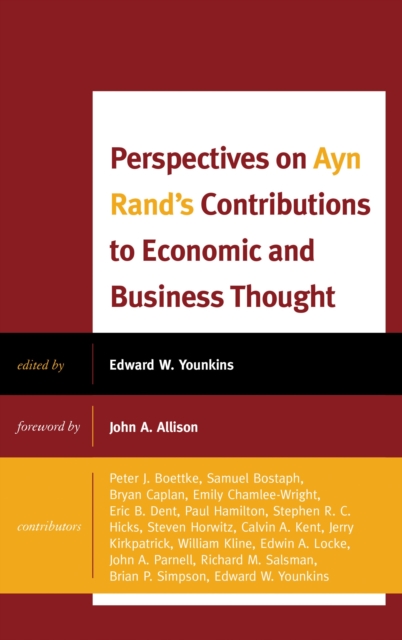
Perspectives on Ayn Rand's Contributions to Economic and Business Thought
Ayn Rand wrote and lectured on economic concepts and topics. This volume addresses the economic and business aspects of her writings. The authors of this anthology are from a variety of fields and all of them are enthusiastic supporters of her ideas.
eBook

Reisman's Net Consumption, Net Investment Theory of Aggregate Profit
. This paper presents the essentials of George Reisman's net consumption, net investment theory of aggregate profit as discussed in Capitalism: A Treatise on Economics. The paper then relates Reisman's ideas to those of Austrian School economists Ludwig von Mises and Murray Rothbard. Delimiting time preference to determining the rate of net consumption, the primary determinant of aggregate profit, Reisman argues that under an invariable money, a one‐time increase in the rate of saving is sufficient to stimulate an increase in the supply of capital goods indefinitely. Reisman thereby rejects the claim that capital accumulation causes a falling rate of profit.
Journal Article
Reisman's Net Consumption, Net Investment Theory of Aggregate Profit: Exposition and Comparison to Mises and Rothbard
This paper presents the essentials of George Reisman's net consumption, net investment theory of aggregate profit as discussed in \"Capitalism: a treatise on economics.\" The paper then relates Reisman's ideas to those of Austrian School economists Ludwig von Mises and Murray Rothbard. Delimiting time preference to determining the rate of net consumption, the primary determinant of aggregate profit, Reisman argues that under an invariable money, a onetime increase in the rate of saving is sufficient to stimulate an increase in the supply of capital goods indefinitely. Reisman thereby rejects the claim that capital accumulation causes a falling rate of profit.
Journal Article

A Philosophic Defense of Advertising
This paper presents a non-traditional defense of advertising against its so-called social criticisms. It is non-traditional because the defense does not rest on the premise that advertising contributes to the welfare of society, but rather on the premise that it is morally right and good to pursue one's own selfish interests. That is, it is right and good for egoistic producers to use persuasive advertising to appeal to the self-interest of consumers for their own (the producers') selfish gain. Further, the author argues that the charges against advertising of manipulative deception, persuasive coercion, and tasteless offensiveness result from a hostility toward capitalism and egoism and that these charges rest on the untenable philosophic doctrines of elitism, intrinsicism and determinism.
Journal Article

Let Christmas be atime; of joy for all of us
I was recently asked to choose the theme for our group's upcoming meeting. Considering the season, I chose a Christmas theme. Shortly thereafter I received an email from one of the group's members cautioning me that not everyone in the group was a Christian and that my theme choice might offend some. What was I to do, follow through on my theme and possibly offend the non Christians, or cancel my theme and offend the Christians?I decided to write to the editor of this newspaper and tell her how I really feel.I suppose there are good arguments on both sides regarding the rights and wrongs of celebrating the holiday season though that's not why I chose the Christmas theme.
Newspaper Article

Theory and history in marketing: Reply
In essence, my article 'Theory and History in Marketing' (Kirkpatrick, 1983), which Professor Runde now challenges, states the following:
Journal Article
Theory and history in marketing
This article presents a theoretical foundation for marketing based on the ideas of the Austrian school of economists. After a discussion of the methodological foundations of Austrian economics, which reject the statistical and experimental methods of the physical sciences as the means to verify theory in the social sciences, the article presents the Austrians' principle of methodological individualism, which provides the basis for a theory of entrepreneurship and marketing.
Journal Article