
Catalogue Search | MBRL


Are you sure you want to remove the book from the shelf?

{{itemTitle}}
408
result(s) for
"Klaas, Brian"
Sort by:

Fluke : chance, chaos, and why everything we do matters
A social scientist dispels people's tidy versions of reality and delves deeply into the theories of random chance and chaos to demonstrate that the world really works through random events that can alter the trajectory of our lives.
Book

How to rig an election
An engrossing analysis of the pseudo-democratic methods employed by despots around the world to retain control Contrary to what is commonly believed, authoritarian leaders who agree to hold elections are generally able to remain in power longer than autocrats who refuse to allow the populace to vote. In this engaging and provocative book, Nic Cheeseman and Brian Klaas expose the limitations of national elections as a means of promoting democratization, and reveal the six essential strategies that dictators use to undermine the electoral process in order to guarantee victory for themselves. Based on their firsthand experiences as election watchers and their hundreds of interviews with presidents, prime ministers, diplomats, election officials, and conspirators, Cheeseman and Klaas document instances of election rigging from Argentina to Zimbabwe, including notable examples from Brazil, India, Nigeria, Russia, and the United States-touching on the 2016 election. This eye-opening study offers a sobering overview of corrupted professional politics, while providing fertile intellectual ground for the development of new solutions for protecting democracy from authoritarian subversion.
eBook

Corruptible : who gets power and how it changes us
Does power corrupt, or are corrupt people drawn to power? Are entrepreneurs who embezzle and cops who kill the outgrowths of bad systems or are they just bad people? Are tyrants made or born? If you were thrust into a position of power, would new temptations to line your pockets or torture your enemies gnaw away at you until you gave in? To answer these questions, Corruptible draws on over 500 interviews with some of the world's noblest and dirtiest leaders, from presidents and philanthropists to rebels, cultists, and dictators.
Book

US public health would be in danger under Robert F Kennedy Jr
Putting RFK Jr in charge of healthcare would push the US towards conspiracy and anti-science sentiment, writes Brian Klaas
Journal Article

How to rig an election
\"In this book, Nic Cheeseman and Brian Klaas expose the limitations of national elections as a means of promoting democratization, and reveal the six essential strategies that dictators use to undermine the electoral process in order to guarantee victory for themselves.\"--Publisher's description.
Book

How to Rig an Election
An engrossing analysis of the pseudo-democratic methods employed by despots around the world to retain control Contrary to what is commonly believed, authoritarian leaders who agree to hold elections are generally able to remain in power longer than autocrats who refuse to allow the populace to vote. In this engaging and provocative book, Nic Cheeseman and Brian Klaas expose the limitations of national elections as a means of promoting democratization, and reveal the six essential strategies that dictators use to undermine the electoral process in order to guarantee victory for themselves. Based on their firsthand experiences as election watchers and their hundreds of interviews with presidents, prime ministers, diplomats, election officials, and conspirators, Cheeseman and Klaas document instances of election rigging from Argentina to Zimbabwe, including notable examples from Brazil, India, Nigeria, Russia, and the United States-touching on the 2016 election. This eye-opening study offers a sobering overview of corrupted professional politics, while providing fertile intellectual ground for the development of new solutions for protecting democracy from authoritarian subversion.
eBook
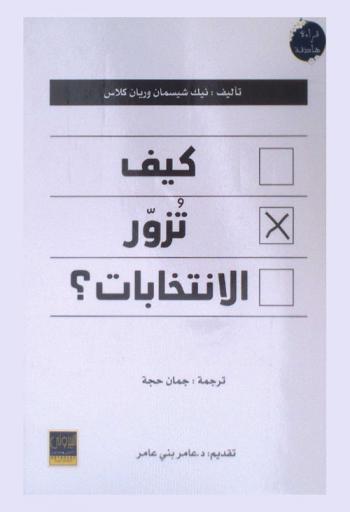
كيف تزور الانتخابات ؟
يتحدث الكتاب عن سبب تزوير الانتخابات وكيفية حدوثه وفوز عدد قليل من الحكومات المتسلطة بها باستعمال الوسائل المشروعة حيث تبني الأغلبية منها مجموعة من الاستراتيجيات لضمان عدم خسارتها، ولسوء الحظ في حين أن بعض الدروس في هذا الكتاب قد تكون جديدة بالنسبة إليك، فهي ليست جديدة على الديكتاتوريين والديمقراطيين المزيفين في العالم طوال عقود ضبطوا استراتيجياتهم من أجل إجراء انتخابات لا يمكن لأحد سواهم أن يفوز بها.
BOOK

From Miracle to Nightmare: An Institutional Analysis of Development Failures in Côte d'Ivoire
Once touted as the \"Ivorian miracle,\" Côte d'Ivoire has become a development nightmare. For two decades after obtaining independence, its economic growth and unwavering political stability baffled economists and inspired other fledgling African states to imitate its development model. Now, almost fifty years later, Côte d'Ivoire is a model of failed development. Recently emerging from a civil war, its economy stands in shambles, and an ongoing political stalemate threatens to reignite the violence. This article couples Elinor Ostrom's institutional analysis-and-development framework with Claude Ake's development paradigm to highlight the institutional roots of the crisis and suggest how institutional transformation may be used to prod the nation to wake up and again become the \"Ivorian miracle.\"
Journal Article

Internet job hunting: A field study of applicant experiences with on-line recruiting
This field study examines the experiences of managers and professionals searching for jobs via the Internet. Results suggest that facility with Internet navigation is significantly associated with the amount of general job searching, particularly for those who want to explore job options initially in private without fear of retribution from supervisors. The data also suggest that managers and professionals are more likely to use the Internet for job hunting when the geographical scope of the job hunt is wide, when a major salary increase is desired, and when both small and large firms are being considered as potential employers. Use of the Internet is perceived as a somewhat less effective job search strategy than personal networking, but far more superior to searching for jobs through newspaper ads and \"cold calling.\"
Journal Article
Outsourcing HR: The impact of organizational characteristics
This study investigates the relationship between a number of organizational characteristics and the decision to outsource HR. Determinants of the outsourcing of 4 categories of HR are examined: 1. HR generalists activities, 2. transactional activities, 3. human capital activities, 4. and recruiting and selecting. HR executives in 432 organizations provided data on outsourcing levels and organizational characteristics. Reliance on HR outsourcing was associated with idiosyncratic HR practices, strategic HR involvement, positive HR outcomes, promotional opportunities, demand uncertainty, and pay level. As predicted, however, the impact of organizational characteristics varied among the different types of HR activities outsourced.
Journal Article