
Catalogue Search | MBRL


Are you sure you want to remove the book from the shelf?

{{itemTitle}}
31
result(s) for
"Klar, Kathryn"
Sort by:


Diffusionism Reconsidered: Linguistic and Archaeological Evidence for Prehistoric Polynesian Contact with Southern California
While the prevailing theoretical orthodoxy of North American archaeology overwhelmingly discourages consideration of transoceanic cultural diffusion, linguistic and archaeological evidence appear to indicate at least one instance of direct cultural contact between Polynesia and southern California during the prehistoric era. Three words used to refer to boats - including the distinctive sewn-plank canoe used by Chumashan and Gabrielino speakers of the southern California coast - are odd by the phonotactic and morphological standards of their languages and appear to correlate with Proto-Central Eastern Polynesian terms associated with woodworking and canoe construction. Chumashan and Gabrielino speakers seem to have borrowed this complex of words along with the sewn-plank construction technique itself sometime between ca. A.D. 400 and 800, at which time there is also evidence for punctuated adaptive change (e.g., increased exploitation of pelagic fish) and appearance of a Polynesian style two-piece bone fishhook in the Santa Barbara Channel. These developments were coeval with a period of major exploratory seafaring by the Polynesians that resulted in the discovery and settlement of Hawaii - the nearest Polynesian outpost to southern California. Archaeological and ethnographic information from the Pacific indicates that the Polynesians had the capabilities of navigation, boat construction, and sailing, as well as the cultural incentives to complete a one-way passage from Hawaii to the mainland of southern California. These findings suggest that diffusion and other forms of historical contingency still need to be considered in constructions of North American prehistory.
Journal Article
American Indian and Indoeuropean Studies
No detailed description available for \"American Indian and Indoeuropean Studies\".
eBook
On Linguistics and Cascading Inventions: A Comment on Arnold's Dismissal of a Polynesian Contact Event in Southern California
In her recent article, \"Credit Where Credit is Due: The History of the Chumash Oceangoing Plank Canoes,\" Jeanne Arnold questions our 2005 paper in which we suggested that a prehistoric contact event with Polynesians resulted in conveyance of the sewn-plank boat construction technique and a particular style of compound bone fishhook to the Chumash and Gabrielino of southern California. We agree with many of Arnold's views about the cascading effects of sewn-plank boat construction on Native societies of southern California, but question her dismissal of certain aspects of the empirical record, particularly the linguistics, in portraying this invention as strictly autochthonous. Here we recast aspects of the linguistic evidence that Arnold overlooks, provide evidence from oral history which she says is lacking, and discuss chronological issues that are much less straightforward than she suggests. We also mention implications of recent findings from South America. Finally, we submit that we have not discredited the Chumash or any other Native society in developing this hypothesis.
Journal Article
American Indian and Indoeuropean studies : papers in honor of Madison S. Beeler
No detailed description available for \"American Indian and Indoeuropean Studies\".
eBook
On Open Minds and Missed Marks: A Response to Atholl Anderson
While we appreciate Atholl Anderson's willingness to consider transoceanic diffusion as a viable possibility, he misrepresents parts of our argument and ignores others, particularly the linguistics that suggest that the Chumash and Gabrieliño borrowed the technique of sewn-plank construction and words related to that technique—not the word for boat or the specific design of a boat. The composite bone fishhook that appears in the Santa Barbara Channel ca. A.D. 700–900 matches simpler Hawaiian variants yet shows a significant stylistic departure from earlier southern California types. A chronological window of A.D. 400–800 for Polynesian contact is still consistent with realistic estimates for both the timing of the appearance of the sewn-plank boat technology in southern California and the initial settlement of Hawaii.
Journal Article
Polynesians in America
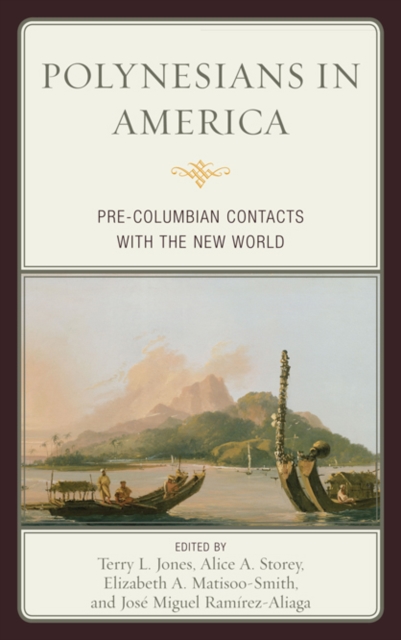
The possibility that Polynesian seafarers made landfall and interacted with the native people of the New World before Columbus has been the topic of academic discussion for well over a century, although American archaeologists have considered the idea verboten since the 1970s. Fresh discoveries made with the aid of new technologies along with re-evaluation of longstanding but often-ignored evidence provide a stronger case than ever before for multiple prehistoric Polynesian landfalls. This book reviews the debate, evaluates theoretical trends that have discouraged consideration of trans-oceanic contacts, summarizes the historic evidence and supplements it with recent archaeological, linguistic, botanical, and physical anthropological findings. Written by leading experts in their fields, this is a must-have volume for archaeologists, historians, anthropologists and anyone else interested in the remarkable long-distance voyages made by Polynesians. The combined evidence is used to argue that that Polynesians almost certainly made landfall in southern South America on the coast of Chile, in northern South America in the vicinity of the Gulf of Guayaquil, and on the coast of southern California in North America.
eBook

Linguistic Evidence for a Prehistoric Polynesia: Southern California Contact Event
We describe linguistic evidence for at least one episode of prehistoric contact between Polynesia and Native California, proposing that a borrowed Proto-Central Eastern Polynesian lexical compound was realized as Chumashan tomol 'plank canoe' and its dialect variants. Similarly, we suggest that the Gabrielino borrowed two Polynesian forms to designate the 'sewnplank canoe' and 'boat' (in general, though probably specifically a dugout). Where the Chumashan form speaks to the material from which plank canoes were made, the Gabrielino forms specifically referred to the techniques (adzing, piercing, sewing). We do not suggest that there is any genetic relationship between Polynesian languages and Chumashan or Gabrielino, only that the linguistic data strongly suggest at least one prehistoric contact event.
Journal Article
On Open Minds and Missed Marks: A Response to Atholl Anderson
While we appreciate Atholl Anderson's willingness to consider transoceanic diffusion as a viable possibility, he misrepresents parts of our argument and ignores others, particularly the linguistics that suggest that the Chumash and Gabrielino borrowed the technique of sewn-plank construction and words related to that technique---not the word for boat or the specific design of a boat. The composite bone fishhook that appears in the Santa Barbara Channel ca. A.D. 700--900 matches simpler Hawaiian variants yet shows a significant stylistic departure from earlier southern California types. A chronological window of A.D. 400--800 for Polynesian contact is still consistent with realistic estimates for both the timing of the appearance of the sewn-plank boat technology in southern California and the initial settlement of Hawaii. [PUBLICATION ABSTRACT]
Journal Article
\Precious Beyond the Power of Money to Buy\: John P. Harrington's Fieldwork with Rosario Cooper
During the years 1912-17, John P. Harrington spent a total of approximately six to seven weeks doing intensive fieldwork with the last speaker of Obispeño Chumash, Mrs. Rosario Cooper of Arroyo Grande, California. In this early work we have a microcosm of the means and methods that Harrington employed throughout his long career. Using the official correspondence between Harrington and F. W. Hodge of the Bureau of American Ethnology and Harrington's notes from his field sessions with Mrs. Cooper, I reconstruct some of their working conditions and the relationship between Harrington and Mrs. Cooper, as well as offer a verbal sketch of Mrs. Cooper herself.
Journal Article