
Catalogue Search | MBRL


Are you sure you want to remove the book from the shelf?

{{itemTitle}}
718
result(s) for
"Klein, Herbert S"
Sort by:

The Atlantic slave trade
\"This survey is a synthesis of the economic, social, cultural, and political history of the Atlantic slave trade, providing the general reader with a basic understanding of the current state of scholarly knowledge of forced African migration and compares this knowledge to popular beliefs. The Atlantic Slave Trade examines the four hundred years of Atlantic slave trade, covering the West and East African experiences, as well as all the American colonies and republics that obtained slaves from Africa. It outlines both the common features of this trade and the local differences that developed. It discusses the slave trade's economics, politics, demographic impact, and cultural implications in relationship to Africa as well as America. Finally, it places the slave trade in the context of world trade and examines the role it played in the growing relationship between Asia, Africa, Europe, and America. This new edition incorporates the latest findings of the last decade in slave trade studies carried out in Europe and America. It also includes new data on the slave trade voyages which have justrecently been made available to the public\"--Provided by publisher.
Book
Revolution and the Rebirth of Inequality
This title is part of UC Press's Voices Revived program, which commemorates University of California Press's mission to seek out and cultivate the brightest minds and give them voice, reach, and impact. Drawing on a backlist dating to 1893, Voices Revived makes high-quality, peer-reviewed scholarship accessible once again using print-on-demand technology. This title was originally published in 1981.
eBook

A population history of the United States
\"This is a fully-updated version of the first full-scale, one-volume survey of the demographic history of the United States from preconquest to the present day\"--Provided by publisher.
Book
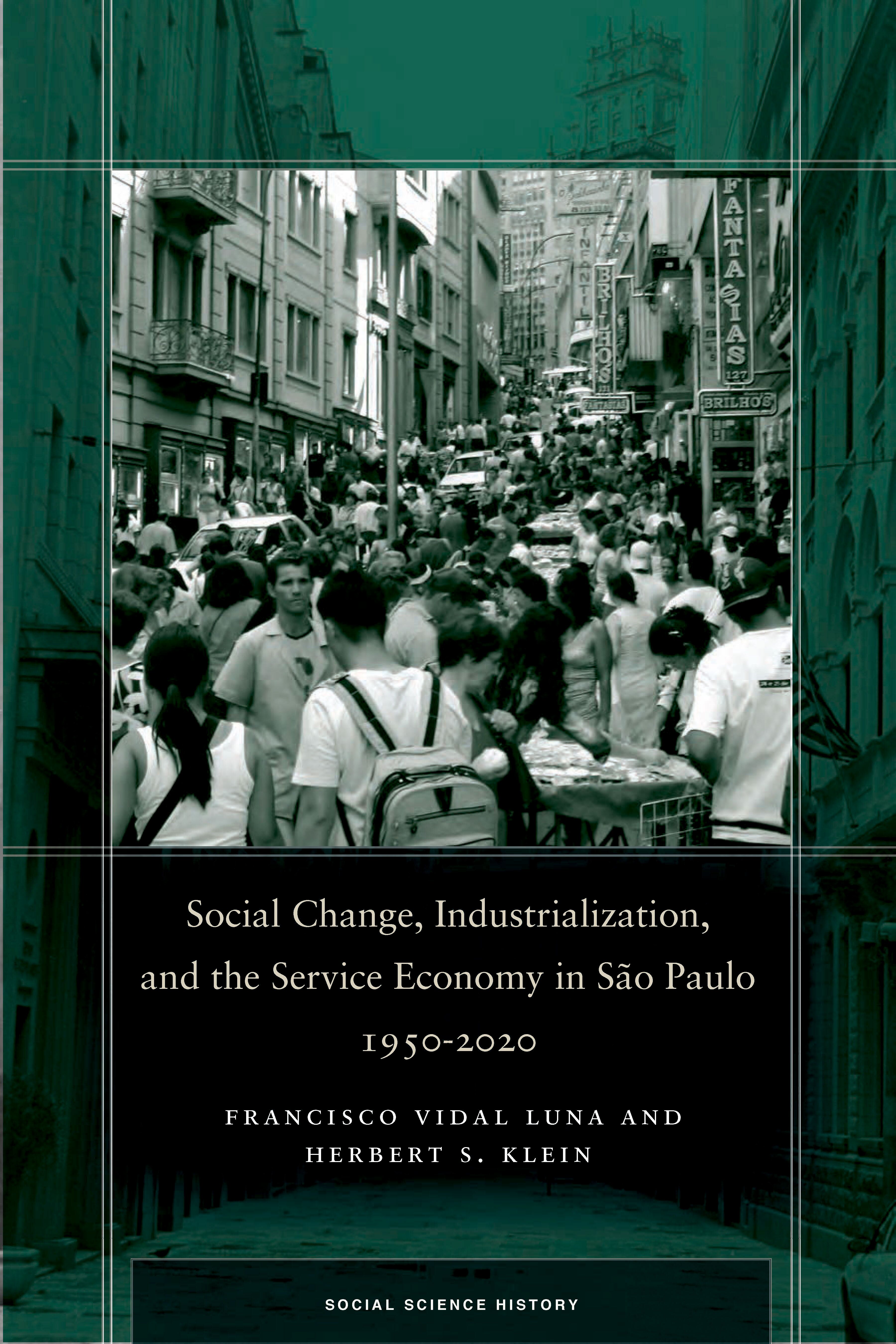
Social Change, Industrialization, and the Service Economy in São Paulo, 1950-2020
In the 1950s–80s, Brazil built one of the most advanced industrial networks among the \"developing\" countries, initially concentrated in the state of São Paulo. But from the 1980s, decentralization of industry spread to other states reducing São Paulo's relative importance in the country's industrial product. This volume draws on social, economic, and demographic data to document the accelerated industrialization of the state and its subsequent shift to a service economy amidst worsening social and economic inequality. Through its cultural institutions, universities, banking, and corporate sectors, the municipality of São Paulo would become a world metropolis. At the same time, given its rapid growth from 2 million to 12 million residents in this period, São Paulo dealt with problems of distribution, housing, and governance. This significant volume elucidates these and other trends during the late twentieth and early twenty-first centuries, and will be an invaluable reference for scholars of history, policy, and the economy in Latin America.
eBook

A concise history of Bolivia
\"Bolivia is an unusual high-altitude country created by imperial conquests and native adaptations, and it remains today the most Indian of the American republics, yet it fully participates in the world economy. It has also seen the most social and economic mobility of Indian and mestizo populations in Latin America. These are among the themes analyzed in this historical survey. In its first Spanish edition, Herbert Klein's A Concise History of Bolivia won immediate acceptance within Bolivia as the new standard history of this important nation. Surveying Bolivia's economic, social, cultural, and political evolution from the arrival of early man in the Andes to the present, this current version brings the history of this society up to the present day, covering the fundamental changes that have occurred since the National Revolution of 1952 and the return of democracy in 1982. These changes have included the introduction of universal education and the rise of the mestizos and Indian populations to political power for the first time in national history. Containing an updated bibliography, A Concise History of Bolivia remains an essential text for courses in Latin American history and politics. The second edition brings this story through the first administration of the first self-proclaimed Indian president in national history and the major changes that the government of Evo Morales has introduced in Bolivia's society, politics, and economy\"-- Provided by publisher.
Book
Revolution and the Rebirth of Inequality
Revolution and the Rebirth of Inequality: A Theory Applied to the National Revolution in Bolivia by Jonathan Kelley and Herbert S. Klein investigates how revolutions reshape social structures, asking whether promises of equality endure or if inequality reemerges in new forms. The authors develop a theory that while revolutions from below-such as those in France, Russia, China, and Bolivia-abolish exploitative elites and initially reduce inequality, in the long run education, skills, land, and capital allow some among the formerly oppressed to rise faster than others. As these advantages accumulate and are transmitted to children, new forms of inherited privilege develop, and inequality begins to grow again. Revolutions, they argue, do improve standards of living for the majority, but not evenly, and not indefinitely. The book applies this theory to Bolivia's National Revolution of 1952, when the Movimiento Nacionalista Revolucionario dismantled centuries-old elites, disbanded the army, redistributed land, and nationalized mines and industries. Drawing on an unusually rich dataset-including ethnographic fieldwork, census data, and a large household survey-the authors provide one of the first systematic analyses of how a successful radical revolution affected ordinary people. They examine pre-revolutionary inequality, describe the dramatic upheaval of 1952, and trace the consequences over the following decade and beyond: shifts in income distribution, changes in social mobility, and the persistence or rebirth of privilege. By combining theoretical modeling with rigorous empirical evidence, the book offers both a case study of Bolivia and a broader framework for understanding the paradoxical outcomes of revolutions worldwide. This title is part of UC Press's Voices Revived program, which commemorates University of California Press's mission to seek out and cultivate the brightest minds and give them voice, reach, and impact. Drawing on a backlist dating to 1893, Voices Revived makes high-quality, peer-reviewed scholarship accessible once again using print-on-demand technology. This title was originally published in 1981.
eBook

A Population History of the United States
The first full-scale, one-volume survey of the demographic history of the United States has been fully updated here. From the arrival of humans in the Western Hemisphere to the current century, Klein analyses the basic demographic trends in the growth of the pre-conquest, colonial and national populations. From the origin and distribution of the Native Americans to late 20th century changes in family structure, fertility and mortality, this updated edition incorporates recent research, including data from the 2010 census. In this definitive study, Klein explores regional patterns of fertility and mortality, trends in births, deaths and international and internal migrations, comparing them with contemporary European developments. The profound impact of historic declines in disease and mortality rates on the population structure of the late-20th century is explained, while the more recent urbanisation and rise of suburbia are examined within the context of new massive international migrations on North American society.
eBook

Hispanics in the United States : a demographic, social, and economic history, 1980-2005
\"Utilizing census data and other statistical source materials, this book examines the transformations in the demographic, social, and economic structures of Latino-Americans in the United States between 1980 and 2005\"--Provided by publisher.
Book

The Development of a Modern Cellulose Industry in South America
Brazil, Chile, and Uruguay today account for well over a third of world exports of cellulose, yet this industry only came into existence in the late twentieth century. The evolution of this industry across the three countries is the object of this study. This nascent industry required direct government support in all three countries to be successful. Forestry laws and government investments in research, education, and factory construction were all needed to encourage local and foreign capital. There were differences among these countries in their linkages to other economic sectors as well as their export mix. But in all three countries, the forestry industry was part of a general modernization of agriculture that allowed for successful competition in world markets.
Brasil, Chile y Uruguay representan hoy más de un tercio de las exportaciones mundiales de celulosa; sin embargo, esta industria solo comenzó a existir a fines del siglo XX. La diferente evolución de esta industria en los tres países es el objeto de este estudio. Esta era una industria incipiente que requería apoyo gubernamental directo en los tres países para tener éxito. Se necesitaban leyes forestales, inversiones gubernamentales en investigación, educación y construcción de fábricas para estimular el capital local y extranjero. Entre estos países había diferencias en sus vínculos con otros sectores de la economía, así como en su combinación de exportaciones. Pero en los tres países, su industria forestal fue parte de una modernización general de la agricultura en la que los tres países pudieron competir con éxito en los mercados mundiales.
Journal Article