
Catalogue Search | MBRL


Are you sure you want to remove the book from the shelf?

{{itemTitle}}
21
result(s) for
"Kleineke, Hannes"
Sort by:


The Medicines of Katherine, Duchess of Norfolk, 1463–71
This article discusses the medicinal remedies consumed at the court of the Yorkist kings of England in the light of a lawsuit in the court of common pleas (edited in an appendix) between John Clerk, king’s apothecary to Edward IV, and Katherine Neville, Duchess of Norfolk, over the partial non-payment of the apothecary’s bills. It argues that the consumption of apothecaries’ wares in large quantities was not merely a direct result of the excessive diet of the late medieval aristocracy, but in itself represented a facet of the conspicuous consumption inherent in the lifestyle of this particular social class. The remedies supplied by Clerk over a period of several years and listed in the legal record are set in the context of contemporary collections of medical recipes, particularly a ‘dispensary’ in the British Library’s Harleian collection generally attributed to the king’s apothecary.
Journal Article

The Fifteenth Century X
Linda S. Clark is a distinguished scholar of fifteenth-century England, best known for her important contribution to the study of the late medieval English parliament. She has served as general editor of 'The Fifteenth Century' since 2003. This special volume in the series marks her four decades of work for the History of Parliament Trust. As is appropriate, its essays focus above all on Parliament and the personalities that served in its chambers, but they also illuminate a wider range of themes that have long concerned students of the later middle ages, including the lawlessness of the gentry and nobility, the acquisition and management of their estates, and their self-expression in pageantry and legend. Other social groups, ranging from the mercantile élite of the city of London and their Italian trading partners to England's common soldiers, also make an appearance. Several of the papers collected here have a geographical focus in London and East Anglia, but other regions are also represented. The collection thus pays tribute to the breadth of Dr Clark's contribution to the field, both in her own writing, and in her long-standing commitment to facilitate the publication of the original research of others. Contributors: A. J. Pollard, Simon Payling, Charles Moreton, Colin Richmond, J. L. Bolton, James Ross, Carole Rawcliffe, Elizabeth Danbury, Matthew Davies, Hannes Kleineke, David Grummitt, Caroline M. Barron
eBook

Just Another Day in Chancery Lane: Disorder and the Law in London's Legal Quarter in the Fifteenth Century
Scarcely any turbulence, quarrels or disturbance ever occur there, but delinquents are punished with no other punishment than expulsion from communion with their society, which is a penalty they fear more than criminals elsewhere fear imprisonment and fetters. For a man once expelled from one of these societies is never received into the fellowship of any other of those societies. Hence the peace is unbroken and the conversation of all of them is as the friendship of united folk.
This was Sir John Fortescue's idealized account to the exiled prince of Wales, Edward of Lancaster, of the peace-loving nature of London's Inns of Court and Chancery in the mid-fifteenth century. Fortescue was not concerned with the reality, which, as he knew all too well, was different. He was concerned with impressing on his young pupil the perfection of the English law and the education of its practitioners, rather than the imperfections that existed in a society that the prince, as he explicitly told him, would never experience. Few who were familiar with the legal quarter that surrounded the Inns would have recognized the Arcadia that Fortescue described. Far from being the peaceful and well-ordered district that the former chief justice invoked, in the period when he wrote the area to the west of London's Temple Bar was a liminal space, populated by—among others—large numbers of young trainee lawyers, in whom the kind of unruly behaviour otherwise also associated with the early universities, not least the western suburb's Paris counterpart, the quartier latin to the south of the river Seine, was endemic. Among the most important factors that made it so was the very existence of the established, and to some extent tribal, all-male societies of the Inns of Court and of Chancery, at close quarters with the royal law courts and their heady mix of disputants and hired legal counsellors in permanent competition with each other.
Journal Article
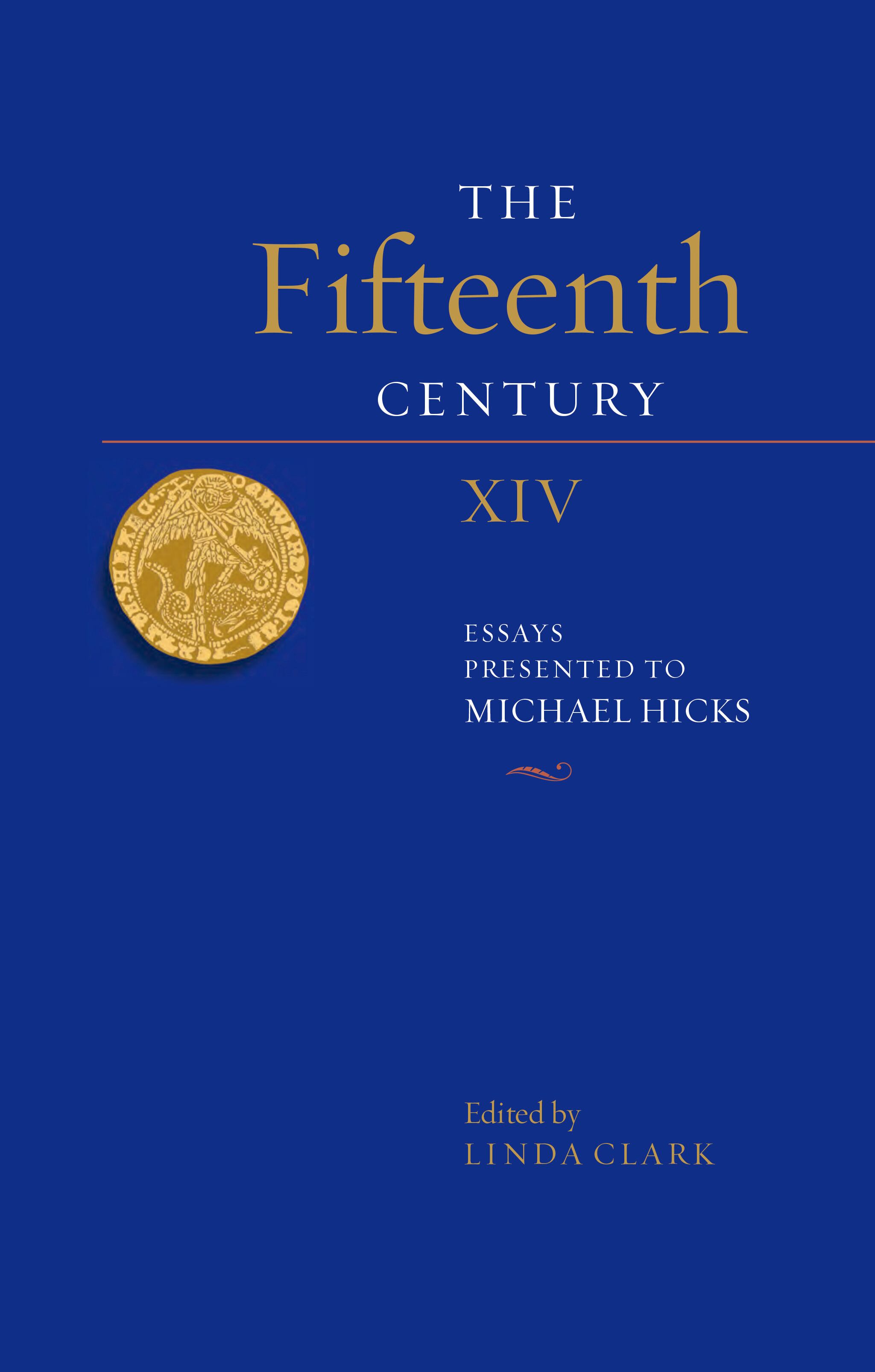
The Fifteenth Century XIV
For four decades, Michael Hicks has been a figure central to the study of fifteenth-century England. His scholarly output is remarkable both for its sheer bulk and for the diversity of the fields it covers. This extraordinary breadth is reflected by the variety of subjects covered by the papers in the present volume, offered to Professor Hicks by friends, colleagues and former students to mark his retirement from the University of Winchester. Fifteenth-century royalty, nobility and gentry, long at the heart of his own work, naturally take centre stage, but his contribution to economic and regional history, both in the early part of his career as a research fellow at the Victoria County History and more recently as director of a succession of major research projects, is also reflected in the essays presented here. The individual contributions are populated by some of the major characters of Yorkist England, many of them made household names by Professor Hicks's own writings - King Edward IV and his mistresses; the Neville earls of Warwick and Salisbury; the Stafford, Herbert, Percy, Tiptoft and de Vere earls of Devon, Pembroke, Northumberland, Worcester and Oxford - while the themes covered span the full panoply of medieval life: from treason to trade, warfare to widowhood and lordship to law enforcement. Equally broad is the papers' geographical spread, covering regions from Catalonia to Normandy, from Hampshire to Yorkshire and from Worcestershire and the Welsh marches to East Anglia. Contributors: Anne Curry, Christopher Dyer, Peter Fleming, Ralph Griffiths, John Hare, Winifred Harwood, Matthew Holford, Hannes Kleineke, Gordon McKelvie, Mark Page, Simon Payling, A.J. Pollard, James Ross, Karen Stöber, Anne F. Sutton
eBook
SOME OBSERVATIONS ON THE HOUSEHOLD AND CIRCLE OF HUMPHREY STAFFORD, LORD STAFFORD OF SOUTHWICK AND EARL OF DEVON
If we disregard the opprobrium heaped upon the ‘new men’ who – at least in the opinion of Richard Neville, earl of Warwick – came to dominate Edward IV’s first reign, the young king’s friends and associates in this early period remain somewhat shadowy figures.¹ While modern biographies outlining the public careers of many leading members of the Yorkist court have been, or are about to be, published,² detail beyond births, marriages and deaths, and lists of official appointments, is available only for a few of the greatest men of the age, such as the ‘Kingmaker’ earl of Warwick, or
Book Chapter
The East Anglian Parliamentary Elections of 1461
In the aftermath of the decisive battle of Towton, fought on Palm Sunday (29 March) 1461, King Edward IV remained at York for several weeks, before moving north to Durham and Newcastle. Only in May did he set out for the south-east and the capital once more, but at a leisurely pace and taking in some of the western midlands. He had thus only reached Manchester when on 23 May he issued writs for a parliament to be held at Westminster in July, probably with a view to put in place a permanent constitutional settlement. The parliament called in Henry VI's name in July 1460 had disbanded, probably in some disarray, in the wake of the arrival of Queen Margaret's forces before the gates of London in February 1461, and fresh elections were thus needed. The practice of seeking parliamentary sanction for the successive changes of dynasty and ruler that marked the history of fifteenth-century England had been begun by Henry IV in 1399, and had been readopted in the political crisis of 1460–1. It could be expected that the new parliament would be asked to lend its authority to Edward IV's assumption of the crown, to attaint the leading adherents of Henry VI and his son, Prince Edward, but also to begin to make good the new king's promise to redress the grievances of the realm. Yet, Lancastrian resistance in the provinces proved stronger than expected, and even before King Edward returned to his capital it was clear that he would need to make further progresses during the summer.
Book Chapter
Poachers and Gamekeepers
This chapter illustrates some of the spectrum of late medieval south-western aristocratic crime. The wealthiest members of the Cornish gentry had no monopoly on criminal activity. Lesser gentlemen, too, might seek to improve their fortunes and settle their disputes by unlawful means, and two such men were Adam Vivian and Richard Tregoys. Qualitatively rather different from the long criminal careers of men such as Tregoys, Vivian or Henry Bodrugan, was the apparently brief lapse into crime of Sir Ralph Botreaux. In the interim, however, Lord Botreaux had been alerted to the conspiracy to murder him by some of the lesser individuals involved. Yet, interestingly enough, Bodrugan's position as a member of parliament gave him enough influence even at Westminster to see the act against him repealed. Once again, one of the gamekeepers had successfully used his privileged position to avoid the consequences of Bodrugan's poaching.
This chapter illustrates some of the spectrum of late medieval south-western aristocratic crime. The wealthiest members of the Cornish gentry had no monopoly on criminal activity. Lesser gentlemen, too, might seek to improve their fortunes and settle their disputes by unlawful means, and two such men were Adam Vivian and Richard Tregoys. Qualitatively rather different from the long criminal careers of men such as Tregoys, Vivian or Henry Bodrugan, was the apparently brief lapse into crime of Sir Ralph Botreaux. In the interim, however, Lord Botreaux had been alerted to the conspiracy to murder him by some of the lesser individuals involved. Yet, interestingly enough, Bodrugan's position as a member of parliament gave him enough influence even at Westminster to see the act against him repealed. Once again, one of the gamekeepers had successfully used his privileged position to avoid the consequences of Bodrugan's poaching.
Book Chapter

