
Catalogue Search | MBRL


Are you sure you want to remove the book from the shelf?

{{itemTitle}}
411
result(s) for
"Klinkowitz, Jerome"
Sort by:

Yanks Over Europe
Contrasts between fighter combat and the bombers' war support Klinkowitz's belief that notions of the air war were determined by one's position in it. He extends his thesis by showing the vastly different style of air war described by veterans of the North African and Mediterranean campaigns and concludes by studying the effects of such combat on adversaries and victims.
Air combat, Klinkowitz writes, offers a unique perspective on the nature of war. The experience of combat has inspired authors to combine exquisite descriptions with probing thoughtfulness, covering the full range of human expression from exultation to heartbreak. Here is a tightly drawn, highly readable account of the European air war.
eBook


Vonnegut in Fact
Vonnegut in Fact offers a thorough assessment of the artistry of Kurt Vonnegut, known not only as the best-selling author of Slaughterhouse-Five, Timequake, and a dozen other novels, but also as the most widely recognized public spokesperson among writers since Mark Twain. Jerome Klinkowitz traces the emergence of Vonnegut's nonfiction since the 1960s, when commentary and feature journalism replaced the rapidly dying short story market. Offering close readings and insightful criticism of Vonnegut's three major works of nonfiction, his many uncollected pieces, and his unique manner of public speaking, Klinkowitz explains how Vonnegut's personal visions developed into a style of great public responsibility that mirrored the growth of his fiction. Klinkowitz views his subject as a gentle manipulator of popular forms and an extremely personable figure; what might seem radically innovative and even iconoclastic in his fiction becomes comfortably avuncular and familiarly American when followed to its roots in his public spokesmanship.
eBook

Pacific Skies
From 1941 to 1945 the skies over the Pacific Ocean afforded the broadest arena for battle and the fiercest action of air combat during World War II. It was in the air above the Pacific that America's involvement in the war began. It was in these skies that air power launched from carriers became a new form of engagement and where the war ultimately ended with kamikaze attacks and with atomic bombs dropped over Japan.
Throughout the conflict American flyers felt a compelling call to supplement the official news and military reports. In vivid accounts written soon after combat and in reflective memoirs recorded in the years after peace came, both pilots and crew members detailed their stories of the action that occurred in the embattled skies. Their first-person testimonies describe a style of warfare invented at the moment of need and at a time when the outcome was anything but certain.
Gathering more than a hundred personal narratives from Americans and from Japanese,Pacific Skiesrecounts a history of air combat in the Pacific theater. Included are the words of such famous aces and bomber pilots as Joe Foss, Pappy Boyington, Dick Bong, and Curtis Lemay, as well as the words of many rank-and-file airmen. Together their stories express fierce individualism and resourcefulness and convey the vast panorama of war that included the skies over Pearl Harbor, Wake, and Guadalcanal and missions from Saipan and Tinian.
AsPacific Skiesrecounts the perilous lives of pilots in their own words, Jerome Klinkowitz weaves the individual stories into a gripping historical narrative that exposes the shades of truth and fiction that can become blurred over time. A book about experiencing and remembering,Pacific Skiesalso is a story of unique perspectives on the war.
Jerome Klinkowitz, a professor of English at the University of Northern Iowa, is the author of forty books, including such World War II titles asTheir Finest Hours,Yanks over Europe, andWith Tigers over China.
eBook

Frank Lloyd Wright and His Manner of Thought
An iconic figure in American culture, Frank Lloyd Wright is famous throughout the world. Although his achievements in architecture are stunning, it is his importance in cultural history, Jerome Klinkowitz contends, that makes Wright the object of such avid and continuing interest. Designing more than just buildings, Wright offered a concept for living that still influences how people conduct their lives today. Wright's innovations in architecture have been widely studied, but this is the most comprehensive and sustained treatment of his thought. Klinkowitz presents a critical biography driven by the architect's own work and intellectual growth, focusing on the evolution of Wright's thinking and writings from his first public addresses in 1894 to his last essay in 1959. Did Wright reject all of Victorian thinking about the home, or do his attentions to a minister's sermon on \"the house beautiful\" deserve closer attention? Was Wright echoing the Transcendentalism of Ralph Waldo Emerson, or was he more in step with the philosophy of William James? Did he reject the Arts and Crafts movement, or repurpose its beliefs and practices for new times? And, what can be said of his deep dissatisfaction with architectural concepts of his own era, the dominant modernism that became the International Style? Even the strongest advocates of Frank Lloyd Wright have been puzzled by his objections to so much that characterized the twentieth century, from ideas for building to styles of living. In
Frank Lloyd Wright and
His Manner of Thought , Klinkowitz, a widely published authority on twentieth-century literature, thought, and culture, examines the full extent of Wright's books, essays, and lectures to show how he emerged from the nineteenth century to anticipate the twenty-first. Outstanding Book, selected by the American Association of School Librarians Best Books for General Audiences, selected by the Public Library Reviewers
eBook
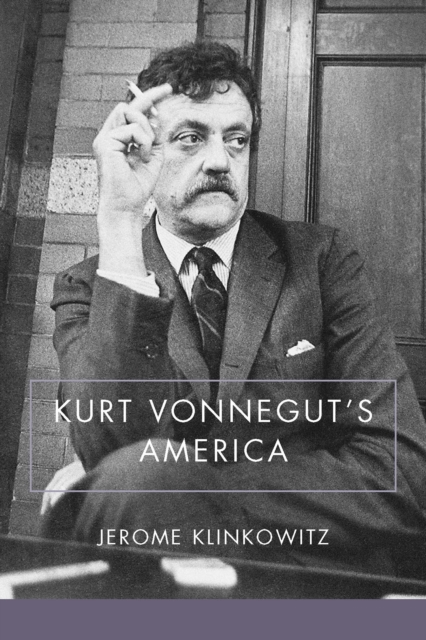
Kurt Vonnegut's America
Kurt Vonnegut's death in 2007 marked the passing of a major force in American life and letters. Jerome Klinkowitz, one of the earliest and most prolific authorities on Vonnegut, examines the long dialogue between the author and American culture—a conversation that produced fourteen novels and hundreds of short stories and essays. Kurt Vonnegut's America integrates discussion of the fiction, essays, and lectures with personal exchanges and biographical sketches to map the complex symbiotic relationship between Vonnegut's work and the cultural context from which it emerged—and which it in turn helped shape. Following an introduction characterizing Vonnegut as Klinkowitz came to know him over the course of their friendship, this study charts the impact of Vonnegut on American society and of that society on Vonnegut for more than a half-century to illustrate how each informed the other. Among his artistic peers, Vonnegut was uniquely gifted at anticipating and articulating the changing course of American culture. Kurt Vonnegut's America shows us that Vonnegut achieved greatness by passing his own test—opening the eyes of his audience to help them better understand their roles and possibilities in the common culture they both shared and crafted.
eBook


The Vonnegut Effect
Kurt Vonnegut is one of the few American writers since Mark Twain to have won and sustained a great popular acceptance while boldly introducing new themes and forms on the literary cutting edge. This is the \"Vonnegut effect\" that Jerome Klinkowitz finds unique among postmodernist authors. In this innovative study of the author's fiction, Klinkowitz examines the forces in American life that have made Vonnegut's works possible. Vonnegut shared with readers a world that includes the expansive timeline from the Great Depression, during which his family lost their economic support, through the countercultural revolt of the 1960s, during which his fiction first gained prominence. Vonnegut also explored the growth in recent decades of America's sway in art, which his fiction celebrates, and geopolitics, which his novels question. A pioneer in Vonnegut studies, Jerome Klinkowitz offers The Vonnegut Effect as a thorough treatment of the author's fiction—a canon covering more than a half century and comprising twenty books. Considering both Vonnegut's methods and the cultural needs they have served, Klinkowitz explains how those works came to be written and concludes with an assessment of the author's place in American fiction.
eBook

Vonnegut in fact : the public spokesmanship of personal fiction
Klinkowitz views his subject as a gentle manipulator of popular forms and an extremely personable figure; what might seem radically innovative and even iconoclastic in his fiction becomes comfortably avuncular and familiarly American when followed to its roots in his public spokesmanship.
eBook
