
Catalogue Search | MBRL


Are you sure you want to remove the book from the shelf?

{{itemTitle}}
18
result(s) for
"Korff, Mandy"
Sort by:

Review article: Applicability and effectiveness of structural measures for subsidence (risk) reduction in urban areas
Managing subsidence and its impacts on cities in coastal and delta areas is a global challenge that requires comprehensive risk reduction policies, including both mitigation and prevention strategies. Urban areas often lack systematic methodologies for determining appropriate countermeasures. This paper proposes a twofold strategy for selecting subsidence reduction measures in urban areas – which refer to structural (i.e. technical) measures to prevent and mitigate subsidence and its physical consequences – based on their applicability and performance. The question-and-response (Q&R) system serves as a decision tree to identify suitable subsidence countermeasures based on their applicability to specific cases. Four indicators of effectiveness – i.e. reduction potential, operational reliability, negative impact, and service life – are then used to assess the performance of subsidence reduction measures. The proposed procedure was applied to 49 cases derived from a review of 52 scientific publications and additional expert sessions and surveys involving 5 academic scholars and 13 experts. Also, the method was applied to examples from Shanghai (China), Jakarta (Indonesia), and the San Joaquin Valley (USA, California). The strategies proposed in this paper proved suitable for an initial screening of subsidence reduction measures applicable in different urban areas, after which a site-specific assessment can follow. Furthermore, this study shows the need to collect and share experiences in evaluating the performance of subsidence reduction measures more systematically and gives a first framework to do so.
Journal Article

Lithological Heterogeneity and Its Impact on Soil Settlements at the Building Scale
Soil heterogeneity, due to variations in the subsurface stratigraphy or properties within a layer, can trigger or amplify differential settlements that affect buildings and infrastructure and can thus lead to (increase in) damage. The state-of-the-art mainly focuses on the effect of heterogeneous properties within a layer on engineering problems. From this, it is known that the variation in properties can increase the vulnerability of a structure. However, nearly always variations in the soil lithological conditions are disregarded, while they can influence subsidence potentially even more. Lithological variations are relevant both at the scale of individual buildings as well as different scales (city, regional, country), for which often detailed soil information is not available. Thus, for a better prediction of potential building damage related to subsidence, knowledge about the scale and influence of lithological variations is needed. This paper describes an approach to quantify and investigate the influence of lithological heterogeneity at the scale of a single building. Moreover, this exploratory study evaluates the influence of lithological heterogeneity on the spatial variability of settlements, intending to upscale the approach to regional application. Two independent datasets at high resolution (site-specific) and low resolution (national level) are used to retrieve the stratigraphic conditions for the area selected for the analyses. One-, Two- and Three-dimensional numerical models, based on the collected information are used to simulate the consolidation process and settlement due to a uniform load imposed on the surface level of the study area. Additional analyses investigate the influence of loading conditions and groundwater table. The parameter “correlation length” is used to quantify the spatial variability of the soil layer thickness and then of the computed settlements. The analyses reveal that the spatial variability of the soil strata thickness matches that of the computed settlements, ranging from 2 to 10 meters. In other words, the lithological variability of the soil leads to differential settlements occurring at the scale of man-made structures such as houses, roads, and embankments. Thus, the results encourage including the contribution of lithological heterogeneity in models and predictions of differential settlement at the scale of individual structures. Moreover, the statistical properties, in terms of mean, spread and distribution shape, of the settlement computed through in-situ specific models, match with those derived at the national scale. These results are expected to support the identification of areas potentially influenced by lithological soil heterogeneity, thus showing potential for upscaling to regional or national levels.
Journal Article

An integrated shear-wave velocity model for the Groningen gas field, The Netherlands
A regional shear-wave velocity (V
S
) model has been developed for the Groningen gas field in the Netherlands as the basis for seismic microzonation of an area of more than 1000 km
2
. The V
S
model, extending to a depth of almost 1 km, is an essential input to the modelling of hazard and risk due to induced earthquakes in the region. The detailed V
S
profiles are constructed from a novel combination of three data sets covering different, partially overlapping depth ranges. The uppermost 50 m of the V
S
profiles are obtained from a high-resolution geological model with representative V
S
values assigned to the sediments. Field measurements of V
S
were used to derive representative V
S
values for the different types of sediments. The profiles from 50 to 120 m are obtained from inversion of surface waves recorded (as noise) during deep seismic reflection profiling of the gas reservoir. The deepest part of the profiles is obtained from sonic logging and V
P
–V
S
relationships based on measurements in deep boreholes. Criteria were established for the splicing of the three portions to generate continuous models over the entire depth range for use in site response calculations, for which an elastic half-space is assumed to exist below a clear stratigraphic boundary and impedance contrast encountered at about 800 m depth. In order to facilitate fully probabilistic site response analyses, a scheme for the randomisation of the V
S
profiles is implemented.
Journal Article
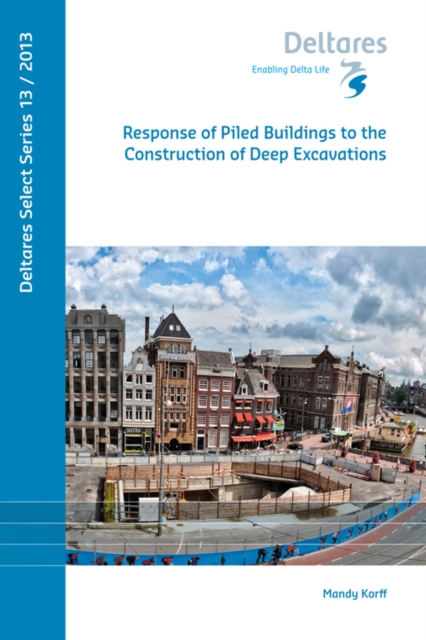
Response of Piled Buildings to the Construction of Deep Excavations
Deep excavations in densely populated urban areas around the world pose specific challenges due to the increasingly complex conditions in which they are undertaken.The construction of underground car parks, cellar storage areas and major infrastructure in deep excavations helps to preserve the quality of space above ground.
eBook

Systematic assessment of damage to buildings due to groundwater lowering-induced subsidence: methodology for large scale application in the Netherlands
In the Netherlands, subsidence of peat and clay soils due to (artificial) lowering of the groundwater table and loading of soft soils is commonplace, causing extensive damage to exposed and vulnerable assets. Awareness of subsidence-related damage to buildings has recently increased in the Netherlands, particularly after reported damages due to the 2018 extremely long dry period. However, despite this being a major concern to homeowners and public authorities, an integrated and systematic risk assessment on regional or national scale is currently lacking which inhibits concrete and meaningful action. In this paper, we propose a methodology for the systematic regional or countrywide assessment of two subsidence-related damage mechanisms to buildings: differential settlement of buildings on shallow foundation, and timber pile degradation due to low groundwater levels. The methodology is set up in a modular, systematic way – initially based on expert judgement and validation with available local detailed information and allows for future improvements. Progress in individual contributing factors to damages can be seamlessly integrated for the systematic improvement of damage estimates. This approach can be replicated for other damage mechanisms and detailed to provide a more local risk assessment. We expect results to be a valuable input for public or private decision making, e.g. in awareness raising and evaluating interventions.
Journal Article
Reliability of InSAR satellite monitoring of buildings near inner city quay walls
Amsterdam currently has a huge task of assessing and potentially upgrading its quay walls along the historic canals. Before replacement can take place, Amsterdam needs to determine the potential impact the replacement can have on the nearby buildings. The rate of vertical deformation of the adjacent buildings is used as indicator of potential foundation problems. To determine that rate, the current practice is to monitor the buildings by levelling for two years at least. This study shows that application of satellite measurements using Permanent Scatterer Interferometric Synthetic Aperture Radar (PS-InSAR) could reduce the monitoring period to a few months. The paper describes the statistical procedure that has been applied to levelling and satellite measurements to verify their reliability and determine the rate of vertical deformation of the buildings. The procedure was applied in three case studies. The rates of deformation observed in the InSAR measurements are in good agreement with the rates of deformation observed in the levelling in two of the case studies. The locally optimized InSAR data set with observations in the period 2014–2019 provides an almost 100 % coverage of reliable data points for all buildings in the case studies. More experience will need to be gained in the interpretation of InSAR measurements with respect to vulnerability of the buildings. Also, the procedure may be extended to include analysis of non-linear trends such as second order trends and seasonal effects.
Journal Article

Response of piled buildings to the construction of deep excavations
Trends in the construction of deep excavations include deeper excavations situated closer to buildings. This research provides insight into mechanisms of soil-structure interaction for piled buildings adjacent to deep excavations to be used in the design and monitoring of deep excavations in urban areas. Most methods to assess building response have originally been developed for tunnelling projects or buildings with shallow foundations. Monitoring data of the construction of three deep excavations for the North South metro Line in Amsterdam, The Netherlands have been used to validate these methods specifically for piled buildings. In all three of the Amsterdam deep excavations studied, the largest impact on the ground surface and buildings is attributed to preliminary activities instead of the commonly expected excavation stage. The in situ preliminary activities caused 55-75% of the surface settlement and 55-65% of the building settlements. Surface settlements measured behind the wall were much larger than the wall deflections and reached over a distance of 2-3 times the excavated depth away from the wall. The shape of the surface settlements found resembles the hogging shape as defined by Peck (1969). For the excavation stage only, the shape of the displacement fits the profile proposed by Hsieh and Ou (1998). Most prediction methods overestimate the soil displacement at depth. An analytical method has been established and tested for the behaviour of piled buildings near excavations. This method includes the reduction of pile capacity due to lower stress levels, settlement due to soil deformations below the base of the pile and development of negative (or positive) skin friction due to relative movements of the soil and the pile shaft. The response of piles in the case of soil displacements depends on the working load of the pile, the percentages of end bearing and shaft friction of the pile, the size and shape of the soil settlements with depth and the distribution of the maximum shaft friction with depth. A method is derived to determine the level for each pile at which the pile and soil settlement are equal. Buildings in Amsterdam built before 1900 and without basement are most sensitive to soil displacements. For all other buildings, the pile settlement depends mainly on the working load. The actual damage experienced in buildings depends also on the relative stiffness of the building compared to the soil. Cross sections in Amsterdam have been evaluated and it is concluded that the Goh and Mair (2011) method provides a realistic, although rather large range of possible modification factors for the deflection of buildings next to excavations, deforming in hogging shape. For the incidents that happened at Vijzelgracht some well known damage indicators have been evaluated.
Dissertation

Characterisation of the Groningen subsurface for seismic hazard and risk modelling
The shallow subsurface of Groningen, the Netherlands, is heterogeneous due to its formation in a Holocene tidal coastal setting on a periglacially and glacially inherited landscape with strong lateral variation in subsurface architecture. Soft sediments with low, small-strain shear wave velocities (V
S30 around 200 m s−1) are known to amplify earthquake motions. Knowledge of the architecture and properties of the subsurface and the combined effect on the propagation of earthquake waves is imperative for the prediction of geohazards of ground shaking and liquefaction at the surface. In order to provide information for the seismic hazard and risk analysis, two geological models were constructed. The first is the ‘Geological model for Site response in Groningen’ (GSG model) and is based on the detailed 3D GeoTOP voxel model containing lithostratigraphy and lithoclass attributes. The GeoTOP model was combined with information from boreholes, cone penetration tests, regional digital geological and geohydrological models to cover the full range from the surface down to the base of the North Sea Supergroup (base Paleogene) at ~800 m depth. The GSG model consists of a microzonation based on geology and a stack of soil stratigraphy for each of the 140,000 grid cells (100 m × 100 m) to which properties (V
S and parameters relevant for nonlinear soil behaviour) were assigned. The GSG model serves as input to the site response calculations that feed into the Ground Motion Model. The second model is the ‘Geological model for Liquefaction sensitivity in Groningen’ (GLG). Generally, loosely packed sands might be susceptible to liquefaction upon earthquake shaking. In order to delineate zones of loosely packed sand in the first 40 m below the surface, GeoTOP was combined with relative densities inferred from a large cone penetration test database. The marine Naaldwijk and Eem Formations have the highest proportion of loosely packed sand (31% and 38%, respectively) and thus are considered to be the most vulnerable to liquefaction; other units contain 5–17% loosely packed sand. The GLG model serves as one of the inputs for further research on the liquefaction potential in Groningen, such as the development of region-specific magnitude scaling factors (MSF) and depth–stress reduction relationships (r
d).
Journal Article