
Catalogue Search | MBRL


Are you sure you want to remove the book from the shelf?

{{itemTitle}}
5
result(s) for
"Kotsko, Adam, translator"
Sort by:

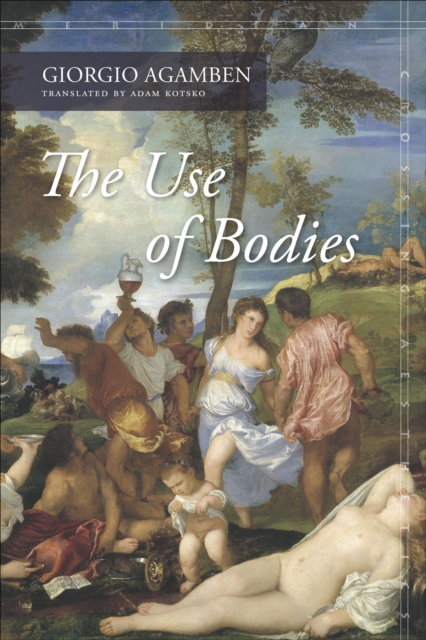
The use of bodies
Giorgio Agamben's Homo Sacer was one of the seminal works of political philosophy in recent decades. It was also the beginning of a series of interconnected investigations of staggering ambition and scope, investigating the deepest foundations of Western politics and thought. The Use of Bodies represents the ninth and final volume in this twenty-year undertaking, breaking considerable new ground while clarifying the stakes and implications of the project as a whole. It comprises three major sections. The first uses Aristotle's discussion of slavery as a starting point for radically rethinking notions of selfhood; the second calls for a complete reworking of Western ontology; and the third explores the enigmatic concept of \"form-of-life,\" which is in many ways the motivating force behind the entire Homo Sacer project. Interwoven between these major sections are shorter reflections on individual thinkers (Debord, Foucault, and Heidegger), while the epilogue pushes toward a new approach to political life that breaks with the destructive deadlocks of Western thought. The Use of Bodies represents a true masterwork by one of our greatest living philosophers.
eBook
Opus Dei : an archaeology of duty
In this follow-up to The Kingdom and the Glory and The Highest Poverty, Agamben investigates the roots of our moral concept of duty in the theory and practice of Christian liturgy. Beginning with the New Testament and working through to late scholasticism and modern papal encyclicals, Agamben traces the Church's attempts to repeat Christ's unrepeatable sacrifice. Crucial here is the paradoxical figure of the priest, who becomes more and more a pure instrument of God's power, so that his own motives and character are entirely indifferent as long as he carries out his priestly duties. In modernity, Agamben argues, the Christian priest has become the model ethical subject. We see this above all in Kantian ethics. Contrasting the Christian and modern ontology of duty with the classical ontology of being, Agamben contends that Western philosophy has unfolded in the tension between the two. This latest installment in the study of Western political structures begun in Homo Sacer is a contribution to the study of liturgy, an extension of Nietzsche's genealogy of morals, and a reworking of Heidegger's history of Being.
eBook
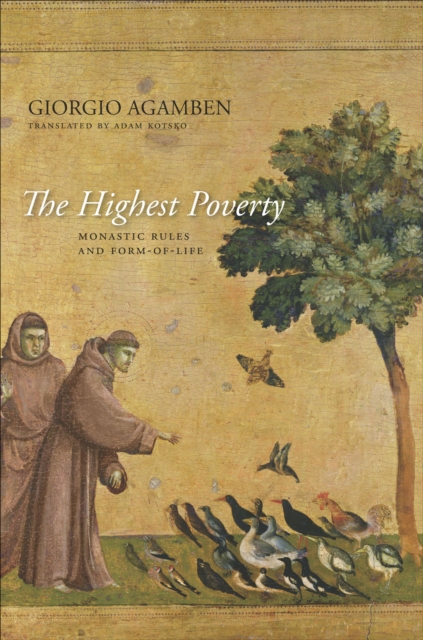
The highest poverty : monastic rules and form-of-life
What is a rule, if it appears to become confused with life? And what is a human life, if, in every one of its gestures, of its words, and of its silences, it cannot be distinguished from the rule? It is to these questions that Agamben's new book turns by means of an impassioned reading of the fascinating and massive phenomenon of Western monasticism from Pachomius to St. Francis. The book reconstructs in detail the life of the monks with their obsessive attention to temporal articulation and to the Rule, to ascetic techniques and to liturgy. But Agamben's thesis is that the true novelty of monasticism lies not in the confusion between life and norm, but in the discovery of a new dimension, in which \"life\" as such, perhaps for the first time, is affirmed in its autonomy, and in which the claim of the \"highest poverty\" and \"use\" challenges the law in ways that we must still grapple with today. How can we think a form-of-life, that is, a human life released from the grip of law, and a use of bodies and of the world that never becomes an appropriation? How can we think life as something not subject to ownership but only for common use?
eBook
Karman : a brief treatise on action, guilt, and gesture
What does it mean to be responsible for our actions? In this brief and elegant study, Giorgio Agamben traces our most profound moral intuitions back to their roots in the sphere of law and punishment. Moral accountability, human free agency, and even the very concept of cause and effect all find their origin in the language of the trial, which Western philosophy and theology both transform into the paradigm for all of human life. In his search for a way out of this destructive paradigm, Agamben not only draws on minority opinions within the Western tradition but engages at length with Buddhist texts and concepts for the first time. In sum, Karman deepens and rearticulates some of Agamben's core insights while breaking significant new ground.
eBook