
Catalogue Search | MBRL


Are you sure you want to remove the book from the shelf?

{{itemTitle}}
77
result(s) for
"Kott, Alexander"
Sort by:

Operational resilience: concepts, design and analysis
Building resilience into today’s complex infrastructures is critical to the daily functioning of society and its ability to withstand and recover from natural disasters, epidemics and cyber-threats. This study proposes quantitative measures that capture and implement the definition of engineering resilience advanced by the National Academy of Sciences. The approach is applicable across physical, information and social domains. It evaluates the critical functionality, defined as a performance function of time set by the stakeholders. Critical functionality is a source of valuable information, such as the integrated system resilience over a time interval and its robustness. The paper demonstrates the formulation on two classes of models: 1) multi-level directed acyclic graphs and 2) interdependent coupled networks. For both models synthetic case studies are used to explore trends. For the first class, the approach is also applied to the Linux operating system. Results indicate that desired resilience and robustness levels are achievable by trading off different design parameters, such as redundancy, node recovery time and backup supply available. The nonlinear relationship between network parameters and resilience levels confirms the utility of the proposed approach, which is of benefit to analysts and designers of complex systems and networks.
Journal Article

From cockroaches to tanks: The same power-mass-speed relation describes both biological and artificial ground-mobile systems
This paper explores whether artificial ground-mobile systems exhibit a consistent regularity of relation among mass, power, and speed, similar to that which exists for biological organisms. To this end, we investigate an empirical allometric formula proposed in the 1980s for estimating the mechanical power expended by an organism of a given mass to move at a given speed, applicable over several orders of magnitude of mass, for a broad range of species, to determine if a comparable regularity applies to a range of vehicles. We show empirically that not only does a similar regularity apply to a wide variety of mobile systems; moreover, the formula is essentially the same, describing organisms and systems ranging from a roach (1 g) to a battle tank (35,000 kg). We also show that for very heavy vehicles (35,000–100,000,000 kg), the formula takes a qualitatively different form. These findings point to a fundamental similarity between biological and artificial locomotion that transcends great differences in morphology, mechanisms, materials, and behaviors. To illustrate the utility of this allometric relation, we investigate the significant extent to which ground robotic systems exhibit a higher cost of transport than either organisms or conventional vehicles, and discuss ways to overcome inefficiencies.
Journal Article

Information Warfare and Organizational Decision-Making
Unconventional warfare is now conventional, and information warfare is a key to the new warfare. You can respond to these unprecedented challenges by creating original organizational structures able to adapt to ever-changing strategies and tactics. This authoritative book gives you practical solutions for organizing and executing organizational warfare, gathering intelligence, deploying antiterrorism measures, and securing information. The book presents a range of computational methods that help you more effectively analyze, identify, and exploit vulnerabilities in the structure and decision-making processes of unknown or poorly understood enemy organizations. You learn how to mitigate attacks on organizational decision-making, and predict the impact of attacks on robustness, quality, and timeliness of your organization, as well as the enemy's. Moreover, this valuable resource shows you how to manage, in real-time, the processes of the attacking enemy or defending friendly organizations. By integrating artificial intelligence, game theory, control theory, management science, organizational science, and cognitive modeling, this book lets you rethink the relations between organization, warfare and information.
eBook
A genetic epidemiology approach to cyber-security
While much attention has been paid to the vulnerability of computer networks to node and link failure, there is limited systematic understanding of the factors that determine the likelihood that a node (computer) is compromised. We therefore collect threat log data in a university network to study the patterns of threat activity for individual hosts. We relate this information to the properties of each host as observed through network-wide scans, establishing associations between the network services a host is running and the kinds of threats to which it is susceptible. We propose a methodology to associate services to threats inspired by the tools used in genetics to identify statistical associations between mutations and diseases. The proposed approach allows us to determine probabilities of infection directly from observation, offering an automated high-throughput strategy to develop comprehensive metrics for cyber-security.
Journal Article
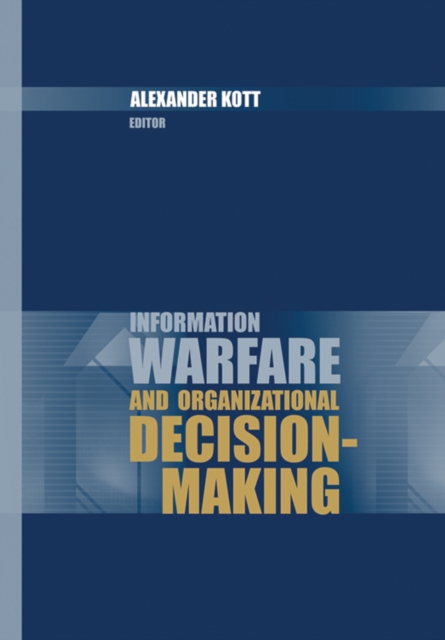
Information Warfare & Organizational Dec
An extremely timely book that examines military organizational and command structures and their decision-making processes. It focuses on identifying and managing decision-making vulnerabilities for self-defense as well as a strategic weapon for undermining enemy actions.
eBook

Information warfare and organizational decision-making
Unconventional warfare is now conventional, requiring the military to organize in new ways that can rapidly respond to unprecedented battlefield challenges. Cutting-edge computing is helping military planners create original organizational structures able to adapt to ever-changing strategies and tactics. The computational techniques in this book provide practical solutions for organizing and commanding military operations, gathering intelligence, deploying antiterrorism measures, and securing information. The book covers artificial intelligence, game and control theory, and cognitive modeling
Book
Autonomous Intelligent Cyber-defense Agent: Introduction and Overview
This chapter introduces the concept of Autonomous Intelligent Cyber-defense Agents (AICAs), and briefly explains the importance of this field and the motivation for its emergence. AICA is a software agent that resides on a system, and is responsible for defending the system from cyber compromises and enabling the response and recovery of the system, usually autonomously. The autonomy of the agent is a necessity because of the growing scarcity of human cyber-experts who could defend systems, either remotely or onsite, and because sophisticated malware could degrade or spoof the communications of a system that uses a remote monitoring center. An AICA Reference Architecture has been proposed and defines five main functions: (1) sensing and world state identification, (2) planning and action selection, (3) collaboration and negotiation, (4) action execution and (5) learning and knowledge improvement. The chapter reviews the details of AICA's environment, functions and operations. As AICA is intended to make changes within its environment, there is a risk that an agent's action could harm a friendly computer. This risk must be balanced against the losses that could occur if the agent does not act. The chapter discusses means by which this risk can be managed and how AICA's design features could help build trust among its users.
Paper

Intelligent Autonomous Agents are Key to Cyber Defense of the Future Army Networks
Intelligent autonomous agents will be widely present on the battlefield of the future. The proliferation of intelligent agents is the emerging reality of warfare, and they will form an ever-growing fraction of total military assets. By necessity, intelligent autonomous cyber defense agents are likely to become primary cyber fighters on the future battlefield. Initial explorations have identified the key functions, components and their interactions for a potential reference architecture of such an agent. However, it is beyond the current state of Artificial Intelligence (AI) to support an agent that could operate intelligently in an environment as complex as the real battlefield. A number of difficult challenges are yet to be resolved. At the same time, a growing body of research in Government and academia demonstrates promising steps towards overcoming some of the challenges. The industry is beginning to embrace approaches that may contribute to technologies of autonomous intelligent agents for the cyber defense of the Army networks.
Journal Article