
Catalogue Search | MBRL


Are you sure you want to remove the book from the shelf?

{{itemTitle}}
680
result(s) for
"Kramer, Steven"
Sort by:


Audiology
With two new chapters, improved artwork, and significant updates made throughout, the fourth edition of Audiology: Science to Practice continues to be the most comprehensive textbook for audiology and hearing science courses, as well as for health care professionals wanting a better understanding of hearing science and audiology practices. It is written in a style that makes new or difficult concepts relatively easy to understand, while still providing more coverage of hearing and vestibular science and clinical audiology than other introductory texts.
eBook
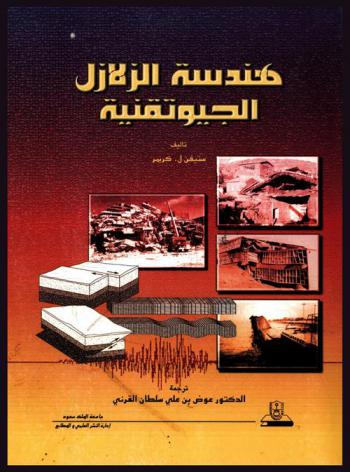
هندسة الزلازل الجيوتقنية
يهدف الكتاب إلى تقديم المفاهيم والنظريات والطرق لهندسة الزلازل الجيوتقنية وهذا الكتاب أعد للاستعمال كمرجع في مقررات الدراسات العليا لهندسة الزلازل الجيوتقنية وككتاب مرجع للمهندسين الممارسين وبإدراك أن هندسة الزلازل الجيوتقنية مجال واسع متعدد الفروع، فالكتاب يستل من علم الزلازل والجيولوجيا والهندسة الإنشائية وتحليل المخاطر والفروع التقنية الأخرى وأوضح المؤلف بأنه تقع مادة الموضوع في مجموعتين رئيسيتين تطرح الملاحق والفصول الستة الأولى المفاهيم الرئيسية لعلم الزلازل والحركة الأرضية والديناميكا. وسلوك التربة وطرحت تطبيقات لهذه المفاهيم للمسائل الشائع اعتبارها عند ممارسة هندسة الزلازل الجيوتقنية في الفصول الستة الأخيرة، يقدم الفصل الأول إلى القارئ أنواع الضرر التي يمكن أن تحدث أثناء الزلازل والمشاكل التي تطرحها لمهندسي الزلازل الجيوتقننين وتوصف المفاهيم الأساسية لعلم الزلازل والمصطلحات المستعملة لوصف الزلازل وتأثيراتها في الفصل الثاني ويصف الفصل الثالث قياس الحركة الأرضية والمعاملات المستخدمة لوصف الحركة الأرضية القوية وطرق التنبؤ بهذه المعاملات وطرحت تحليلات المخاطر والزلازل التحديدية والاحتمالية في الفصل الرابع ويقدم الفصل الخامس الانتشار الموجي، بداية بالموجات الباطنية أحادية البعد البسيطة في المواد المتجانسة والممتدة إلى الموجات السطحية ووصف خصائص التربة التي تتحكم في سلوك انتشارها الموجي في الفصل السادس ويطرح الفصل السابع طرق التحليل للاستجابة الأرضية أثناء الزلازل ويقدم الفصل الثامن أيضا مفهوم الحركات الأرضية التصميمية ويتعامل الفصل التاسع مع التميع. وتغطي الاستقرارية الزلزالية للميول في الفصل العاشر والتصميم الزلزالي السائد في الفصل الحادي عشر ويقدم الفصل الثاني عشر تقنيات تحسين التربة الشائع استخدامها لتقليل المخاطر الزلزالية.
Book

Performance-based design methodologies for geotechnical earthquake engineering
Performance-based design offers a number of advantages over historically common design approaches. As currently practiced, performance is most commonly evaluated in terms of system response, typically displacement-related, using traditional ground motion intensity measures defined at two or more discrete hazard levels. Such approaches do not necessarily allow all of the potential benefits of performance-based design to be realized. More recently, integral performance-based procedures that account for ground shaking hazards at all hazard levels have been developed. This paper reviews basic concepts of performance and different approaches to the implementation of performance-based design. An load and resistance factor-like methodology is described and illustrated with an example.
Journal Article

Posing Significant Research Questions
This first editorial in a series, building on 50 years of JRME archives, explores what counts as a significant research question in mathematics education research, where significant research questions come from, and how researchers can develop their manuscripts to make the case for the significance of their research questions.
Journal Article
Theoretical Framing as Justifying
In our March editorial (Cai et al., 2019), we discussed the nature of significant research questions in mathematics education. We asserted that the choice of a suitable theoretical framework is critical to establishing the significance of a research question. In this editorial, we continue our series on high-quality research in mathematics education by elaborating on how a well-constructed theoretical framework strengthens a research study and the reporting of research for publication. In particular, we describe how the theoretical framework provides a connecting thread that ties together all of the parts of a research report into a coherent whole. Specifically, the theoretical framework should help (a) make the case for the purpose of a study and shape the literature review; (b) justify the study design and methods; and (c) focus and guide the reporting, interpretation, and discussion of results and their implications.
Journal Article
So What? Justifying Conclusions and Interpretations of Data
We use this editorial to propose some ideas for presenting and interpreting results with an eye toward addressing the “so what” question by leveraging the alignment among research questions, theoretical framework, and methods in a well-designed research study. Our aim is to present some practical ideas that could help researchers evaluate their findings with this question in mind.
Journal Article

Dynamic soil characterization and site response estimation for Erbaa, Tokat (Turkey)
Site amplification is one of the most important factors controlling damage in urban areas through strong earthquakes. Local site effects play an important role in earthquake-resistant design and should be considered for site response analyses. In this study, ground response analyses in Erbaa, Turkey, a settlement in the North Anatolian Fault Zone, using one-dimensional equivalent linear analysis and empirical approaches based on shear wave velocity profiles are evaluated and compared. The ground response analyses were performed with consideration of shear wave velocity, and modulus reduction and damping behavior for different confining pressure and plasticity index-dependent models. The results of ground response analyses and amplification values from empirical equations using shear wave velocity are illustrated in terms of amplification and predominant period maps of the seismically active Erbaa settlement area. The comparison has been made in these produced maps of the study area in order to evaluate different site response analyses.
Journal Article
Choosing and Justifying Robust Methods for Educational Research
In our recent editorials (Cai et al., 2019a, 2019b), we discussed the important roles that research questions and theoretical frameworks play in conceptualizing, carrying out, and reporting mathematics education research. In this editorial, we discuss the methodological choices that arise when one has articulated research questions and constructed at least a rudimentary theoretical framework. Just as the researcher must justify the significance of research questions and the appropriateness of the theoretical framework, we argue that the researcher must thoroughly describe and justify the selection of methods. Indeed, the research questions and the theoretical framework should drive the choice of methods (and not the reverse). In other words, a sufficiently well-specified set of research questions and theoretical framework establish the parameters within which the most productive methods will be selected and developed.
Journal Article
Addressing the Problem of Always Starting Over: Identifying, Valuing, and Sharing Professional Knowledge for Teaching
Cai et al discuss the possibilities of retaining and sharing professional knowledge as a way of addressing the problem of always starting over, which is one of the overarching problems in mathematics education. The problem is encountered by every new teacher beginning from scratch on their own rather than taking advantage of what thousands of colleagues have learned over time about how to teach effectively toward the same learning goals. The mathematics education community must address this problem if there is ever to be long-term, lasting improvement in educational practice.
Journal Article