
Catalogue Search | MBRL


Are you sure you want to remove the book from the shelf?

{{itemTitle}}
160
result(s) for
"Kristen Renwick Monroe"
Sort by:

The evils of polygyny : evidence of its harm to women, men, and society
\"One powerful structural factor which enforces and replicates patterns of male dominance is the practice of polygyny, which is shown by data to be harmful to women, children, men, and society\"-- Provided by publisher.
Book

The Unspoken Morality of Childhood
The Unspoken Morality of Childhood: reflects the thoughts of a senior ethicist. Each essay begins with a homey essay about the kind of everyday event that happens to everyone and then proceeds to discuss the ethical issues raised by such an event. The manuscript is interdisciplinary, located at the intersection of ethics, political psychology, moral psychology, philosophy, and political science/political theory. It uses stories to teach ethics and falls in the virtue ethics approach to ethics, making it perfect as a supplementary text for introductory courses to philosophy, moral psychology and political theory.
The manuscript discusses complex ethical concepts such as identity, agency, self-esteem, forgiveness, relations with our parents, dealing with loss, the moral imagination, and a wide range of other issues that people confront every day.
One of the essays, Walnut , tells a story about the author’s visiting her grandparents in a small, Midwestern town. This is turned into a discussion of the need for roots, how children formulate their sense of self, and how politicians like Donald Trump can turn the love of family and nostalgia for the past into a vicious tool in politics in which clever politicians exploit fears of foreigners and people who are 'not like us'. The essay uses this prompt to discuss the importance of the moral imagination and the ability some have to conceptualize their way out of a dilemma that can plague others.
eBook

Politics, Principle and Standing up to Donald Trump
The Muslim ban. Immigrant children, caged, isolated from their families. Downplaying COVID-19. Infatuation with foreign dictators. Voter fraud. Election denial. Encouraging the January 6th 2021 Capital insurrection. Despite Donald Trump's many legal and moral abuses, most Republican Party leaders continue to support him. Why? How can we explain Republican complicity? True believers in the MAGA cult are rare. There are moderate Republican members of Congress - Kevin McCarthy, Lindsay Graham, and Mitch McConnell - who publicly rebuked Trump, only to later back down and support him and his version of the truth. The motivation driving these powerful political leaders - fear, self-interest, lack of moral fiber - is less interesting than is a related question: What propelled the moral courage of the few traditionally conservative Republicans who refused to go along with Trump and his obvious lies? The world saw great physical courage on January 6th, as members of the Capital police fought against overwhelming odds, risking their lives to protect members of Congress. Such physical courage is commendable and rare. Yet moral courage - the willingness to stand up and fight for what you believe is right, even when you know it will cost you - is even rarer. How can we explain why some Republicans followed their consciences, while many others did not? This is the topic of this book. Analyzing in-depth interviews, public speeches, journals, documents, and other data from dedicated Republicans -- Senators McCain, Romney, and Flake, Representatives Kinzinger and Cheney, committed Republican stalwarts Rick Wilson and Anthony Scaramucci, and dedicated Republican officeholders like Miles Taylor -- lends insight into both what drives moral courage, and the double-edged sword aspect of moral courage in politics, in which every act of moral courage is also a complex
act of betrayal.
eBook

The Rush to Transparency: DA-RT and the Potential Dangers for Qualitative Research
What is the impact of the recent Data Access and Research Transparency (DA-RT) initiative and the Journal Editors Transparency Statement (JETS) on scholars working with qualitative data? Analysis finds DA-RT insufficiently sensitive to the needs of qualitative data and focuses on four inter-related reasons why DA-RT needs to be revised before being widely adopted by political science journals: (1) space constraints that hinder full journal presentation of the analysis of qualitative data; (2) ethical concerns about protecting human subjects, and the time needed to prepare such data before publicly sharing them; (3) costs of data collection and the right of first usage; and (4) a potentially chilling effect of DA-RT on certain types of research topics. Analysis of the author’s own journey from econometric and survey analysis to narrative interviews with people in vulnerable situations, facing moral dilemmas, illustrates why DA-RT needs additional safeguards for qualitative data and methods. Given the increasing importance of qualitative data, and its ability to lend insight into critical political topics, the author argues that implementing the current version of the DA-RT initiative could hinder political science’s ability to address important political questions. Thus DA-RT must be modified to address the special needs of qualitative data.
Journal Article

The Hand of Compassion
Through moving interviews with five ordinary people who rescued Jews during the Holocaust, Kristen Monroe casts new light on a question at the heart of ethics: Why do people risk their lives for strangers and what drives such moral choice? Monroe's analysis points not to traditional explanations--such as religion or reason--but to identity. The rescuers' perceptions of themselves in relation to others made their extraordinary acts spontaneous and left the rescuers no choice but to act. To turn away Jews was, for them, literally unimaginable. In the words of one German Czech rescuer, \"The hand of compassion was faster than the calculus of reason.\"
At the heart of this unusual book are interviews with the rescuers, complex human beings from all parts of the Third Reich and all walks of life: Margot, a wealthy German who saved Jews while in exile in Holland; Otto, a German living in Prague who saved more than 100 Jews and provides surprising information about the plot to kill Hitler; John, a Dutchman on the Gestapo's \"Most Wanted List\"; Irene, a Polish student who hid eighteen Jews in the home of the German major for whom she was keeping house; and Knud, a Danish wartime policeman who took part in the extraordinary rescue of 85 percent of his country's Jews.
We listen as the rescuers themselves tell the stories of their lives and their efforts to save Jews. Monroe's analysis of these stories draws on philosophy, ethics, and political psychology to suggest why and how identity constrains our choices, both cognitively and ethically. Her work offers a powerful counterpoint to conventional arguments about rational choice and a valuable addition to the literature on ethics and moral psychology. It is a dramatic illumination of the power of identity to shape our most basic political acts, including our treatment of others.
But always Monroe returns us to the rescuers, to their strong voices, reminding us that the Holocaust need not have happened and revealing the minds of the ethically exemplary as they negotiated the moral quicksand that was the Holocaust.
eBook

The Evils of Polygyny
Why do men act violently toward women?
What are the consequences of \"normal violence,\" not only for
women and children but also for the men who instigate it, and for
the societies that sanction it?
The Evils of Polygyny examines one powerful structural
factor that instigates, enforces, and replicates patterns of male
dominance: the practice of polygyny. From more than a decade's
worth of study, Rose McDermott has produced a book that uncovers
the violent impact of polygyny on women, children, and the
nation-state and adds fundamentally to the burgeoning focus on
gender concerns in political psychology and international
relations. Integrating these fields, as well as domestic policy and
human rights, the author urges us to address the question of
violence toward women and children. If we do not, a system that
tells young women they must marry whom their elders dictate and
devote their entire lives to serving others will continue to plague
the contemporary world, and restrict development.
The timely nature of McDermott's book reflects the mission of
the Easton Lectures at the Interdisciplinary Center for the
Scientific Study of Ethics and Morality at the University of
California, Irvine, which charges its lecturers to produce work
that is creative, controversial, and cutting-edge, and offers
substantial real-world impact. The Evils of Polygyny ,
edited by Kristen Renwick Monroe, includes commentary from Valerie
Hudson, Robert Jervis, and B. J. Wray. The book does just that,
providing a coherent analysis of sexual violence and a provocative
and chilling analysis of one of the major problems of the
contemporary world.
eBook

Cracking the Code of Genocide: The Moral Psychology of Rescuers, Bystanders, and Nazis during the Holocaust
What turns neighbors into genocidalists? Why do some stand by, while others risk their lives to help? A narrative analysis of interviews with rescuers, bystanders, and Nazi supporters during World War II focuses attention on self-image, worldview, and cognitive categorization as critical influences. Rescuers, bystanders, and Nazis demonstrated dramatically different self concepts, yet identity constrained choice for all groups. A critical aspect of identity is relational: the sense of self in relation to others. Worldview, canonical expectations, and idealized cognitive models are critical determinants, with the ethical importance of values emanating not from particular values but from the integration of these values into the speaker's sense of self. Finally, cognitive categorization carries strong ethical overtones. The dehumanization that spurs perpetrators and the sense of moral salience that drives rescuers work through the cognitive classification of \"the other.\"
Journal Article


Politics and an Innate Moral Sense: Scientific Evidence for an Old Theory?
Part of a symposium arguing for increased interdisciplinary conversations, this article suggests how political scientists can benefit from recent scientific work in child development, evolutionary biology, behavioral economics, primatology, and linguistics. All offer empirical evidence suggesting human beings are born with a moral grammar hard-wired into their neural circuitry. The analysis challenges claims for cultural relativity and suggests psychological egoism and rational choice theory leave unexplained much political behavior because they rest on too narrow a conceptualization of basic human nature, omitting precisely the sociability that moral sense theory places as a fundamental part of our human nature.
Journal Article
The hand of compassion
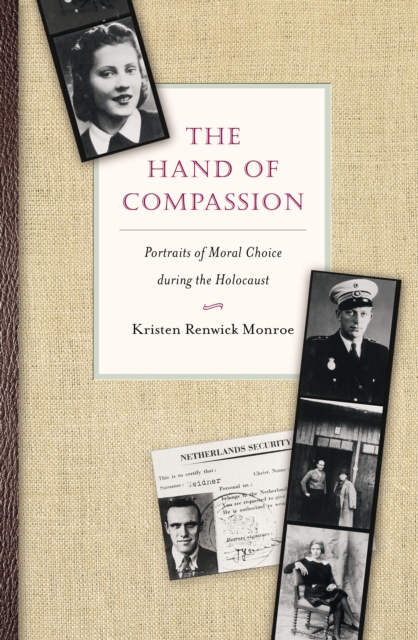
Through moving interviews with five ordinary people who rescued Jews during the Holocaust, Kristen Monroe casts new light on a question at the heart of ethics: Why do people risk their lives for strangers and what drives such moral choice? Monroe's analysis points not to traditional explanations--such as religion or reason--but to identity. The rescuers' perceptions of themselves in relation to others made their extraordinary acts spontaneous and left the rescuers no choice but to act. To turn away Jews was, for them, literally unimaginable. In the words of one German Czech rescuer, \"The hand of compassion was faster than the calculus of reason.\" At the heart of this unusual book are interviews with the rescuers, complex human beings from all parts of the Third Reich and all walks of life: Margot, a wealthy German who saved Jews while in exile in Holland; Otto, a German living in Prague who saved more than 100 Jews and provides surprising information about the plot to kill Hitler; John, a Dutchman on the Gestapo's \"Most Wanted List\"; Irene, a Polish student who hid eighteen Jews in the home of the German major for whom she was keeping house; and Knud, a Danish wartime policeman who took part in the extraordinary rescue of 85 percent of his country's Jews. We listen as the rescuers themselves tell the stories of their lives and their efforts to save Jews. Monroe's analysis of these stories draws on philosophy, ethics, and political psychology to suggest why and how identity constrains our choices, both cognitively and ethically. Her work offers a powerful counterpoint to conventional arguments about rational choice and a valuable addition to the literature on ethics and moral psychology. It is a dramatic illumination of the power of identity to shape our most basic political acts, including our treatment of others. But always Monroe returns us to the rescuers, to their strong voices, reminding us that the Holocaust need not have happened and revealing the minds of the ethically exemplary as they negotiated the moral quicksand that was the Holocaust.
eBook