
Catalogue Search | MBRL


Are you sure you want to remove the book from the shelf?

{{itemTitle}}
3
result(s) for
"Kritzinger, Nicola"
Sort by:

Visualising China in Southern Africa
Engaging with the work of contemporary African and Chinese artists while analysing broader material production, the essays in this volume are wide-ranging in their analysis of ceramics, photography, painting, etching, sculpture, film, performance, postcards, stamps, installations, political posters, cartoons and architecture.
With China’s rise as the new superpower, its presence in Africa has expanded, leading to significant economic, geopolitical and cultural shifts. Chinese and African encounters through the lens of the visual arts and material culture, however, is a neglected field. Visualising China in Southern Africa is a ground-breaking volume that addresses this deficit through engaging with the work of contemporary African and Chinese artists while analysing broader material production that prefigures the current relationship. The essays are wide-ranging in their analysis of ceramics, photography, painting, etching, sculpture, film, performance, postcards, stamps, installations, political posters, cartoons and architecture. Richly illustrated, the collection includes scholarly chapters, photo essays, interviews, and artists’ personal accounts, organised around four themes: material flows, orientations and transgressions, spatial imaginaries, and biographies.
eBook
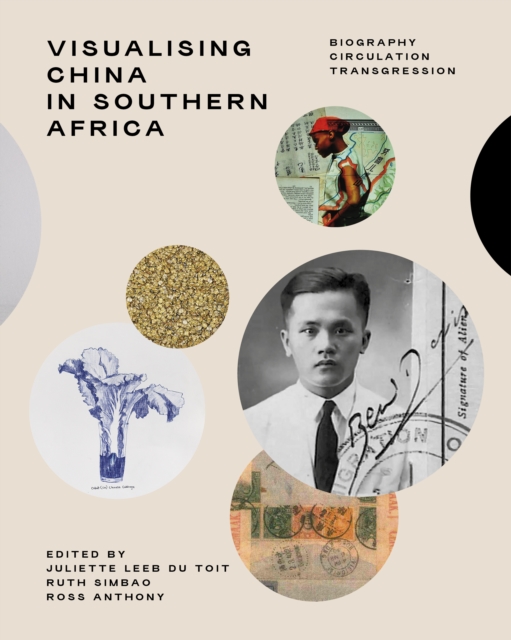
Visualising China in Southern Africa: Circulation, Biography, Transgression
China and Africa have long shared a history of allegiance and contact points through global political forces from the time of colonialism and the Cold War. With China's rise as the new superpower, its presence in Africa has expanded, leading to significant economic, geopolitical and cultural shifts. While issues such as trade, aid and development have received much attention, Chinese and African encounters through the lens of the visual arts and material culture is a neglected field. Visualising China in Southern Africa: Biography, Circulation, Transgression is a ground-breaking volume that addresses this deficit through engaging with the work of contemporary African and Chinese artists while analysing broader material production that prefigures the current relationship. The essays are wide-ranging in their analysis of ceramics, photography, painting, etching, sculpture, film, performance, postcards, stamps, installations, political posters, cartoons and architecture. Visualising China in Southern Africa confines its focus to southern Africa, yet even within this region, the context is complex. Ethnicity and nationalism, the lingering influence of Cold War allegiances and colonial configurations all continue to play a role. The various visual cultures discussed in this volume emphasise the commonality of these categories, but also point towards other shared histories that transcend the nation-state category. The collection includes scholarly chapters, photo essays, interviews, and artists' personal accounts, organised around four themes: material flows, orientations and transgressions, spatial imaginaries, and biographies. The artists, photographers, filmmakers, curators and collectors in this volume include: Stary Mwaba, Hua Jiming, Anawana Haloba, Gerald Machona, Nobukho Nqaba, Marcus Neustetter, Brett Murray, Diane Victor, William Kentridge, Kristin NG-Yang, Kok Nam, Mark Lewis, the Chinese Camera Club of South Africa, Wu Jing, Henion Han and Shengkai Wu.
eBook
Hidden Objects at the Johannesburg Art Gallery: Han Dynasty Míngqì
One of the more unusual sculptures housed at the Johannesburg Art Gallery (JAG) is a 2 000-year-old Chinese burial ceramic stemming from the Han dynasty (206 BCE–220 CE). Known in Chinese as a míngqì, or funerary object, the sculpture portrays a ceramic model of a farmyard (JAGC34) (Figure 7.1). Given how it stands out in terms of the broader collection of largely European and African art in the museum collection, this chapter seeks to understand how the míngqì came into the gallery's possession but also how, as gallery contexts have changed through the years, the object itself has assumed different layers of meaning. Drawing on archival materials, I discuss the work's ‘biography’ (Kopytoff 1986), where looking ‘outwards’ from the object reveals socio-cultural values that have become entangled with it. This aims at a better understanding of ancient East Asian art in a South African context, and also how the trajectory of such ‘irritating’ objects illustrates socio-cultural changes within the museum and South Africa more broadly.I draw on the use of ‘irritating’ here, from the work of Julia Kelly, who argues that some objects in collections are considered irritating because they are ‘unusual’ or have ‘not yet been the subject of research’ (2007, 2). While others have written on the history of objects in the JAG, these works primarily interrogate the tensions between the European and the African binary, as well as associated binaries: the modern and the ‘primitive’, fine art and the ethnographic, and how such tensions manifest themselves through the likes of exhibitions, acquisitions and policy formulation.1 None of these histories includes the Chinese ceramics collection in their exploration of the gallery's history, with the exception of one Ming dynasty roof tile image in the catalogue for the One Hundred Years of Collecting: The Johannesburg Art Gallery exhibition, juxtaposed with some Japanese prints (Carman 2010, 29). As if to highlight its liminality, the ‘Oriental ceramics collection’ is referred by Jillian Carman as ‘extraneous to JAG's core policy’, though it nevertheless comprises ‘superb assets which enhance JAG's collection and exhibition profile’ (2010, 23).The Han dynasty objects have thus been largely overlooked in terms of critical engagement. This is due in no small part to the general lack of East Asian expertise in South Africa.
Book Chapter