
Catalogue Search | MBRL


Are you sure you want to remove the book from the shelf?

{{itemTitle}}
76
result(s) for
"Kuipers, Giselinde"
Sort by:

Good Humor, Bad Taste
This is an updated edition of Good Humor, Bad Taste: A Sociology of the Joke, published in 2006. Using a combination of interview materials, survey data, and historical materials, it explores the relationship between humor and gender, age, social class, and national differences in the Netherlands and the United States. This edition includes new developments and research findings in the field of humor studies.
eBook

Cultural Globalization and Arts Journalism: The International Orientation of Arts and Culture Coverage in Dutch, French, German, and U.S. Newspapers, 1955 to 2005
This article charts key developments and cross-national variations in the coverage of foreign culture (i.e., classical and popular music, dance, film, literature, theater, television, and visual arts) in Dutch, French, German, and U.S. elite newspapers between 1955 and 2005. Such coverage signals the awareness of foreign culture among national elites and the degree and direction of \"globalization from within.\" Using content analysis, we examine the degree, direction, and diversity of the international orientation of arts journalism for each country and cultural genre. Results denote how international arts and culture coverage has increased in Europe but not in the United States. Moreover, the centrality of a country in the cultural \"world-system\" offers a better explanation for cross-national differences in international orientation than do other country-level characteristics, such as size and cultural policy framework. Recorded and performance-based genres differ markedly in their levels of internationalization, but the effect of other genre-level characteristics, such as language dependency and capital intensiveness, is not clear. In each country, international coverage remains concentrated on a few countries, of which the United States has become the most prominent. Although the global diversity of coverage has increased, non-Western countries are still underrepresented.
Journal Article
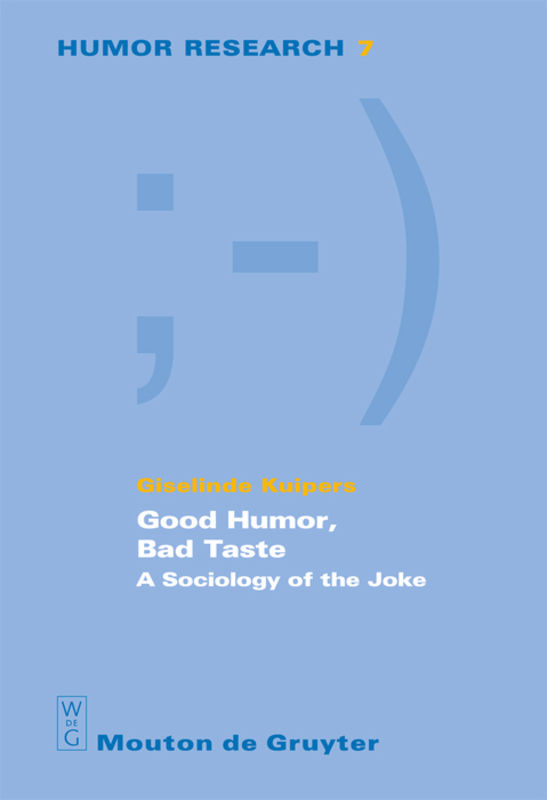
Good Humor, Bad Taste
Good Humor, Bad Taste is the first extensive sociological study of the relationship between humor and social background.Using a combination of interview materials, survey data, and historical materials, the book explores the relationship between humor and gender, age, regional background, and especially, humor and social class in the Netherlands.
eBook
How National Institutions Mediate the Global: Screen Translation, Institutional Interdependencies, and the Production of National Difference in Four European Countries
How do national institutional contexts mediate the global? This article aims to answer this question by analyzing screen translation—the translation of audiovisual materials like movies and television programs—in four European countries: France, Italy, the Netherlands, and Poland. A cross-national, multi-method research project combining interviews, ethnography, and a small survey found considerable cross-national differences in translation norms and practices, sometimes leading to very different translated versions of the same product. The analysis shows how differences between national translation fields are produced and perpetuated by the interplay of institutional factors on four interdependent levels: technology, and the organizational, national, and transnational fields. On each level, various institutions are influential in shaping nationally specific translation norms and practices by producing institutional constraints or imposing specific meanings. I propose a model that explains the persistence of national translation systems—not only from the logics of specific institutions, fields, or levels—but by the feedback loops and interdependencies between institutions on various levels. This analysis has implications for the sociological understanding of globalization, the production of culture and media, cross-national comparative research, as well as institutional theory and the role of translation in sociological practice.
Journal Article

Is sociologie klaar voor de mediasamenleving?
Is sociology ready for media society? A quick survey of recent sociology journals shows that as far as sociologists are concerned, social life is not very different from how it was in the 1980s: primarily based on face-to-face interactions, written communication, print media and an incidental phone call. The essay then presents a ‘bare bones’ version of sociology to show how the recent processes of accelerated mediatisation affects the basic ingredients of sociological analysis – interaction, culture and social structure – as well as the relation between these ingredients. It ends with an invitation to sociologists. For each study you do: ask yourself could this be done with the same methods or concepts in 1975? If so, consider adapting your design or conceptual framework to incorporate at least some elements related to the recent wave of mediatisation.
Journal Article

Verbalizing Sensations: Making Sense of Embodied Sexual Experiences
Embodied experiences are strongly felt, but hard to communicate or verbalize. This article examines people’s articulation and sense-making of their sexual sensations, during interviews, to gain insight into what we refer to as a “perceptual loop” between embodied sensations, body-sensorial knowledge, and social meanings. We employ a combination of interactionist and practice theory to study sex as an embodied practice that unfolds in interactions. We analyze this using in-depth interviews with 34 Dutch women and men about their sexual interactions. We focus on how they make sense, with their partner and with the interviewer, of their embodied experiences within an interview setting that requires them to verbalize their experience. Participants communicated these embodied sensations by (1) using multi-interpretable sensory wordings; (2) drawing comparisons between different sexual sensations; and (3) referring to other sensory sensations, and by exemplifying their effect (e.g. breathing, shrieking). We argue that to analyze people’s verbalized understanding of their sensations, we need to attend to an ongoing feedback process: sex both shapes and is shaped by social meaning and cultural knowledge. Embodied sensations are not the material onto which the social is mapped. Instead, embodied practices and interactions mediate and shape the social, leading to body-sensorial knowledge. While sex, as an intense embodied practice, is a strategic case to show this process, this “perceptual loop” between embodied practice and body-sensorial knowledge occurs in all human (inter)actions.
Journal Article

Is sociologie klaar voor de mediasamenleving?
Is sociology ready for media society? A quick survey of recent sociology journals shows that as far as sociologists are concerned, social life is not very different from how it was in the 1980s: primarily based on face-to-face interactions, written communication, print media and an incidental phone call. The essay then presents a ‘bare bones’ version of sociology to show how the recent processes of accelerated mediatisation affects the basic ingredients of sociological analysis ‐ interaction, culture and social structure ‐ as well as the relation between these ingredients. It ends with an invitation to sociologists. For each study you do: ask yourself could this be done with the same methods or concepts in 1975? If so, consider adapting your design or conceptual framework to incorporate at least some elements related to the recent wave of mediatisation.
Journal Article

\Where Was King Kong When We Needed Him?\ Public Discourse, Digital Disaster Jokes, and the Functions of Laughter after 9/11
Kuipers looks at the way the events of 9/11 affected American humor. She discerns three different ways in which these events affected American humor: the suspension of humor; the call for humor as a means to cope with the events of 9/11; and the jokes that did emerge about these events, notwithstanding the public discourse about the inappropriateness of such humor. She specifically focuses on the new genre of Internet jokes about these events.
Journal Article

Structure, Strategy and Self in Cultural Peripheries: Theorizing the Periphery in the Polish and Dutch Fashion Fields
This article analyzes the creation of value in (semi-)peripheral fields, using interview (N=94) and ethnographic data of creatives, models and cultural intermediaries in Polish and Dutch fashion. Drawing on field theory and center-periphery theories we show that these peripheral fields have a distinct structure—peripheral worlds—marked by the dependence on foreign centers for goods, standards and consecration, in which actors employ field-specific peripheral strategies for pursuing value and success. Workers in the (semi-)periphery develop peripheral selves, marked by a “double consciousness”, simultaneously seeing themselves from a local perspective and through the eyes of “central” others. We theorize “peripheralness” as a dimension of social inequality, a continuum ranging from “most central” to “most peripheral”, that spring from transnational interdependencies; and offer building blocks for a theory of the periphery that connects structural conditions and personal experiences. This theory explains, among others, why peripheries are not the reverse of centers, why centers also need peripheries (though not as much as peripheries need centers), and why peripheral and semi-peripheral actors don’t leave for cultural hubs to “make it there”.
Journal Article