
Catalogue Search | MBRL


Are you sure you want to remove the book from the shelf?

{{itemTitle}}
140
result(s) for
"Kull, Steven"
Sort by:

Feeling betrayed : the roots of Muslim anger at America
\"Explores the depth of anti-Americanism felt by Muslim populations in the Middle East and South Asia by reporting on opinions expressed during focus group sessions and in-depth surveys over several years, complemented by data from Gallup polls, World Values Survey, and Arab Barometer\"--Provided by publisher.
Book

Feeling Betrayed
Though it has been nearly a decade since the attacks of September 11, the threat of terrorism emanating from the Muslim world has not subsided. U.S. troops fight against radical Islamists overseas, and on a daily basis, Americans pass through body scanners as part of the effort to defend against another attack. Naturally, many Americans wonder what is occurring in Muslim society that breeds such hostility toward the United States.
Steven Kull, a political psychologist and acknowledged authority on international public opinion, has sought to understand more deeply how Muslims see America. How widespread is hostility toward the United States in the Muslim world? And what are its roots? How much support is there for radical groups that attack Americans, and why? Kull conducted focus groups with representative samples in Egypt, Morocco, Pakistan, Jordan, Iran, and Indonesia; conducted numerous in-depth surveys in eleven majority-Muslim nations over a period of several years; and comprehensively analyzed data from other organizations such as Gallup, World Values Survey and the Arab Barometer. He writes:
\"A premise of this book is that the problem of terrorism does not simply lie in the small number of people who join terrorist organizations. Rather, the existence of terrorist organizations is a symptom of a tension in the larger society that finds a particularly virulent expression in certain individuals. The hostility toward the United States in the broader society plays a critical role in sustaining terrorist groups, even if most disapprove of those groups' tactics. The essential 'problem,' then, is one of America's relationship with the society as a whole.\"
Through quotes from focus groups as well as survey data, Kull digs below the surface of Muslim anger at America to reveal the underlying narrative of America as oppressing - and at a deeper level, as having betrayed -the Muslim people. With the subtlety of a psychologist he shows how this anger is fed by an \"inner clash of civilizations,\" between Muslims' desire to connect with America and all that it represents, and their fear that America will overwhelm and destroy their traditional Islamic culture.
Finally, Kull maps out the implications of these findings for U.S. foreign policy, showing how many U.S. actions antagonize the larger Muslim population and help al Qaeda by improving their capacity for recruitment. He specifies steps that can mitigate Muslim hostility and draw on some of the underlying shared values that can support more respectful and, possibly, even amicable Muslim-American relations.
eBook

Misperceptions, the Media, and the Iraq War
The Iraq war and its aftermath have raised compelling questions about the capacity of the executive branch to elicit public consent for the use of military force and about the role the media plays in this process. Here, Kull et al explore the degree of pervasiveness or misperceptions and analyzes the relationship between the holding of these misperceptions and support for the Iraq war by using multivariate regression analysis to compare the strength of this factor with a range of other factors.
Journal Article
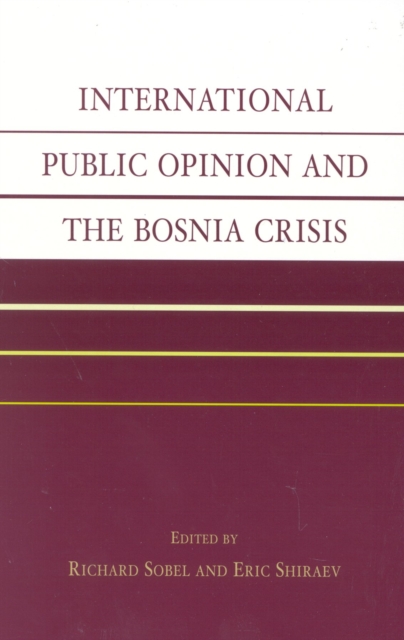
International public opinion and the Bosnia crisis
Does public opinion matter in international conflict resolution? Does national foreign policy remain independent of public opinion and the media? International Public Opinion and the Bosnia Crisis examines, through U.S., Canadian, and European case studies, how public reaction impacted democratic governments' response to the ethnic and religious conflict in Bosnia during the period from 1991-1997. Each case study offers an overview of the national media coverage and public reaction to the war in the former Yugoslavia and examines the links between public opinion and political and military intervention in Bosnia. The result is a comprehensive evaluation of the complex relationship between public opinion, media coverage, and foreign policy decision-making.
eBook
Introduction
It has been nearly a decade since the United States was attacked by a group of radical Islamists on September 11, 2001. Since then, rooting out the network of terrorists behind the attacks and related radical Islamist groups has been a major focus of American foreign and military policy. The magnitude of the American investment in this goal is extraordinary. Extensive U.S. military and intelligence resources have been directed toward fighting the central radical Islamist network al Qaeda in numerous theaters. The war in Afghanistan was waged because of al Qaeda’s base of operations there under radical Islamist Taliban government
Book Chapter
The United States as Hostile to Islam
One of the most powerful sources of anger toward the United States is the widespread perception that the United States is hostile to Islam itself. This perception is disturbing not only from an Islamic perspective in which Islam is seen as threatened, but also from a liberal perspective because the United States is seen as having failed to live up to principles of religious tolerance.
Majorities see the United States as seeking to undermine the Islamic world, undermine Islamic culture and identity, and impose American culture and even Christianity on the Muslim world. This U.S. intention is seen as being
Book Chapter
The Narrative of Oppression and Betrayal and the Inner Clash of Civilizations
The polling cited in chapter 1 makes clear that negative feelings among Muslims toward the United States are widespread and enduring. The question remains, however, as towhythese feelings are so pervasive and deep-seated. The focus groups conducted in six different majority-Muslim countries revealed the beliefs that drive Muslim anger. There was a strikingly consistent pattern when respondents discussed their views of the United States. While there were some differences of emphasis, in every case the dominant, overt theme was that the United States oppresses the Muslim people in a variety of ways. Eventually, a more subtle, underlying theme
Book Chapter
The United States as Undermining Democracy
The fourth central theme in the narrative of American oppression of the Muslim people is the claim that the United States actively undermines democracy in the Muslim world by providing critical support to authoritarian regimes that are friendly to it and that it effectively controls. Despite America’s professions of support for democracy, the United States is seen as an obstacle to real democratization, and professions of support are seen as purposely misleading. Muslim governments—as well as the Muslim people—are often seen as victims of U.S. domination. From this view of the United States flows a desire for the
Book Chapter
The Scope of Muslim Anger and Support for Violent Anti-American Groups
The premise of this book is that the problem of terrorism does not simply lie in the small number of people who join terrorist organizations. Rather, the existence of terrorist organizations is a symptom of tension in the larger society that finds a particularly virulent expression in certain individuals. Hostility toward the United States in the broader society plays a critical role in sustaining terrorist groups, even if most disapprove of those groups’ tactics. The essential “problem,” then, is one of America’s relationship with Muslim societies as a whole, or an integrated system.
Clark McCauley has depicted the relationship between
Book Chapter
Views of Al Qaeda and Other Radical Islamists
Some of the most prominent articulators of the narrative of U.S. oppression of the Muslim people are al Qaeda and other radical Islamist groups who espouse violence against America. Given the widespread anger at America in the Muslim world, it would not seem surprising if there were significant support for such groups. But feelings toward such groups are complex and replete with ambivalence.
Attitudes toward radical Islamists are influenced by much more than the Islamists’ approach to the United States. Radical Islamism has been the counterpoint to liberalism in the Muslim-world discourse. It has rejected the democratic process as the
Book Chapter