
Catalogue Search | MBRL


Are you sure you want to remove the book from the shelf?

{{itemTitle}}
91
result(s) for
"Kurzweil, Ray"
Sort by:


The Computer and the Brain
In this classic work, one of the greatest mathematicians of the twentieth century explores the analogies between computing machines and the living human brain. John von Neumann, whose many contributions to science, mathematics, and engineering include the basic organizational framework at the heart of today's computers, concludes that the brain operates both digitally and analogically, but also has its own peculiar statistical language.
In his foreword to this new edition, Ray Kurzweil, a futurist famous in part for his own reflections on the relationship between technology and intelligence, places von Neumann's work in a historical context and shows how it remains relevant today.
eBook
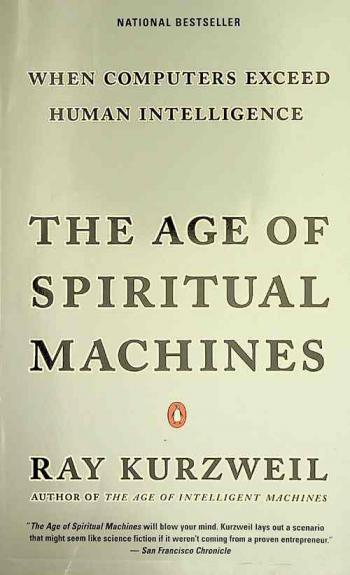
The age of spiritual machines : when computers exceed human intelligence
Imagine a world where the difference between man and machine blurs, where the line between humanity and technology fades, and where the soul and the silicon chip unite. This is not science fiction. This is the twenty-first century according to Ray Kurzweil, the inventor of the most innovative and compelling technology of our era. In his inspired hands, life in the new millennium no longer seems daunting. Instead, it promises to be an age in which the marriage of human sensitivity and artificial intelligence fundamentally alters and improves the way we live. More than just a list of predictions, Kurzweil's prophetic blueprint for the future guides us through the inexorable advances that will result in: computers exceeding the memory capacity and computational ability of the human brain by the year 2020 (with human-level capabilities not far behind); relationships with automated personalities who will be our teachers, companions, and lovers; and information fed straight into our brains along direct neural pathways. Eventually, the distinction between humans and computers will have become sufficiently blurred that when the machines claim to be conscious, we will believe them. - Back cover.
Book


The singularity is nearer : when we merge with Al
\"This successor volume to The Singularity Is Near explores how technology will refashion the human race in the decades to come. In this entirely new book, Ray Kurzweil brings a fresh perspective to advances in the singularity-assessing the progress of many of his predictions and examining the novel advancements that, in the near future, will bring a revolution in knowledge and an expansion of human potential. Among the topics he discusses are rebuilding the world atom by atom with devices like nanobots; radical life extension beyond the current age limit of 120; reinventing intelligence by expanding biological capacity with nonbiological intelligence in the cloud; how life is improving with declines in poverty and violence; and the growth of technologies that can be applied to everything from clothes to building materials to growing human organs. He also considers the potential perils of biotechnology, nanotechnology, and artificial intelligence, including such topics as how AI will impact unemployment and the safety of autonomous cars, and \"After Life\" technology, which will reanimate people who have passed away through a combination of data and DNA\"-- Provided by publisher.
Book
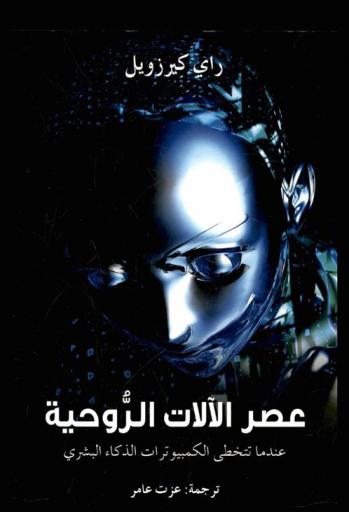
عصر الآلات الروحية : عندما تتخطى الكمبيوترات الذكاء البشري
كتاب كيرزويل ليس مجموعة من النبوءات المجردة فهذا المخطط التنبؤي للمستقبل يطوف بنا في جولة يستعرض فيها التطورات المتعاقبة التي ستنتهي إلى تفوق الكمبيوترات بحلول عام ٢٠٢٠ على العقل البشري من حيث سعة الذاكرة والقدرات الحسابية (لكن الهوة لن تكون واسعة) وإنشاء علاقات مع شخصيات آلية سيكون منها معلمونا ورفاقنا وأحباؤنا واستخدام وسائل عصبية لتغذية عقولنا بالمعلومات مباشرة وفي النهاية سيتضاءل الفارق كثيرا بين البشر والكمبيوترات حتى إننا سنصدق الآلات عندما تدعي أن لها وعيا.
Book

Superintelligence and Singularity
Singularity is a future period during which the pace of technological change will be so rapid, its impact so deep, that human life will be irreversibly transformed. This chapter argues that within several decades information‐ based technologies will encompass all human knowledge and proficiency, ultimately including the pattern‐recognition powers, problem‐solving skills, and emotional and moral intelligence of the human brain itself. The Singularity will allow us to transcend these limitations of our biological bodies and brains. Most long‐range forecasts of what is technically feasible in future time periods dramatically underestimate the power of future developments because they are based on the “intuitive linear” view of history rather than the “historical exponential” view. The history of evolution ‐ both biological and technological ‐ is conceptualized as occurring in six epochs. The Singularity begins with Epoch Five and will spread from Earth to the rest of the universe in Epoch Six.
Book Chapter
Who Am I? What Am I?
“Who am I?” is the ultimate ontological question, and we often refer to it as the issue of consciousness. When people speak of consciousness they often slip into considerations of behavioral and neurological correlates of consciousness (for example, whether or not an entity can be self‐reflective). But these are third‐person (objective) issues and do not represent what David Chalmers calls the “hard question” of consciousness. The question of whether or not an entity is conscious is apparent only to itself. The difference between neurological correlates of consciousness (such as intelligent behavior) and the ontological reality of consciousness is the difference between objective and subjective reality. That is why we cannot propose an objective consciousness detector without philosophical assumptions built into it.
Book Chapter

Progress and Relinquishment
Technology has always been a double‐edged sword, bringing us longer and healthier lifespans, freedom from physical and mental drudgery, and many new creative possibilities, on the one hand, while introducing new and salient dangers on the other. Technology empowers both our creative and destructive natures.
Book Chapter