
Catalogue Search | MBRL


Are you sure you want to remove the book from the shelf?

{{itemTitle}}
42
result(s) for
"Kyriakoudes, Louis M"
Sort by:


The tobacco industry's deadly distortions of history
In the 1950s and 1960s the Tobacco Institute sponsored histories that celebrated the rise of the cigarette in American life. 2 In the 1980s, Philip Morris underwrote the costs of the national bicentennial tour of one of the original parchment copies of the Bill of Rights, drawing directly the connections between American's core political freedoms and the 'freedom' to smoke cigarettes. 3 And as Callard's study shows, the industry still employs historians to whitewash the history of the tobacco industry in the courtroom.
Journal Article
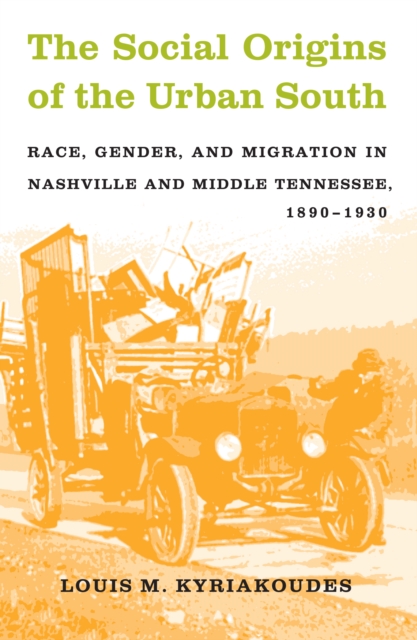
The social origins of the urban South : race, gender, and migration in Nashville and middle Tennessee, 1890-1930
In the late nineteenth and early twentieth centuries, millions of black and white southerners left farms and rural towns to try their fate in the regions cities. This transition brought about significant economic, social, and cultural changes in both urban centers and the countryside. Focusing on Nashville and its Middle Tennessee hinterland, Louis Kyriakoudes explores the impetus for this migration and illuminates its effects on regional development. Kyriakoudes argues that increased rural-to-urban migration in the late nineteenth century grew out of older seasonal and circular migration patterns long employed by southern farm families. These mobility patterns grew more urban-oriented and more permanent as rural blacks and whites turned increasingly to urban migration in order to cope with rapid economic and social change. The urban economy was particularly welcoming to women, offering freedom from the male authority that dominated rural life. African Americans did not find the same freedoms, however, as whites found ways to harness the forces of modernization to deny them access to economic and social opportunity. By linking urbanization, economic and social change, and popular cultural institutions, Kyriakoudes lends insight into the development of an urban, white, working-class identity that reinforced racial divisions and laid the demographic and social foundations for todays modern, urban South.
eBook

Southern society and its transformations, 1790-1860
In Southern Society and Its Transformations, a new set of scholars challenge conventional perceptions of the antebellum South as an economically static region compared to the North. Showing that the pre-Civil War South was much more complex than once thought, the essays in this volume examine the economic lives and social realities of three overlooked but important groups of southerners: the working poor, non-slaveholding whites, and middling property holders such as small planters, professionals, and entrepreneurs. The nine essays that comprise Southern Society and Its Transformations explore new territory in the study of the slave-era South, conveying how modernization took shape across the region and exploring the social processes involved in its economic developments. The book is divided into four parts, each analyzing a different facet of white southern life. The first outlines the legal dimensions of race relations, exploring the effects of lynching and the significance of Georgia's vagrancy laws. Part II presents the advent of the market economy and its effect on agriculture in the South, including the beginning of frontier capitalism. The third section details the rise of a professional middle class in the slave era and the conflicts provoked. The book's last section deals with the financial aspects of the transformation in the South, including the credit and debt relationships at play and the presence of corporate entrepreneurship. Between the dawn of the nation and the Civil War, constant change was afoot in the American South. Scholarship has only begun to explore these progressions in the past few decades and has given too little consideration to the economic developments with respect to the working-class experience. These essays show that a new generation of scholars is asking fresh questions about the social aspects of the South's economic transformation. Southern Society and Its Transformations is a complex look at how whole groups of traditionally ignored white southerners in the slave era embraced modernizing economic ideas and actions while accepting a place in their race-based world. This volume will be of interest to students of Southern and U.S. economic and social history.
eBook
Historians’ testimony on “common knowledge” of the risks of tobacco use: a review and analysis of experts testifying on behalf of cigarette manufacturers in civil litigation
A qualitative analysis of the trial and deposition testimony of professional historians who have testified on behalf of the tobacco industry shows that defence historians present a view of past knowledge about tobacco in which the public was frequently warned that cigarettes were both deadly and addictive over the broad historical period. While defence historians testify to conducting significant levels of independent research, they also draw upon a common body of research conducted by industry counsel to support its litigation efforts. Defence historians unduly limit their research materials, ignoring industry records and, therefore, critically undermine their ability to evaluate industry activity in the smoking and health controversy as it unfolded in historical time. A consequence is that defence historians present a skewed history of the cigarette in which the tobacco industry all but ceases to exist.
Journal Article

The Grand Ole Opry and Big Tobacco
Kyriakoudes recounts the Grand Ole Opry, a thirty-minute radio program sponsored by R. J. Reynolds Tobacco Co (RJR) since 1938 to promote Prince Albert Smoking Tobacco, and its Cavalier and Camel cigarette brands. Sponsoring the Opry broadcasts allowed RJR to identify its smoking tobacco and cigarettes with the authenticity of country music. The company was quick to let the public know that smoking felt good and that the smoke was mild, among other things.
Journal Article
Selling Which South?
Although most people do not realize it, it has been a long time now since agriculture dominated rural areas in the developed world. Most do know that farmers today constitute but a tiny proportion of the U.S. labor force-about 1.55 percent in 2005 -yet few have bothered to ask just what rural folks are doing for a living.1 While the public at large appears to have missed the decoupling of \"rural\" from \"agriculture,\" this development has shaken several academic disciplines to the core.
Journal Article

Lower-Order Urbanization and Territorial Monopoly in the Southern Furnishing Trade: Alabama, 1871-1890
Sometime during World War I,Ned Cobb, an African American sharecropper better known to us by his pseudonym Nate Shaw, journeyed from the Tallapoosa County, Alabama, farm where he was sharecropping to Opelika, a small market town about 12 miles away, to buy cotton seed hulls for his mules,meal for his family, and shoes for his children. At Mr. Sadler’s general store, Cobb had a chilling encounter with one Henry Chase, a crippled white store clerk. Chase, resentful that Cobb had been served by one of the store's white female clerks, tried to provoke a fight with Cobb and then accused Cobb of threatening him with a pistol. Cobb wisely refused to be goaded, but he was arrested anyway when Chase brought his complaint to the sheriff. Cobb only escaped trouble with the law and more trouble with Chase and his gang because of the intercession of influential white merchants who knew Cobb from earlier business in town (Rosengarten 1974: 162–72).
Journal Article
Lower-Order Urbanization and Territorial Monopoly in the Southern Furnishing Trade
Sometime during World War I,Ned Cobb, an African American sharecropper better known to us by his pseudonym Nate Shaw, journeyed from the Tallapoosa County, Alabama, farm where he was sharecropping to Opelika, a small market town about 12 miles away, to buy cotton seed hulls for his mules,meal for his family, and shoes for his children. At Mr. Sadler’s general store, Cobb had a chilling encounter with one Henry Chase, a crippled white store clerk. Chase, resentful that Cobb had been served by one of the store's white female clerks, tried to provoke a fight with Cobb and then accused Cobb of threatening him with a pistol. Cobb wisely refused to be goaded, but he was arrested anyway when Chase brought his complaint to the sheriff. Cobb only escaped trouble with the law and more trouble with Chase and his gang because of the intercession of influential white merchants who knew Cobb from earlier business in town (Rosengarten 1974: 162–72).
Journal Article