
Catalogue Search | MBRL


Are you sure you want to remove the book from the shelf?

{{itemTitle}}
58
result(s) for
"LUCARINI, CARLO M."
Sort by:

TRE NOTE ALLO PS.-SCILACE
The aim of this paper is to shed new light on three passages of Ps.-Scylax’s Periplus: at 99.13, the words τῆς Κνίδου (that we read on the margin of the Paris. Suppl. Gr. 443) should be not included in the text (as Shipley does); at 26.1, the sentence καὶ Αἴας ποταµὸς ... παραρρεῖ should be retained; at 110.10 read ἐστιν ἰσθµὸς σταδίων ρπ´ (i.e. 180 stadia wide).
Journal Article

L’ἐκκύκλημα nel teatro greco dell’età classica
The aim of this paper is to demonstrate that the tragic poets of the fifth century BC used an engine called ekkyklema in order to reveal the scenes supposed to take place inside. I think I can indicate a passage, that clearly demonstrates the use of such an engine (Eur. Her. 1028 ff.), since the chorus’ words are otherwise unintellegibile. Comic poets used this engine only for paratragic purpose, because the distinction inside/outside was not relevant for comedy.
Journal Article
La tradizione manoscritta del centone di Proba
The manuscript tradition of Proba’s \"Cento\" was investigated by K. SCHENKL, whose edition (CSEL 1888) remains the basis of every further inquiry. He knew some 25 manuscripts, only eleven of which are reported in his apparatus. Going through catalogues I have discovered about 40 new manuscripts, most of which belong to the humanistic age. After listing all the manuscripts, I try to establish their relationships. Although I consider restricted evidence (I have collated systematically about 100 verses), some facts seem to be plain. The humanistic tradition originates from three old manuscripts (Cantabrig. Sanctae Trinitatis O.7.7; Parisinus Lat. 13048; Vaticanus Pal. Lat. 1753), while another very important old manuscript (Parisinus Lat. 7701) has no progeny. I try to place all the manuscripts in a stemma.
Journal Article

Textkritisches zu Herodian
Für sieben Stellen des Historikers Herodian (2.–3. Jh. n. Chr.) wird eine neue Textfassung vorgelegt.
Journal Article
Zu Pomponius Mela 3,101
The aim of this paper is to show that the transmitted text in Pomp. Mel. 3,101 should be emended in Atlas, de eis consurgens (Atlas, ex eis, resp.).
Journal Article

Note ai Florida e all’ Apologia di Apuleio
The aim of this paper is to cast new light on the textual constitution of some passages of Apuleius. For ca. 15 passages of Florida as well as for 5 passages of Apologia a new textual solution is proposed.
Journal Article
Per il testo, il ritmo e lo iato dell’Epistola di Aristea a Filocrate
The aim of the first part of this paper is to cast new light on the textual constitution of some passages of the Epistula Aristeae ad Philocratem. Ca. 20 pieces are discussed and for most of them a new solution is proposed; in the other cases I argue for a solution already proposed, but not accepted by the editors. The aim of the second part is to establish whether the ps.-Aristeas used rhythmical prose or not, and whether he avoided the hiatus. The analysis shows that he wrote rhythmical prose and avoided the hiatus.
Journal Article
Note ai Florida e all’Apologia di Apuleio
The aim of this paper is to cast new light on the textual constitution of some passages of Apuleius. For ca. 15 passages of Florida as well as for 5 passages of Apologia a new textual solution is proposed.
Journal Article
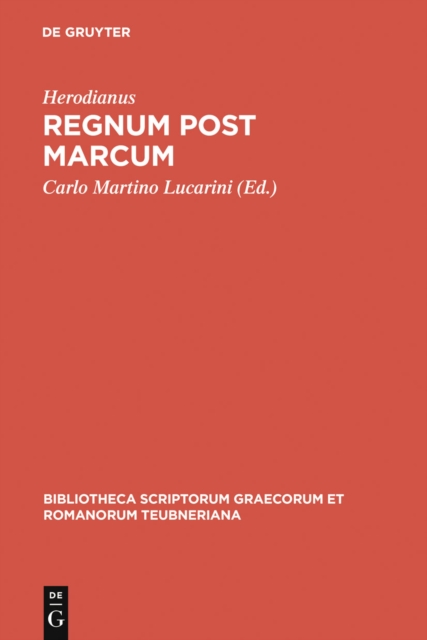
Regnum Post Marcum
The Bibliotheca Teubneriana, established in 1849, has evolved into the world's most venerable and extensive series of editions of Greek and Latin literature, ranging from classical to Neo-Latin texts. Some 4-5 new editions are published every year.
eBook