
Catalogue Search | MBRL


Are you sure you want to remove the book from the shelf?

{{itemTitle}}
150
result(s) for
"Labanyi, Jo"
Sort by:


Engaging the Emotions in Spanish Culture and History
Rather than being properties of the individual self, emotions are socially produced and deployed in specific cultural contexts, as this collection documents with unusual richness. All the essays show emotions to be a form of thought and knowledge, and a major component of social life-including in the nineteenth century, which attempted to relegate them to a feminine intimate sphere. The collection ranges across topics such as eighteenth-century sensibility, nineteenth-century concerns with the transmission of emotions, early twentieth-century cinematic affect, and the contemporary mobilization of political emotions including those regarding nonstate national identities. The complexities and effects of emotions are explored in a variety of forms-political rhetoric, literature, personal letters, medical writing, cinema, graphic art, soap opera, journalism, popular music, digital media-with attention paid to broader European and transatlantic implications.
eBook


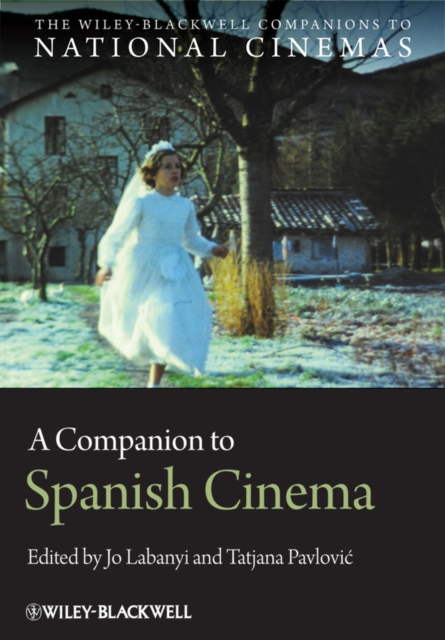
A companion to Spanish cinema
A Companion to Spanish Cinema is a bold collection of newly commissioned essays written by top international scholars that thoroughly interrogates Spanish cinema from a variety of thematic, theoretical and historic perspectives. Presents an insightful and provocative collection of newly commissioned essays and original research by top international scholars from a variety of theoretical, disciplinary and geographical perspectives Offers a systematic historical, thematic, and theoretical approach to Spanish cinema, unique in the field Combines a thorough and insightful study of a wide spectrum of topics and issues with in-depth textual analysis of specific films Explores Spanish cinema's cultural, artistic, industrial, theoretical and commercial contexts pre- and post-1975 and the notion of a \"national\" cinema Canonical directors and stars are examined alongside understudied directors, screenwriters, editors, and secondary actors Presents original research on image and sound; genre; non-fiction film; institutions, audiences and industry; and relations to other media, as well as a theoretically-driven section designed to stimulate innovative research
eBook

AFECTIVIDAD Y AUTORÍA FEMENINA. LA CONSTRUCCIÓN ESTRATÉGICA DE LA SUBJETIVIDAD EN LAS ESCRITORAS DEL SIGLO XIX
Abstract The article aims to trace the complex emotional evolution of female subjectivity over the course of the nineteenth century, through analysis of the successive generations of women writers who emerged from the 1840s on. Dav idoff, Leonore y Hall, Catherine: Family Fortunes: Men and Women of the English Middle Class 1780-1850. Véase Pau lk, Julia C.: «Nothing to Hide: Sab as an Anti-Slavery and Feminist Novel», en Albin, María C., Corbin, Megan & Marrero, Raúl (eds.), Gender and the Politics of Literature: Gertrudis Gómez de Avellaneda. Davidoff, Leonore y Catherine Hall, Family Fortunes: Men and Women of the English Middle Class 1780-1850.
Journal Article


Historias de víctimas: la memoria histórica y el testimonio en la España contemporánea
En los últimos tres años se ha producido un fenómeno en España, la reivindicación de parte de la derecha del protagonismo del sufrimiento en la Guerra Civil. Este ensayo se centrará en el análisis de algunos de los libros de testimonios, tanto nacionales como republicanos, que se han publicado en España desde el año 2000. Para evitar malentendidos, debo aclarar que no pretendo sugerir que habría sido mejor no publicar información sobre lo sufrido por las víctimas de la Guerra Civil y la represión posterior –todo lo contrario, puesto que existe el deber de transmitir a las generaciones futuras el conocimiento de atrocidades que, en el caso de las cometidas en la zona nacional y bajo el franquismo, fueron silenciadas durante casi cuarenta años de dictadura–. Sólo de esta manera se puede librar a las víctimas de la humillación y vergüenza sufridas durante tantas décadas. Lo que quisiera señalar son las consecuencias negativas que pueden resultar de la insistencia exclusiva en las víctimas y de la idea de que existe una equivalencia entre lo sufrido por los dos bandos, lo cual permite comparar la cantidad de sufrimiento de los unos y de los otros.
Journal Article

Testimonies of Repression
The number of historical studies on the Civil War and dictatorship published in Spain since General Franco’s death in 1975 is now massive; these have been published throughout the postdictatorship period. The mid-1980s additionally saw the emergence of a number of novels and feature films on the war (Labanyi, “Memory”), followed in the mid-1990s by a flurry of early Francoist memorabilia and related reminiscences (Harvey). It was only in the late 1990s, however, that historical studies, novels, and documentary and feature films started to focus overwhelmingly on the wartime and postwar Francoist repression.¹ A key text was Santos Juliá’s 1999
Book Chapter