
Catalogue Search | MBRL


Are you sure you want to remove the book from the shelf?

{{itemTitle}}
191
result(s) for
"Labov, William"
Sort by:


Transmission and Diffusion
The transmission of linguistic change within a speech community is characterized by incrementation within a faithfully reproduced pattern characteristic of the family tree model, while diffusion across communities shows weakening of the original pattern and a loss of structural features. It is proposed that this is the result of the difference between the learning abilities of children and adults. Evidence is drawn from two studies of geographic diffusion. (i) Structural constraints are lost in the diffusion of the New York City pattern of tensing short-α to four other communities: northern New Jersey, Albany, Cincinnati, and New Orleans, (ii) The spread of the Northern Cities Shift from Chicago to St. Louis is found to represent the borrowing of individual sound changes, rather than the diffusion of the structural pattern as a whole.
Journal Article
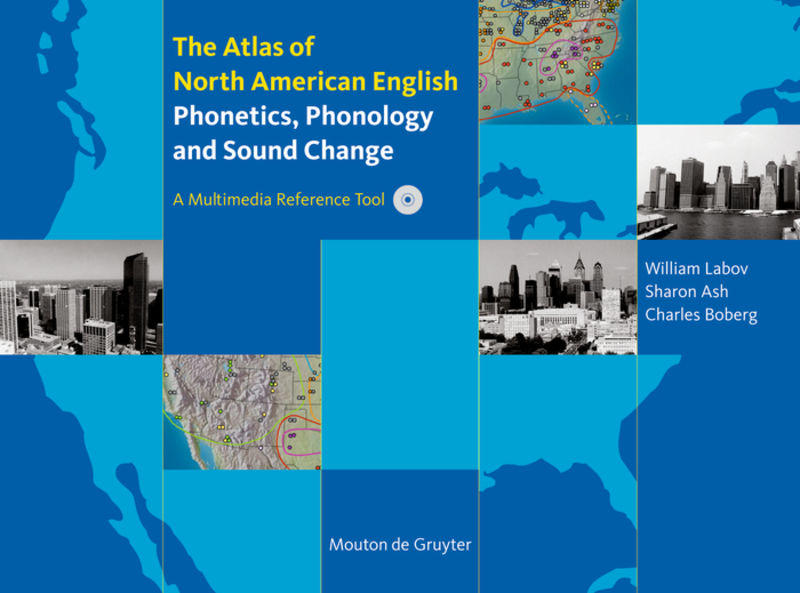
The Atlas of North American English
The Atlas of North American English provides the first overall view of the pronunciation and vowel systems of the dialects of the U.S. and Canada. The Atlas re-defines the regional dialects of American English on the basis of sound changes active in the 1990s and draws new boundaries reflecting those changes. It is based on a telephone survey of 762 local speakers, representing all the urbanized areas of North America. It has been developed by Bill Labov, one of the leading sociolinguists of the world, together with his colleagues Sharon Ash and Charles Boberg. The Atlas consists of a printed volume accompanied by an interactive CD-ROM. The print and multimedia content is also available online. Combined Edition: Book and Multimedia CD-ROM The book contains * 23 chapters that re-define the geographic boundaries of North American dialects and trace the influence of gender, age, education, and city size on the progress of sound change; * findings that show a dramatic and increasing divergence of English in North America; * 139 four color maps that illustrate the regional distribution of phonological and phonetic variables across the North American continent; * 120 four color vowel charts of individual speakers. The multimedia CD-ROM supplements the articles and maps by providing * a data base with measurements of more than 100,000 vowels and mean values for 439 speakers; * the Plotnik program for mapping each of the individual vowel systems; * extended sound samples of all North American dialects; * multimedia applications to enhance classroom presentations. Online Version: Book and CD-ROM content plus additional data The online version comprises the contents of the book and the multimedia CD-ROM along with additional data. It * presents a wider selection of data, maps, and audio samples that will be recurrently updated; * proffers simultaneous access to the information contained in the book and on the multimedia CD-ROM to all users in the university/library network; * provides students with easy access to research material for classroom assignments. For more information, please contact Mouton de Gruyter: customerservice@degruyter.com [customerservice@degruyter.com] System Requirements for CD-ROM and Online Version Windows PC: Pentium PC, Windows 9x, NT, or XP, at least 16MB RAM, CD-ROM Drive, 16 Bit Soundcard, SVGA (600 x 800 resolution) Apple MAC: OS 6 or higher, 16 Bit Soundcard, at least 16MB RAM Supported Browsers: Internet Explorer, 5.5 or 6 (Mac OS: Internet Explorer 5.1)/Netscape 7.x or higher/Mozilla 1.0 or higher/Mozilla Firefox 1.0 or higher PlugIns: Macromedia Flash Player 6/Acrobat Reader
eBook
The regularity of regular sound change
The regularity of sound change as set out by the scholars of the late nineteenth century is a fundamental principle of historical linguistics. The principle as recognized by the Neogrammarian linguists states that once a sound change has begun, it affects every word in the vocabulary that contains the sound in question. The principle has been disputed by many linguists and especially dialectologists, who argue that ‘every word has its own history’. This article demonstrates how the Neogrammarian principle operates in one prototypical change in progress, the raising of the mid front long vowel /ey/ before a consonant in Philadelphia English. Mixed-level regression analysis shows consistent phonetic constraints across the nineteenth century, with no effect of word frequency. The regularity of sound change is reflected in the common pattern of behavior of the most frequent words, those of moderate frequency, and words that occur only once in the corpus.
Journal Article


Narratives of Uncontrollable Grief
This paper deals with narratives that report events of great personal concern to the narrator, especially the unexpected death of a near member of the family. It is common for the expression of such uncontrollable grief to involve silence, or the assertion that language is not adequate to convey what needs to be said. This retreat from linguistic engagement is a challenge to the general adequacy of human language as a means of communication. When we examine several such narratives in detail, we find reports of physical violence in place of linguistic expression. But we also find the development of elaborate syntax as a means of keeping emotional expression at a distance.
Journal Article
The role of the Avant Garde in linguistic diffusion
The spread of the new quotative be like throughout the English-speaking world is a change from above for each community that receives it. Diffusion of this form into Philadelphia is traced through the yearly interviews of the Philadelphia Neighborhood Corpus, beginning with young adults in 1979 and spreading to adolescents in 1990, a generation later. The first users of be like form the Avant Garde, young adults with extensive awareness of linguistic patterns within and without the city. The use of this quotative in Philadelphia is favored by constraints that are found elsewhere, particularly to introduce inner speech that is not intended to be heard by others and to cite exemplars of a range of utterances. Not previously reported is a strong tendency to be favored for quotations with initial exclamations, prototypically expressions of surprise and alarm such as “Oh” and “Oh my god!”.
Journal Article
ONE HUNDRED YEARS OF SOUND CHANGE IN PHILADELPHIA: LINEAR INCREMENTATION, REVERSAL, AND REANALYSIS
The study of sound change in progress in Philadelphia has been facilitated by the application of forced alignment and automatic vowel measurement to a large corpus of neighborhood studies, including 379 speakers with dates of birth from 1888 to 1991. Two of the sound changes active in the 1970s show a linear pattern of incrementation in succeeding decades. The fronting of back upgliding vowels /aw/ and /ow/ shows a reversal in the direction of change, beginning with those born after 1940. The study also finds a general withdrawal from two salient features of local phonology, tense /æh/ and /oh/, led by those with higher education. Younger speakers with higher education have also reorganized the traditional Philadelphia tense/lax split of short-a to form a nasal system with tensing before all and only nasal consonants. The development of the Philadelphia vowel system can be understood in the geographic context of neighboring dialects. Features in common with North and North Midland dialects have accelerated in use while features in common with South Midland and Southern dialects have been reversed in favor of Northern patterns. The microevolution of a linguistic system can be seen here as subject to phonological generalizations but driven by social evaluation as features rise in level of salience for members of the speech community.*
Journal Article

A materialist response
I am grateful to the editor of Language in Society for the opportunity to respond to the criticism directed at 'The logic of nonstandard English' (LNE; Labov 1972) and 'Objectivity and commitment in linguistic science' (OCLS; Labov 1982). The author of the critique has already given me ample room to be heard, quoting at length from papers that have been read by many. Yet a discussion of the issues raised by Lewis can only do good by bringing more people into the effort to raise reading levels in inner city schools. Though the author is critical of efforts in this direction, I have no doubt that he will welcome the recent developments that I report on here.
Journal Article