
Catalogue Search | MBRL


Are you sure you want to remove the book from the shelf?

{{itemTitle}}
50
result(s) for
"Lachmann, Renate"
Sort by:
Dmitrij Tschižewskij’s Reading of Jan Amos Komenský’s Labyrint světa a ráj srdce
This paper deals with Dmitrij Tschižewskij’s interpretation of Jan Amos Komenský’s poetical work Labyrint světa a ráj srdce. In Dmitrij Tschižewskij’s articles dedicated to this masterpiece of Czech literature the analysis of its structure and the exploration of its moral-religious message are intertwined. The fact that the work is an outstanding example of Baroque literature is of prime interest and allows for an innovative approach to its devices. Dmitrij Tschižewskij detects a structural quality of the poem which he is the first to name ‘word chains’. In following the overwhelming quantity of this device he lays bare a unique verbal construction that consists of a multitude of word groups each of which belongs to a semantic field of its own. In order to capture the very essence of this procedure Dmitrij Tschižewskij makes use of notions which the rhetorical system offers. In pointing out the Baroque character of some rhetorical figures that Komenský adopts in his poem, Dmitrij Tschižewskij reveals the interplay between these figures and the ‘world view’ they convey — according to his twofold interpretive style.
Journal Article

Russia’s Iconoclasms
Two iconoclasms took place in twentieth-century Russian history: the iconoclasm after the October revolution, and the iconoclasm after the breakdown of the Soviet Union. These two (ideologically opposite) phases of iconoclastic actions (dismantling, destruction) were incited by programmes concerning the abolition of tsarist monuments of 1918 and met by controversial reactions to the removal of the statues of the former Soviet politicians in the 1990s. The revolutionary demolition of the symbols of the imperial past was executed in accordance with a clear-cut plan and included the erection of new monuments for outstanding communist activists. The official aim of the post-soviet removal of these monuments, to delete traces of a problematic past, was confronted with a revitalized communist ideology on the one hand and with the reaction of the Human Rights Organization Memorial on the other, which criticized the insufficient demolition of soviet symbols. This multifaceted situation is complicated by the reconstruction of destroyed pre-revolutionary monuments of Russian (predominantly religious) history.
Journal Article
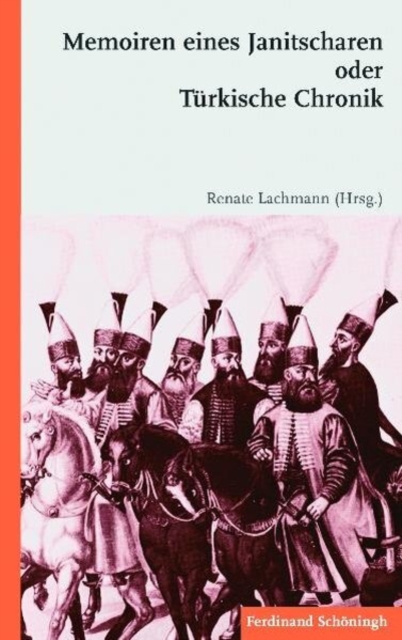
Memoiren Eines Janitscharen Oder Türkische Chronik
Ein Klassiker der Geschichte der osmanischen Eroberung des Balkans: Die 'Memoiren' des Kosovo-Serben Konstantin (*ca.1435), der in Anatolien zum Janitscharen erzogen wurde.Als Angehöriger dieser Elitetruppe nahm er an den Feldzügen Mehmeds II.teil, der die soziale und religiöse Ordnung des Balkans dauerhaft verändert hat.
eBook

Die Lehre der Affekte und ihre Rolle im Werk Dostoevskijs
The rhetorical doctrine of affects has not only developed a catalogue of emotions but has also described strategies to produce emotions and it has organized them into different stylistic types. Emotional symptoms are linked to rhetorical rules, aiming at the representation and production of passions. Rhetorical and poetic treatises have preserved the memories of these emotional techniques, and every period in history has its own ideas about exhibiting or suppressing emotional outbursts, highlighting either the Aristotelian or the Stoic tradition. Dostoevsky's work combines a modernized version of the rhetoric of affects with a psychosomatic discourse on hysteria and epilepsy. Hysteria appears in his novels as a special form of representation rather than as a psychic illness. Hysteria redefined as a stylistic means, combines illness with rhetoric in such a way that both refer to each other.
Journal Article
Cultural memory and the role of literature
The history of mnemonic concepts encompasses utopian and sceptical views that produce either a hypertrophic memory or denounce any representation as false. Each literary text incorporates or stores other texts, thus mnemonic space unfolds between and within texts. In storing and accumulating cultural data, the literary text in its intertextual dimension functions as part of cultural memory. A fantastic text points to a silenced repressed memory, confronting culture with its oblivion. Yet the fantastic in restoring the displaced and vanished parts of culture is not merely a mnemonic memory: its speculative potential strives for arbitrary creations that erase the accepted mnemonic imagery.
Journal Article

