
Catalogue Search | MBRL


Are you sure you want to remove the book from the shelf?

{{itemTitle}}
190
result(s) for
"Lackenbauer, P. Whitney"
Sort by:


The Joint Arctic Weather Stations
This is the first systematic account of the Joint Arctic Weather
Stations (JAWS), a collaborative science program between Canada and
the United States that created a distinctive state presence in the
Canadian Arctic Archipelago from 1946-1972. These five
meteorological stations, constructed at Eureka, Resolute, Isachsen,
Mould Bay, and Alert, became remote hubs for science and
sovereignty, revealing the possibilities and limits of modernity in
the High Arctic.
Drawing on extensive archival evidence, unpublished personal
memoirs, and interviews with former JAWS personnel, this book
systematically analyzes the diplomatic, scientific, social,
environmental, and civil-military dimensions of this binational
program. From the corridors of power in Washington and Ottawa to
everyday life at the small outposts, The Joint Arctic Weather
Stations explores delicate statecraft, changing scientific
practices, as well as the distinctive station cultures that emerged
as humans coped with isolation in polar environments.
eBook
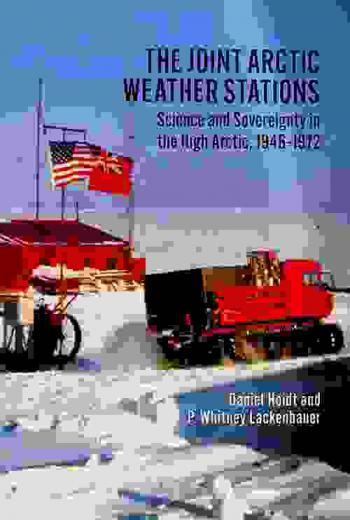
The joint Arctic weather stations : science and sovereignty in the high Arctic, 1946-1972
\"The first comprehensive study of the Canada-U.S. Joint Arctic Weather Stations, systematically analyzing large- and small-scale aspects from scientific diplomacy to site logistics to understand how these isolated posts were so successful. The Joint Arctic Weather Stations were five meteorological and scientific monitoring stations constructed at Resolute, Eureka, Mould Bay, Isachsen, and Alert with the cooperation of the Canadian Department of Transport's meteorological branch and the United States Weather Bureau. From 1947 to the early 1970s as few as four Canadians and four Americans worked and lived at each of the four satellite stations, observing and collecting scientific data. This is the first systematic account of the Joint Arctic Weather Stations, a project that profoundly shaped state activates and scientific inquiry in the Arctic Archipelago. Drawing on extensive archival evidence, unpublished personal memoirs, and interviews with former employees, The Joint Arctic Weather Stations analyzes the diplomatic, scientific, social, military, and environmental dimensions of the program alongside each station as a nexus of state planning and personal agency. Contrary to previous scholarship, The Joint Arctic Weather Stations reveals that Canadian officials sought--and achieved--a firm policy that afforded effective control of Canada's Arctic while enjoying the advantages of American contribution to the joint meteorological program. It explores the changing ways science was conducted over time and how the details of everyday life at remote stations, from the climate to leisure activities to debates over alcohol, hunting, and leadership, shaped the program's effectiveness. An exploration of the full duration of the Joint Arctic Weather Stations from high-level planning and diplomacy to personal interactions in the stations makes this book an essential exploration of collaborative polar science in the North American Arctic.\"-- Provided by publisher.

Two Years below the Horn
In Two Years Below the Horn, engineer Andrew Taylor vividly recounts his experiences and accomplishments during Operation Tabarin, a landmark British expedition to Antarctica to establish sovereignty and conduct science during the Second World War. When mental strain led the operation's first commander to resign, Taylor- a military engineer with extensive prewar surveying experience-became the first and only Canadian to lead an Antarctic expedition. As Commander of the operation, Taylor oversaw construction of the first permanent base on the Antarctic continent at Hope Bay. From there, he led four-man teams on two epic sledging journeys around James Ross Island, overcoming arduous conditions and correcting cartographic mistakes made by previous explorers. The editors' detailed afterword draws on Taylor's extensive personal papers to highlight Taylor's achievements and document his significant contributions to polar science.This book will appeal to readers interested in history of polar exploration, science and sovereignty. It also sheds light on the little-known contribution of a Canadian to a distant theatre of the Second World War. The wartime service of Major Taylor reveals important new details about a groundbreaking operation that laid the foundation for the British Antarctic Survey and marked a critical moment in the transition from the heroic to the modern scientific era in polar exploration.
eBook


Northern and Arctic Security and Sovereignty: Challenges and Opportunities for a Northern Corridor
Key Messages Key issues related to Canada’s security and defence agenda, which involve critical and essential infrastructure development, must be considered in the development and implementation of a Canadian Northern Corridor (CNC). Canada’s northern and Arctic security and defence agenda is related to several key policy domains that are relevant from a CNC perspective. These include infrastructure development, climate change, Indigenous sovereignty and natural resource development. A CNC will gain international attention and be internationally recognized as a strategy for Canada to assert its sovereignty over its Arctic territory, including the internationally disputed Northwest Passage. The CNC advocates for the inclusion and participation of Indigenous communities. Thus, Indigenous Peoples will also carry a significant role in the monitoring and surveillance of accessibility within and to the North, improved through enhanced infrastructure development. Canada’s investments in Arctic defence infrastructure are modest comparedto those of its Russian and American neighbours. A CNC, potentially adding strategically important infrastructure in the Canadian North, will directly tie into the discourse of Arctic security and power relations. In addition to natural disasters, the Canadian North is at significant risk of human-made disasters that pose serious prospective challenges for northerners and for federal and territorial governments. The CNC will likely foster the development of surveillance and monitoring assets. The CNC rights-of-way could trigger security concerns regarding the impactof foreign investment as a security threat, especially if natural resource development is coupled with the development of strategic transportation hubs, such as ports along the coast of the Arctic Ocean. CNC transportation infrastructure would also become a part of Canada’s defence strategy as it forms a potential key asset in the defence and safeguarding of Canada’s northern and Arctic regions. Future research should identify the role of dual-use infrastructure (infrastructure that satisfies both military and civilian purposes) in the CNC context and also examine to what extent security and defence stakeholders should be involved in the CNC’s planning and implementation.
Journal Article

The Cold War on Canadian Soil: Militarizing a Northern Environment
Given the low standard of contact between environmental and military historians, it is unsurprising, if regrettable, that the relationship between military activity and natural landscapes in Canada has received minimal scholarly attention. This paper seeks to open space for such an environmental history of militarism and militarization. Focusing on the Cold War and its aftermath, the essay documents the history of military activity on Canadian soil, with an emphasis on the North, specifically examining a set of crucial projects and operations that redefined not only physical terrain but associated imaginative understandings of nature. The history of Cold War Canada is littered with suitable examples, from early military exercises and the construction of the Distant Early Warning (DEW) radar line to more recent missile tests and low-level training flights. While it is crucial that these are understood in environmental terms, a genealogy of military activity in the Canadian North reveals changing and at times contrasting approaches to the military-environment relationship. Equally, however, as northern nature was viewed through a series of shifting strategic perspectives, it remained a target of state-driven modernization linked consistently to military objectives.
Journal Article

China's Arctic Ambitions and What They Mean for Canada
China’s Arctic Ambitions and What They Mean for Canada is one of the first in-depth studies of China’s increasing interest in the Arctic. It offers a holistic approach to understanding Chinese motivations and the potential impacts of greater Chinese presence in the circumpolar region, exploring resource development, shipping, scientific research, governance, and security. Drawing on extensive research in Chinese government documentation, business and media reports, and current academic literature, this timely volume eschews the traditional assumption that Chinese actions are unified and monolithic in their approach to Arctic affairs. Instead, it offers a careful analysis of the different, and often competing, interests and priorities of Chinese government and industry. Analyzing Chinese interests and activities from a Canadian perspective, the book provides an unparalleled point of reference to discuss the implications for the Canadian and broader circumpolar North.
eBook

Tolerant allies
From 1947–1972, the Joint Arctic Weather Stations (JAWS) program transformed Canada’s High Arctic. This article focuses on Canada’s aspirations to “Canadianize” the joint program from the late 1940s to the late 1960s. Both Canada and the United States questioned the extent and form of American involvement in the JAWS program intermittently over 25 years of joint operations. Was Canadianization of these remote weather stations necessary or practical? This article concludes that, in retrospect, the conventional, dominant narrative that emphasizes the ongoing American threat to Canada’s Arctic sovereignty seems misplaced with respect to the JAWS story.
Journal Article

China's Arctic ambitions and what they mean for Canada
Canada is the one of the first in-depth studies of China's increasing interest in the Arctic. It offers a holistic approach to understanding Chinese motivations and the potential impacts of greater Chinese presence in the circumpolar region, exploring resource development, shipping, scientific research, governance, and security. Drawing on extensive research in Chinese government documentation, business and media reports, and current academic literature, this timely volume eschews the common assumption that China poses an acute threat to Arctic states' polar interests. Instead, it offers a nuanced assessment of how different Chinese stakeholders approach the region and how carefully managed relationships can contribute to positive circumpolar development. Analyzing Chinese interests and activities from a Canadian perspective, the book provides an unparalleled point of reference to discuss the implications for the Canadian and broader circumpolar North.
Book