
Catalogue Search | MBRL


Are you sure you want to remove the book from the shelf?

{{itemTitle}}
64
result(s) for
"Laird, Sam"
Sort by:

The International Trade Centre
In the era of rapid globalization, the ITC plays a significant and wide ranging role working with both governments and trade support institutions to nurture an export culture, this work will provide a much needed overview of this dynamic organization.
This book:
Details the history of the organization since its inception
Examines its current mandate and the impact of recent reforms
Analyses the ability of the ITC to provide trade intelligence, and its role in the development of national export strategies
Evaluates the future challenges, and emphasises that the ITC must continue to broaden its mandate and continue to be responsive and results orientated to remain a key player
The status of ITC - half-in and half-out of the UN - could prove to be an interesting model for the future, and this work will be of interest to not only to academics but also government trade specialists and negotiators, the \"aid for trade\" donors, NGOs, and those involved in the running of international organizations.
eBook
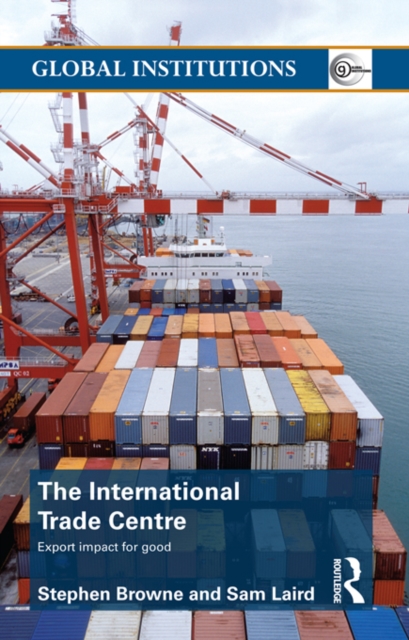
The international trade centre: promoting an export culture
In the era of rapid globalization, the ITC plays a significant and wide ranging role working with both governments and trade support institutions to nurture an export culture, this work will provide a much needed overview of this dynamic organization. This book: Details the history of the organization since its inception Examines its current mandate and the impact of recent reforms Analyses the ability of the ITC to provide trade intelligence, and its role in the development of national export strategies Evaluates the future challenges, and emphasises that the ITC must continue to broaden its mandate and continue to be responsive and results orientated to remain a key player The status of ITC - half-in and half-out of the UN - could prove to be an interesting model for the future, and this work will be of interest to not only to academics but also government trade specialists and negotiators, the \"aid for trade\" donors, NGOs, and those involved in the running of international organizations.
eBook


Trade Intelligence
Publications
Market analysis tools
Information dissemination
Online information services
Conclusion
The raison d
'
être-and defining public image-of ITC since its inception is as a provider of information on trade and trading conditions to trade support institutions and the private sector in the developing world. This chapter shows how ITC has carried out and developed this fundamental role, in particular in response to technological developments. The chapter also shows how the basic information on trade and trading conditions is supplemented with capacity-building in the use of such information for market development and negotiations. These activities help to level the playing field by reducing or eliminating asymmetries in the availability of information to countries that do not have easy access, if any, to information about market conditions, trade trends, product developments, and even trade negotiations (as discussed in Chapter 4). ITC's \"trade intelligence\"-now enshrined as one of its core functions, or \"business lines\"-constitutes a public good that can be utilized by a range of users with diverse interests in developing countries and transition economies.
Book Chapter
Origins and History
The trade information need
Foundation of ITC
A joint agency
The 1970s: a solid start
The 1980s: a period of consolidation
The 1990s: retrenchment and revival
Strategic export development
Post-2006 renewal
Aid for Trade
Conclusion
This chapter traces the origins of ITC which, even before its creation in 1964, were linked to attempts to redress the trade environment in favor of developing countries, especially in the face of adverse trends in the terms of trade. Like all international organizations it has traversed good and bad periods, and the chapter goes on to describe the highs and lows, right up to the most recent change management process.
Book Chapter
Facing the Future
ITC, UNCTAD, and the WTO
Looking ahead
Conclusion
ITC came into being in response to a clear technical need. If developing countries were to take advantage of expanding trade and overcome the chronic tendency for external deficits to widen, their enterprises needed access to trade information. Once ITC had provided the first clearing house, as a unique and timely public good, the developing countries-it was argued-would have knocked down an important obstacle to an expansion in exports.
Book Chapter
Enterprise Competitiveness
Exporter competitiveness and the value-chain
Connecting global markets and poor communities
Ethical fashion
Women as beneficiaries
Marketing through IT
Environment as a niche market
Standards and the fair trade movement
Scaling up: can niches contribute to development?
Facing up to global competition
Conclusion
The views of the UN system on the role of business in development have been through an interesting evolution. Most agencies began working exclusively with counterparts in the public sector and traditionally maintained a highly circumspect attitude to international business, whose activities were regarded as indifferent, or even predatorial, to the interests of development. The original rationale for the UN's Centre for Transnational Corporations in New York was founded on tracking and, if necessary, trying to mitigate the impacts of multinationals in developing countries, for example by providing legal support to developing countries engaged in negotiating foreign direct investment conditions.
1
Book Chapter