Search Results Heading

MBRLSearchResults

mbrl.module.common.modules.added.book.to.shelf
Title added to your shelf!
View what I already have on My Shelf.
Oops! Something went wrong.
While trying to add the title to your shelf something went wrong :( Kindly try again later!
Are you sure you want to remove the book from the shelf?
Oops! Something went wrong.
While trying to remove the title from your shelf something went wrong :( Kindly try again later!
    Done
    Filters
    Reset
  • Discipline
      Discipline
      Clear All
      Discipline
  • Is Peer Reviewed
      Is Peer Reviewed
      Clear All
      Is Peer Reviewed
  • Reading Level
      Reading Level
      Clear All
      Reading Level
  • Content Type
      Content Type
      Clear All
      Content Type
  • Year
      Year
      Clear All
      From:
      -
      To:
  • More Filters
      More Filters
      Clear All
      More Filters
      Item Type
    • Is Full-Text Available
    • Subject
    • Publisher
    • Source
    • Donor
    • Language
    • Place of Publication
    • Contributors
    • Location
40 result(s) for "Laird, Tracey E. W"
Sort by:
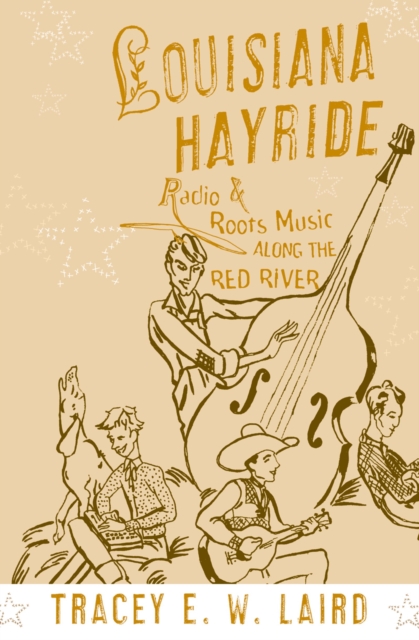
Louisiana Hayride
The Louisiana Hayride was broadcast from Shreveport, Louisiana, and reached listeners in over twenty-eight states, luring them to packed performances of the Hayride's road show. By tracing the dynamic history of the Hayride and its sponsoring station, the book reveals the critical role that this part of northwestern Louisiana played in the development of both country music and rock and roll. Sitting between the Old South and the West, this one-time frontier town provided an ideal setting for the cross-fertilization of musical styles. The scene was shaped by the region's easy mobility, the presence of a legal “red-light” district from 1903–17, and musical interchanges between blacks and whites who lived in close proximity and in nearly equal numbers. The region nurtured such varied talents as Huddie Ledbetter, the “king of the twelve-string guitar,” and Jimmie Davis, the two term “singing governor” of Louisiana who penned “You Are My Sunshine.” Against the backdrop of the colorful history of Shreveport, the unique contribution of this radio barn dance is revealed. Radio shaped musical tastes, and the Hayride' frontier-spirit producers took risks with artists whose reputations may have been shaky or whose styles did not neatly fit musical categories.
Country music USA
\"Starting with the music's folk roots in the rural South, [this book] traces country music from the early days of radio into the twenty-first century. In this fiftieth-anniversary edition, Malone, the featured historian in Ken Burns's 2019 documentary on country music, has revised every chapter to offer new information and fresh insights. Co-author Tracey Laird tracks developments in country music in the new millennium, exploring the relationship between the current music scene and the traditions from which it emerged\"--Back cover.
Shreveport Sounds in Black and White

To borrow words from Stan \"The Record Man\" Lewis, Shreveport, Louisiana, is one of this nation\\'s most important \"regional-sound cities.\" Its musical distinctiveness has been shaped by individuals and ensembles, record label and radio station owners, announcers and disc jockeys, club owners and sound engineers, music journalists and musicians. The area\\'s output cannot be described by a single genre or style. Rather, its music is a kaleidoscope of country, blues, R&B, rockabilly, and rock.

Shreveport Sounds in Black and White presents that evolution in a collection of scholarly and popular writing that covers institutions and people who nurtured the musical life of the city and surroundings. The contributions of icons like Leadbelly and Hank Williams, and such lesser-known names as Taylor-Griggs Melody Makers and Eddie Giles come to light. New writing explores the famed Louisiana Hay-ride, musicians Jimmie Davis and Dale Hawkins, local disc jockey \"Dandy Don\" Logan, and KWKH studio sound engineer Bob Sullivan. With glimpses into the lives of original creators, Shreveport Sounds in Black and White reveals the mix that emerges from the ongoing interaction between the city\\'s black and white musicians.

Beyond Country Music
On 16 October 1954 theLouisiana Hayridescheduled a guest appearance of nineteen-year-old Elvis Presley, calling himself “The Hillbilly Cat.” From that moment, in the fertile ground of a KWKH radio show, a new sapling was successfully planted, one that conspicuously exposed its country roots. On this autumn night during the dawn of nuclear anxiety, no one could foresee the megaton explosion of popular music aimed at teenagers. The mostly white audience at Shreveport’s Municipal Auditorium saw an unsung “cat” with herky-jerky legs sing a few quirky covers, including a high-octane version of Bill Monroe’s bluegrass standard “Blue Moon of
Real Country: Music and Language in Working-Class Culture
Laird reviews Real Country: Music and Language in Working-Class Culture by Aaron A. Fox.
Introduction from Louisiana Hayride
This and many scenes like it played out across the nation during the golden era of the radio barn dance. KWKH’sLouisiana Hayridestaked its territory in the ethereal radio universe, one among many shows funneling live dobros and fiddles into parlors from the Gulf to the Great Lakes. The history of this radio genre reached back into the earliest days of mass broadcasting. WBAP in Fort Worth, Texas, created the prototype on 4 January 1923, when it broadcast a variety program led by fiddler and Confederate veteran Captain M. J. Bonner.² The next year, Chicago’s WLS christened itsNational
Reconsider Me
Under the egg crates, two women write. In 1959, Margaret Lewis and Mira Smith composed “From the Cradle to the Blues” in Shreveport, Louisiana. Ten years later, in Nashville, the two women wrote “Reconsider Me.” There are several different ways that these two songs might be used to tell stories about country music. One story might tell of an invisible drain that sucked talent from Shreveport to Nashville throughout the 1950s. Like many musicians and musical entrepreneurs before them, Lewis and Smith honed their skills in Shreveport and then migrated to the citadel of country music, where success was more