
Catalogue Search | MBRL


Are you sure you want to remove the book from the shelf?

{{itemTitle}}
108,867
result(s) for
"Lang, A"
Sort by:


Parton distributions from LHC, HERA, Tevatron and fixed target data: MSHT20 PDFs
We present the new MSHT20 set of parton distribution functions (PDFs) of the proton, determined from global analyses of the available hard scattering data. The PDFs are made available at NNLO, NLO, and LO, and supersede the MMHT14 sets. They are obtained using the same basic framework, but the parameterisation is now adapted and extended, and there are 32 pairs of eigenvector PDFs. We also include a large number of new data sets: from the final HERA combined data on total and heavy flavour structure functions, to final Tevatron data, and in particular a significant number of new LHC 7 and 8 TeV data sets on vector boson production, inclusive jets and top quark distributions. We include up to NNLO QCD corrections for all data sets that play a major role in the fit, and NLO EW corrections where relevant. We find that these updates have an important impact on the PDFs, and for the first time the NNLO fit is strongly favoured over the NLO, reflecting the wider range and in particular increased precision of data included in the fit. There are some changes to central values and a significant reduction in the uncertainties of the PDFs in many, though not all, cases. Nonetheless, the PDFs and the resulting predictions are generally within one standard deviation of the MMHT14 results. The major changes are the u-d valence quark difference at small x, due to the improved parameterisation and new precise data, the d¯,u¯ difference at small x, due to a much improved parameterisation, and the strange quark PDF due to the effect of LHC W, Z data and inclusion of new NNLO corrections for dimuon production in neutrino DIS. We discuss the phenomenological impact of our results, and in general find reduced uncertainties in predictions for processes such as Higgs, top quark pair and W, Z production at post LHC Run-II energies.
Journal Article
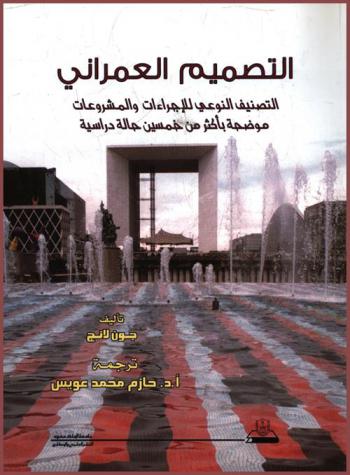
التصميم العمراني : التصنيف النوعي للإجراءات والمشروعات موضحة بأكثر من خمسين حالة دراسية
يتناول هذا الكتاب طبيعة التصميم العمراني والتصميم الحضري من تخطيط عام للمدن وإجراءات للتصميم، ثم تناول مهن التصميم التقليدية، كما أشار إلى جوهر العمل بالتصميم العمراني من خلال إجراءاته ومشروعاته، فشرح مفاهيم التصميم العمراني الكلي، والتصميم كقطعة واحدة، والتصميم قطعة بقطعة، والتصميم بالتركيب، وأخيراً تناول مستقبل التصميم العمراني كما حاول الإجابة على التساؤل : التصميم العمراني مجال أم انضباط ومهنة ؟
Book
Parton distributions in the LHC era: MMHT 2014 PDFs
We present LO, NLO and NNLO sets of parton distribution functions (PDFs) of the proton determined from global analyses of the available hard scattering data. These MMHT2014 PDFs supersede the ‘MSTW2008’ parton sets, but they are obtained within the same basic framework. We include a variety of new data sets, from the LHC, updated Tevatron data and the HERA combined H1 and ZEUS data on the total and charm structure functions. We also improve the theoretical framework of the previous analysis. These new PDFs are compared to the ‘MSTW2008’ parton sets. In most cases the PDFs, and the predictions, are within one standard deviation of those of MSTW2008. The major changes are the
u
-
d
valence quark difference at small
x
due to an improved parameterisation and, to a lesser extent, the strange quark PDF due to the effect of certain LHC data and a better treatment of the
D
→
μ
branching ratio. We compare our MMHT PDF sets with those of other collaborations; in particular with the NNPDF3.0 sets, which are contemporary with the present analysis.
Journal Article

Edward Hopper's New York
\"A revealing exploration of Edward Hopper's inspired relationship to New York City through his paintings, drawings, prints, and never-before-published archival materials This engaging book delves into the iconic relationship between Edward Hopper (1882-1967) and New York City. This comprehensive look at an essential aspect of the revered American artist's life reveals how Hopper's experience of New York's spaces, sensations, and architecture shaped his vision and served as a backdrop for his distillations of the urban experience. During sidewalk strolls and elevated train rides, Hopper sketched the city's many windowed facades. Exterior views gave way to interior lives, forging one of Hopper's defining preoccupations: the convergence of public and private. These permeable walls allowed Hopper to evoke the perplexing awareness of being alone in a crowd that is synonymous with modern urban life. Drawing on the vast resources of the Whitney Museum of American Art, the largest repository of Hopper's work, and the recently acquired gift of the Sanborn Hopper Archive, this book features more than 300 illustrations and fresh insight from authoritative and emerging scholars\"-- Provided by publisher.
BOOK

Transatlantic spread of highly pathogenic avian influenza H5N1 by wild birds from Europe to North America in 2021
Highly pathogenic avian influenza (HPAI) viruses of the A/Goose/Guangdong/1/1996 lineage (GsGd), which threaten the health of poultry, wildlife and humans, are spreading across Asia, Europe, Africa and North America but are currently absent from South America and Oceania. In December 2021, H5N1 HPAI viruses were detected in poultry and a free-living gull in St. John’s, Newfoundland and Labrador, Canada. Our phylogenetic analysis showed that these viruses were most closely related to HPAI GsGd viruses circulating in northwestern Europe in spring 2021. Our analysis of wild bird migration suggested that these viruses may have been carried across the Atlantic via Iceland, Greenland/Arctic or pelagic routes. The here documented incursion of HPAI GsGd viruses into North America raises concern for further virus spread across the Americas by wild bird migration.
Journal Article

Choices : all-new tales of Valdemar
\"The Heralds of Valdemar are the kingdom's ancient order of protectors. They are drawn from all across the land, from all walks of life, and at all ages--and all are Gifted with abilities beyond those of normal men and women. They are Mindspeakers, FarSeers, Empaths, ForeSeers, Firestarters, FarSpeakers, and more. These inborn talents--combined with training as emissaries, spies, judges, diplomats, scouts, counselors, warriors, and more--make them indispensable to their monarch and realm. Sought and Chosen by mysterious horse-like Companions, they are bonded for life to these telepathic, enigmatic creatures. The Heralds of Valdemar and their Companions ride circuit throughout the kingdom, protecting the peace and, when necessary, defending their land and monarch. Now, twenty-three authors ride with Mercedes Lackey to her magical land of Valdemar, adding their own unique voices to the Heralds, Bards, Healers, and other heroes of this beloved fantasy realm.\"--Amazon.com.
Book
Exclusive LHC physics with heavy ions: SuperChic 3
We present results of the updated SuperChic 3 Monte Carlo event generator for central exclusive production. This extends the previous treatment of proton–proton collisions to include heavy ion (pA and AA) beams, for both photon and QCD-initiated production, the first time such a unified treatment of exclusive processes has been presented in a single generator. To achieve this we have developed a theory of the gap survival factor in heavy ion collisions, which allows us to derive some straightforward results about the A scaling of the corresponding cross sections. We compare against the recent ATLAS and CMS measurements of light-by-light scattering at the LHC, in lead-lead collisions. We find that the background from QCD-initiated production is expected to be very small, in contrast to some earlier estimates. We also present results from new photon-initiated processes that can now be generated, namely the production of axion-like particles, monopole pairs and monopolium, top quark pair production, and the inclusion of W loops in light-by-light scattering.
Journal Article

A new approach to modelling elastic and inelastic photon-initiated production at the LHC: SuperChic 4
We present the results of the new SuperChic 4 Monte Carlo implementation of photon-initiated production in proton–proton collisions, considering as a first example the case of lepton pair production. This is based on the structure function calculation of the underlying process, and focusses on a complete account of the various contributing channels, including the case where a rapidity gap veto is imposed. We provide a careful treatment of the contributions where either (single dissociation), both (double dissociation) or neither (elastic) proton interacts inelastically and dissociates, and interface our results to Pythia for showering and hadronization. The particle decay distribution from dissociation system, as well the survival probability for no additional proton–proton interactions, are both fully accounted for; these are essential for comparing to data where a rapidity gap veto is applied. We present detailed results for the impact of the veto requirement on the differential cross section, compare to and find good agreement with ATLAS 7 TeV data on semi-exclusive production, and provide a new precise evaluation of the background from semi-exclusive lepton pair production to SUSY particle production in compressed mass scenarios, which is found to be low.
Journal Article