
Catalogue Search | MBRL


Are you sure you want to remove the book from the shelf?

{{itemTitle}}
1,907
result(s) for
"Laurent, Jacques"
Sort by:


Non-parametric PSF estimation from celestial transit solar images using blind deconvolution
Context: Characterization of instrumental effects in astronomical imaging is important in order to extract accurate physical information from the observations. The measured image in a real optical instrument is usually represented by the convolution of an ideal image with a Point Spread Function (PSF). Additionally, the image acquisition process is also contaminated by other sources of noise (read-out, photon-counting). The problem of estimating both the PSF and a denoised image is called blind deconvolution and is ill-posed. Aims: We propose a blind deconvolution scheme that relies on image regularization. Contrarily to most methods presented in the literature, our method does not assume a parametric model of the PSF and can thus be applied to any telescope. Methods: Our scheme uses a wavelet analysis prior model on the image and weak assumptions on the PSF. We use observations from a celestial transit, where the occulting body can be assumed to be a black disk. These constraints allow us to retain meaningful solutions for the filter and the image, eliminating trivial, translated, and interchanged solutions. Under an additive Gaussian noise assumption, they also enforce noise canceling and avoid reconstruction artifacts by promoting the whiteness of the residual between the blurred observations and the cleaned data. Results: Our method is applied to synthetic and experimental data. The PSF is estimated for the SECCHI/EUVI instrument using the 2007 Lunar transit, and for SDO/AIA using the 2012 Venus transit. Results show that the proposed non-parametric blind deconvolution method is able to estimate the core of the PSF with a similar quality to parametric methods proposed in the literature. We also show that, if these parametric estimations are incorporated in the acquisition model, the resulting PSF outperforms both the parametric and non-parametric methods.
Journal Article

Jacques Majorelle (1886-1962) : catalogue of work
\"Jacques Majorelle (1886-1962) is an emblematic figure of Orientalism. The son of the cabinet-maker Louis Majorelle, he trained at the Ecole nationale des Beaux-arts appliques of Nancy then in Paris, at the Academie Julian. Majorelle travelled through Spain, Egypt and Italy, starting from 1908. In 1917 he moved to Morocco. There, he developed a singular chromatic language which gave him a place divested of all influences among his contemporaries. Landscapes, bazaar scenes, and portraits, he based his art around the city of Marrakech where he lived, as well as across the rest of Morocco. He gathered inspiration from his many trips to Sudan, Guinea and Cote d'Ivoire, amassing a considerable oeuvre of over 1,000 works in which light, colour and a certain viewpoint on exoticism played a decisive role.\"-- Provided by publisher.
Book

Diffeomorphic Registration of Images with Variable Contrast Enhancement
Nonrigid image registration is widely used to estimate tissue deformations in highly deformable anatomies. Among the existing methods, nonparametric registration algorithms such as optical flow, or Demons, usually have the advantage of being fast and easy to use. Recently, a diffeomorphic version of the Demons algorithm was proposed. This provides the advantage of producing invertible displacement fields, which is a necessary condition for these to be physical. However, such methods are based on the matching of intensities and are not suitable for registering images with different contrast enhancement. In such cases, a registration method based on the local phase like the Morphons has to be used. In this paper, a diffeomorphic version of the Morphons registration method is proposed and compared to conventional Morphons, Demons, and diffeomorphic Demons. The method is validated in the context of radiotherapy for lung cancer patients on several 4D respiratory-correlated CT scans of the thorax with and without variable contrast enhancement.
Journal Article
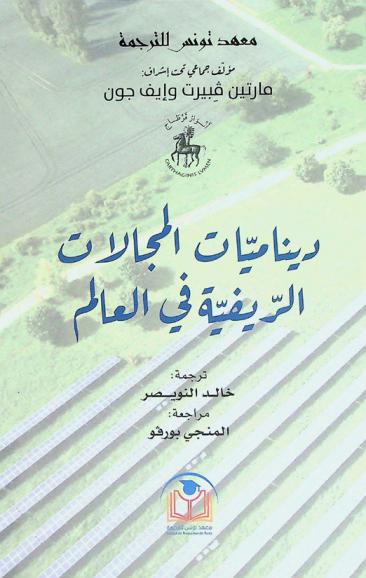
ديناميات المجالات الريفية في العالم
يتناول كتاب \"ديناميات المجالات الريفية في العالم\" لمجموعة من الباحثين بقيادة دومينيك أندريو التحولات العميقة التي طرأت على الأرياف عالميا، حيث لم تعد تعرف فقط كمجالات زراعية، بل أصبحت فضاءات متعددة الوظائف تشمل السياحة، والخدمات، والحفاظ على البيئة. يسلط الكتاب الضوء على التفاوتات المجالية، والهجرة من وإلى الأرياف، وتأثير السياسات العمومية في دعم التنمية المحلية، كما يناقش التحديات البيئية المتزايدة مثل التغير المناخي والتصحر. ويقدم من خلال أمثلة من مختلف القارات، مما يعكس تنوع التجارب الريفية في ظل العولمة ومتطلبات التنمية المستدامة.
BOOK

The influence of land-use composition on fecal contamination of riverine source water in southern British Columbia
The potential for riverine drinking source water to become contaminated with pathogens is related to the production and transport of fecal waste from within the local catchment area. Identifying specific relationships between land‐use types and fecal contamination in riverine water provides an indication of the risk associated with land‐use change and helps to target mitigation measures toward land‐use types of concern. Fecal coliform (FC) data from 42 riverine sites across British Columbia (BC), Canada, were examined in relation to land‐use composition (including 16 land‐use types) in the local catchment area. FC concentration significantly increased in relation to anthropogenic land‐use impacts but was negatively associated with undisturbed and high‐elevation land types. Regression tree analysis identified that highest FC concentrations occurred in catchments characterized by more than 12.5% agricultural land and more than 1.6% urban land. Furthermore, the risk of violation of the BC partial treatment raw drinking water quality guideline for FC concentration (100 CFU 100 mL−1) increased in relation to agricultural impacts. Additional factors, such as sewage treatment discharge, low dilution in smaller streams, and higher temperatures, were associated with higher FC concentration among sites with similar levels of agricultural development. These results identify land‐use types that present the greatest threat to riverine contamination, namely agricultural and urban land, and indicate the proportion of such land use associated with high contamination. Land use should be managed and source water protection should be targeted in light of these results so as to minimize the risk of surface water exposure to fecal contaminants. Key Points Land‐use impact on fecal contamination among 42 riverine sites examined Agriculture and urban land‐use presented greatest threat to water quality Further factors included wastewater, low dilution, and higher temperatures
Journal Article
Fully Differentiable Ray Tracing via Discontinuity Smoothing for Radio Network Optimization
Recently, Differentiable Ray Tracing has been successfully applied in the field of wireless communications for learning radio materials or optimizing the transmitter orientation. However, in the frame of gradient based optimization, obstruction of the rays by objects can cause sudden variations in the related objective functions or create entire regions where the gradient is zero. As these issues can dramatically impact convergence, this paper presents a novel Ray Tracing framework that is fully differentiable with respect to any scene parameter, but also provides a loss function continuous everywhere, thanks to specific local smoothing techniques. Previously non-continuous functions are replaced by a smoothing function, that can be exchanged with any function having similar properties. This function is also configurable via a parameter that determines how smooth the approximation should be. The present method is applied on a basic one-transmitter-multi-receiver scenario, and shows that it can successfully find the optimal solution. As a complementary resource, a 2D Python library, DiffeRT2d, is provided in Open Access, with examples and a comprehensive documentation.
Paper
Comparing Differentiable and Dynamic Ray Tracing: Introducing the Multipath Lifetime Map
With the increasing presence of dynamic scenarios, such as Vehicle-to-Vehicle communications, radio propagation modeling tools must adapt to the rapidly changing nature of the radio channel. Recently, both Differentiable and Dynamic Ray Tracing frameworks have emerged to address these challenges. However, there is often confusion about how these approaches differ and which one should be used in specific contexts. In this paper, we provide an overview of these two techniques and a comparative analysis against two state-of-the-art tools: 3DSCAT from UniBo and Sionna from NVIDIA. To provide a more precise characterization of the scope of these methods, we introduce a novel simulation-based metric, the Multipath Lifetime Map, which enables the evaluation of spatial and temporal coherence in radio channels only based on the geometrical description of the environment. Finally, our metrics are evaluated on a classic urban street canyon scenario, yielding similar results to those obtained from measurement campaigns.
Paper
Towards Generative Ray Path Sampling for Faster Point-to-Point Ray Tracing
Radio propagation modeling is essential in telecommunication research, as radio channels result from complex interactions with environmental objects. Recently, Machine Learning has been attracting attention as a potential alternative to computationally demanding tools, like Ray Tracing, which can model these interactions in detail. However, existing Machine Learning approaches often attempt to learn directly specific channel characteristics, such as the coverage map, making them highly specific to the frequency and material properties and unable to fully capture the underlying propagation mechanisms. Hence, Ray Tracing, particularly the Point-to-Point variant, remains popular to accurately identify all possible paths between transmitter and receiver nodes. Still, path identification is computationally intensive because the number of paths to be tested grows exponentially while only a small fraction is valid. In this paper, we propose a Machine Learning-aided Ray Tracing approach to efficiently sample potential ray paths, significantly reducing the computational load while maintaining high accuracy. Our model dynamically learns to prioritize potentially valid paths among all possible paths and scales linearly with scene complexity. Unlike recent alternatives, our approach is invariant with translation, scaling, or rotation of the geometry, and avoids dependency on specific environment characteristics.
Paper
Min-Path-Tracing: A Diffraction Aware Alternative to Image Method in Ray Tracing
For more than twenty years, Ray Tracing methods have continued to improve on both accuracy and computational time aspects. However, most state-of-the-art image-based ray tracers still rely on a description of the environment that only contains planar surfaces. They are also limited by the number of diffractions they can simulate. We present Min-Path-Tracing (MPT), an alternative to the image method that can handle diffractions seamlessly, while also leveraging the possibility to use different geometries for surfaces or edges, such as parabolic mirrors. MPT uses implicit representations of objects to write the path finding challenge as a minimization problem. We further show that multiple diffractions can be important in some situations, which MPT is capable to simulate without increasing neither the computational nor the implementation complexity.
Paper