
Catalogue Search | MBRL


Are you sure you want to remove the book from the shelf?

{{itemTitle}}
123
result(s) for
"Leahy, Robert L"
Sort by:

Cognitive therapy techniques : a practitioner's guide
\"This indispensable book has given many tens of thousands of practitioners a wealth of evidence-based tools for maximizing the power of cognitive therapy and tailoring it to individual clients. Leading authority Robert L. Leahy describes ways to help clients identify and modify problematic thoughts, core beliefs, and patterns of worry, self-criticism, and approval-seeking; evaluate personal schemas; cope with painful emotions; and take action to achieve their goals. Each technique includes vivid case examples and sample dialogues. Featuring 125 reproducible forms, the print book has a large-size format for easy photocopying; purchasers also get access to a Web page where they can download and print the reproducible materials. New to This Edition *Numerous additional techniques and reproducible tools, including 48 new or revised forms. *Chapters on decision-making problems, intrusive thoughts, and anger management issues. *Incorporates the latest theory and research as well as cutting-edge techniques drawn from acceptance and commitment therapy (ACT), behavioral activation, dialectical behavior therapy (DBT), emotional schema therapy, and the metacognitive model. *Significantly revised chapters on emotion regulation and worries. *Filled-out examples for many of the forms\"-- Provided by publisher.
Book

Cognitive-Behavioral Therapy for Envy
Envy is a ubiquitous social emotion often associated with depression, hostility and shame. Often confused with jealousy which involves the fear or anger that a primary relationship is threatened by a third party, envy is an emotion focused on threats to status such that another person’s “gain” is viewed as a “loss” for the self. There is very little in the cognitive behavioral literature on the nature and treatment of envy. In this article I outline the research on the nature of envy, the evolutionary model of envy, the relevance of an integrative CBT model that draws on Beck’s Generic Cognitive Model and Emotional Schema Therapy, and the implications for case conceptualization and treatment.
Journal Article


Don't Believe Everything You Feel
Many people struggle with difficult emotions, whether as a result of depression, anxiety, or simply dealing with the common struggles of daily life. Based on the groundbreaking theory of emotional schema, this workbook helps readers explore their own deeply held personal beliefs about emotions, determine if these beliefs are helpful or harmful, and find the motivation to adopt alternative coping strategies. With this guide, readers will learn to increase their capacity to feel the full range of life's emotions at the center of a meaningful life.
eBook

The jealousy cure : learn to trust, overcome possessiveness, & save your relationship
\"[In this book, the author] invites you to gain a greater understanding of your jealous feelings, keep jealousy from hijacking your life, and create healthier relationships\"--Amazon.com.
Book

The Therapeutic Relationship in Cognitive-Behavioral Therapy
Cognitive behavioral therapy has often been criticized for ignoring the role of the therapeutic relationship. In this article, I outline several dimensions for case formulation and intervention that suggest that the cognitive-behavioral approach can be a powerful theoretical model for understanding the causes of and the strategies for overcoming impasses in therapy. I review how the clinician and patient can collaborate in understanding the importance of case conceptualization, validation, emotional philosophies, victim resistance, schematic resistance, schematic mismatch, sunk-cost commitment, and self-handicapping. The relevance of these factors for both patient and therapist are discussed. During the last decade there has been increased interest in the nature of the therapeutic relationship in cognitive behavioral therapy (Gilbert, 1992; Safran, 1998; Safran and Muran, 2000; Greenberg, 2002; Leahy, 2001; Gilbert and Irons, 2005; Leahy, 2005; Bennett-Levy and Thwaites, 2007; Gilbert and Leahy, 2007). Cognitive behavioral therapists have proposed that the therapeutic relationship reflects interpersonal schemas, earlier attachment problems, emotional processing, failures in validation and compassion, and a variety of processes underlying non-compliance or resistance. Resolving “ruptures” in the therapeutic relationship provides an often essential opportunity for using the relationship as a means to modify cognitive and emotional problems (Safran, Muran, Samstag and Stevens, 2002; Katzow and Safran 2007). In light of the emphasis on “empirically supported treatments” (such as CBT) there is the risk that the alliance in therapy may be foreshadowed by the techniques and protocols used in CBT, perhaps giving credibility to Mahoney's (1991) earlier claim that therapy can become “technolatry”.
Journal Article

بدون قلق : تحرر من مخاوفك قبل أن تسيطر عليك
يتناول هذا الكتاب الذي هو بين أيدينا، يوضح لنا الدكتور \"\"روبرت ال. ليهي\" الأسباب الرئيسة للقلق ويعلمنا كيف نعالج مخاوفنا بذكاء لكي نعيش حياة خالية من التوتر والعناء. وبتطبيق الأساليب الموضحة في هذا الكتاب، والتي وضعها المؤلف طبقا لأفضل الطرق المتاحة في العلاج النفسي، يمكننا الوصول في النهاية الى أن نعيش حياة خالية من الخوف، والتوتر، ومتلازمة التهرب ، المصاحبة للقلق.
Book

Treatment Resistant Anxiety Disorders
Treatment Resistant Anxiety Disorders: Resolving Impasses to Symptom Remission brings together leading cognitive behavioral therapists from major theoretical orientations to provide clinicians with a greatly needed source of information, skills, and strategies from a wide range of CBT approaches.
It describes how to combine empirically-based findings, broad based and disorder specific theoretical models, and individualized case conceptualization to formulate and apply specific strategies for varied aspects of resistance during treatment of anxiety disorders.
Debbie Sookman, PhD, is Director of the Obsessive Compulsive Disorder (OCD) Clinic, and Training Director, Department of Psychology, McGill University Health Centre (MUHC), and Associate Professor of Psychiatry, McGill University, Montreal, Canada.
Robert L. Leahy, PhD, is Director of the American Institute for Cognitive Therapy, President of the Association for Behavioral and Cognitive Therapies, Past-President of the International Association of Cognitive Psychotherapy, Past- President of the Academy of Cognitive Therapy, Clinical Professor of Psychology in Psychiatry at Weill-Cornell University Medical School, and the editor and author of seventeen books. He has been featured in The New York Times Sunday Magazine, Forbes, Fortune, Newsweek, Psychology Today, Washington Post, Redbook, Women’s Health, Self Magazine, USA Today Magazine and he has appeared on national and local radio and on television.
Sookman, Introduction. Wells, Metacognitive Therapy: Application to Generalized Anxiety Disorder. Sookman, Steketee, Specialized Cognitive Behavior Therapy for Treatment Resistant Obsessive Compulsive Disorder. Jackson, Nissenson, Cloitre, Treatment for Complex PTSD. Bruce, Sanderson, Understanding and Managing Treatment-resistant Panic Disorder: Perspectives from the Clinical Experience of Several Expert Therapists. Leahy, Emotional Schemas in Treatment-resistant Anxiety. Welch, Osburne, Pryzgoda, Augmenting Exposure-based Treatment for Anxiety Disorders with Principles and Skills for Dialectical Behavior Therapy. Westra, Arkowitz, Combining Motivational Interviewing and Cognitive-Behavioral Therapy to Increase Treatment Efficacy for Generalized Anxiety Disorder. Lee, Using a Compassionate Mind to Enhance the Effectiveness of Cognitive Therapy for Individuals who Suffer from Shame and Self-criticism. Twohig, Plumb, Mukherjee, Hayes, Suggestions from Acceptance and Commitment Therapy for Dealing with Treatment-resistant Obsessive-compulsive Disorder. Stewart, O’Connor, Treating Anxiety Disorders in the Context of Concurrent Substance Misuse. Kolivakis, Margolese, Ducharme, The Pharmacotherapy of Treatment-resistant Anxiety Disorders in Adults in the Setting of Cognitive-Behavior Therapy. Leahy, Conclusions.
eBook

Treatment plans and interventions for depression and anxiety disorders
\"_This widely used book is packed with indispensable tools for treating the most common clinical problems encountered in outpatient mental health practice. Chapters provide basic information on depression and the six major anxiety disorders; step-by-step instructions for evidence-based assessment and intervention; illustrative case examples; and practical guidance for writing reports and dealing with third-party payers. In a convenient large-size format, the book features 125 reproducible client handouts, homework sheets, and therapist forms for assessment and record keeping. The included CD-ROM enables clinicians to rapidly generate individualized treatment plans, print extra copies of the forms, and find information on frequently prescribed medications._New to This Edition*The latest research on each disorder and its treatment.*Innovative techniques that draw on cognitive, behavioral, mindfulness, and acceptance-based approaches.*Two chapters offering expanded descriptions of basic behavioral and cognitive techniques.*47 of the 125 reproducibles are entirely new. __\"--Provided by publisher.
Book
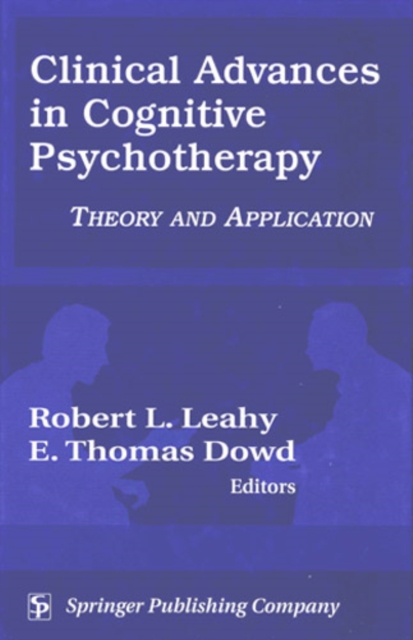
Clinical advances in cognitive psychotherapy
A virtual Who's Who in the field of cognitive psychotherapy! Tracing the history and derivation of cognitive psychotherapy, the authors discuss its recent developments as an evolving and integrative therapy. Chapters illustrate the applications of cognitive psychotherapy to treat such disorders as anxiety, depression, and social phobia. Other chapters discuss integration with therapy models such as schema-focused and constructivism. New empirically-based research is cited for treating the HIV-positive depressed client, the anorexic or bulimic sufferer, as well as applying cognitive therapy to family and group issues. Aaron Beck, E. Thomas Dowd, Robert Leahy, W.J. Lyddon, Michael Mahoney, Robert A. Neimeyer are among the stellar contributors to this book.
eBook