
Catalogue Search | MBRL


Are you sure you want to remove the book from the shelf?

{{itemTitle}}
81
result(s) for
"Lederach, John Paul"
Sort by:


The moral imagination : the art and soul of building peace
This book poses the question, “How do we transcend the cycles of violence that bewitch our human community while still living in them?” Peacebuilding, in the view of this book, is both a learned skill and an art. Finding this art, this book says, requires a worldview shift. Conflict professionals must envision their work as a creative act — an exercise of what the book terms the “moral imagination.” This imagination must, however, emerge from and speak to the hard realities of human affairs. The peacebuilder must have one foot in what is and one foot beyond what exists. The book is organized around four guiding stories that point to the moral imagination but are incomplete. The book seeks to understand what happened in these individual cases and how they are relevant to large-scale change. The purpose is not to propose a grand new theory; instead it wishes to stay close to the “messiness” of real processes and change, and to recognize the serendipitous nature of the discoveries and insights that emerge along the way. Like most professional peacemakers, the author of this book sees his work as a religious vocation.
eBook

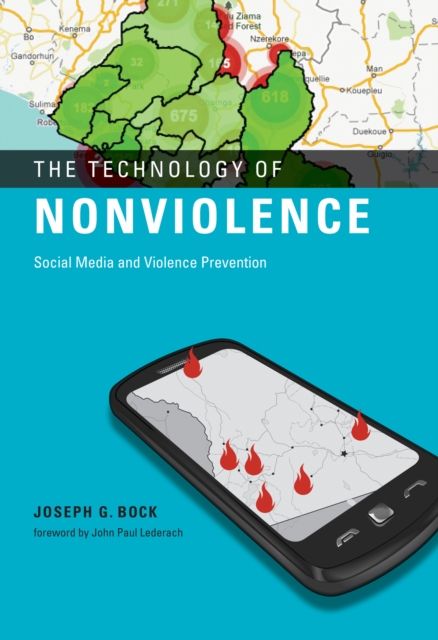
The Technology of Nonviolence - Social Media and Violence Prevention
Tunisian and Egyptian protestors famously made use of social media to rally supporters and disseminate information as the \"Arab Spring\" began to unfold in 2010. Less well known, but with just as much potential to bring about social change, are ongoing local efforts to use social media and other forms of technology to prevent deadly outbreaks of violence. In The Technology of Nonviolence, Joseph Bock describes and documents technology-enhanced efforts to stop violence before it happens in Africa, Asia, and the United States. Once peacekeeping was the purview of international observers, but today local citizens take violence prevention into their own hands. These local approaches often involve technology--including the use of digital mapping, crowdsourcing, and mathematical pattern recognition to identify likely locations of violence--but, as Bock shows, technological advances are of little value unless they are used by a trained cadre of community organizers. After covering general concepts in violence prevention and describing technological approaches to tracking conflict and cooperation, Bock offers five case studies that range from \"low-tech\" interventions to prevent ethnic and religious violence in Ahmedebad, India, to an anti-gang initiative in Chicago that uses Second Life to train its \"violence interrupters.\" There is solid evidence of success, Bock concludes, but there is much to be discovered, developed, and, most important, implemented.
eBook

The Origins and Evolution of Infrastructures for Peace: A Personal Reflection
I first began to formulate the concept of an infrastructure for peace in the 1980s. During several local and national peace processes, particularly a mediation effort in Nicaragua, the support mechanisms to sustain the changes under negotiation, and which subsequently found their way into signed accords, required both conceptual and practical development. In Central America at that time, the support for the negotiations relied heavily on commissions. The innovation in Nicaragua led to the creation of commissions that functioned at local, regional and national levels, although these focused almost exclusively on the negotiation process and in some instances on short-term implementation of some key aspects in the accords. The challenge I observed at the time was how to develop the necessary support over time for the social, political and cultural change processes that formed the underlying purpose and intent of more concrete, specific agreements. Reflecting on those experiences a few years later, I proposed the idea of an infrastructure for peace as a core ingredient of a comprehensive approach to peacebuilding in Building Peace: Sustainable Reconciliation in Divided Societies (1997). Adapted from the source document.
Journal Article

The cooperative solution : toward a just economy
All over the world, poverty is gradually giving way to cooperative economic activity. At the same time, there are signs that standard competitive 'free' markets are failing. Empirical evidence shows that cooperation works better than competition and that cooperatives succeed more often than standard corporations. Assumptions underlying the competitive system are that competition results in equity for all and that poverty can be eliminated through the market. These assumptions simply are not true. On the contrary, the rich get richer; the poor, poorer. Cooperatives, where each member holds one share and one vote, are more democratic than hierarchical corporations. Poverty is actually eliminated through a combination of microfinance and cooperation. Examples include Muhammed Yunus' Grameen Bank, Indonesia's People's Bank, and the cooperative adventure of Mondragon in Spain. These examples provide a vision of true globalization from below, a vision of a just and sustainable world. The 'how-to' is right here.
eBook

Peacebuilding and Religion
Religion and faith provide a cornerstone for people who serve as informal and sometimes more formalized intermediary spokespersons working across divides, from the early work of opening conversation to the longer and slower processes of healing and reconciliation. Religion is seen as dealing with things that are more connected to the emotional landscape and those things that may not pertain directly to rational thought. The most visible external aspect emerges when peacebuilding responds to conflict in places where religious identity creates the marker of the deep and often violent polarizaiton. Faith‐based often implies going to the dogma of a particular faith. Faith‐motivated suggests that there is an element of rising to express and living into something that expresses, aspires in an embodied way to live out the understanding of the faith.
Book Chapter

The Moral Imagination: the Art and Soul of Building Peace Association of Conflict Resolution, Sacramento, September 30, 2004
I am not sure who proposed the phrase 'expanding the art and practice' but it lends itself to what has been preoccupying my professional journey for some years now. I wish to speak about this phrase, about the essence, the 'heart's core', the rhythms and pulse of what is required to build genuine constructive change, what it takes to heal deep divisions, what is vital and necessary to value peace in a polarized world.
Journal Article

The Moral Imagination
I am not sure who proposed the phrase 'expanding the art and practice' but it lends itself to what has been preoccupying my professional journey for some years now. I wish to speak about this phrase, about the essence, the 'heart's core', the rhythms and pulse of what is required to build genuine constructive change, what it takes to heal deep divisions, what is vital and necessary to value peace in a polarized world.
Journal Article