
Catalogue Search | MBRL


Are you sure you want to remove the book from the shelf?

{{itemTitle}}
45
result(s) for
"Ledger, Sally"
Sort by:

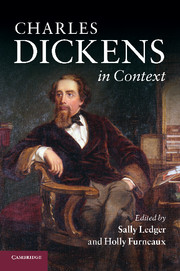
Charles Dickens in Context
Charles Dickens, a man so representative of his age as to have become considered synonymous with it, demands to be read in context. This book illuminates the worlds - social, political, economic and artistic - in which Dickens worked. Dickens's professional life encompassed work as a novelist, journalist, editor, public reader and passionate advocate of social reform. This volume offers a detailed treatment of Dickens in each of these roles, exploring the central features of Dickens's age, work and legacy, and uncovering sometimes surprising faces of the man and of the range of Dickens industries. Through 45 digestible short chapters written by a leading expert on each topic, a rounded picture emerges of Dickens's engagement with his time, the influence of his works and the ways he has been read, adapted and re-imagined from the nineteenth century to the present.
eBook

Dickens, Natural History, and Our Mutual Friend
The paper argues that, well aware of the developments in contemporary science, including biology and political economy, Dickens believed in the significance of the scientific paradigm shifts for ordinary human life. Dickens's early fiction constituted, among other things, a passionate critique of para-Malthusian political economy. This critique is resumed in Our Mutual Friend , yet with the new awareness of the shift of dominant paradigms from political economy to Darwinist biological thinking. Whereas the legislature that grew out of political economy could be challenged and modified, Darwin's account of natural selection, a biological theory that had permanent ontological ramifications, had a claim to the stability of a natural law which disabled beliefs in Providential design. Darwin's work, however, did not deny the potential of benevolent sympathetic human agency. Dickens's novel pits such agency against the blind forces of the struggle for survival, even while subverting the confidence in overall ethical design trailed in by the residual elements of the traditional melodrama.
Journal Article

\GOD BE THANKED: A RUIN!\ THE REJECTION OF NOSTALGIA \IN PICTURES FROM ITALY\
The good old English laws were garnished well with gibbets, whips and chains, With fine old English penalties, and fine old English pains, With rebel heads, and seas of blood once hot in rebel veins; For all these things were requisite to guard the rich old gains Of the fine old English Tory times; Soon may they come again! ... [...]poverty, and ignorance, shall swell the rich and grand, So, rally round the rulers with the gentle iron hand, Of the fine old English Tory days; Hail to the coming time! (Forster Bk. 1, ch. 12) Turning to other Dickensian productions of the early 1840s, Pictures from Italy was in formation as Dickens attacked Young-England inspired paternalistic rhetoric in the figure of Sir Joseph Bowley in The Chimes; and was published five years after Barnabe Rudge, his most extended attack on both private and public paternalism. Dickens's embrace of contemporary popular culture in Pictures from Italy is accompanied by a commitment to modernity that leads him to broad approval of Leghorn, which he describes as: a thriving, business-like, matter-of-fact place, where idleness is shouldered out of the way by commerce. (109) Always a fan of the mushrooming railway system in Europe, Dickens approves, too, of the new railroad between Leghorn and Pisa - it \"is a good one\" that has already begun to astonish Italy \"with a precedent of punctuality, order, plain dealing, and improvement - the most dangerous and heretical astonisher of all.\"
Journal Article


Wilde Women and The Yellow Book: The Sexual Politics of Aestheticism and Decadence
Ledger discusses the cultural and literary history of The Yellow Book, a British literary periodical published from 1894 to 1897 by Elkin Mathews and John Lane, and highlights the publication's apparent connection with the renowned Irish writer Oscar Wilde. She notes that aestheticism and Decadence were part of an avant-gardist cultural formation of the periodical, thoroughly peopled by women as literary and artistic subjects, and not simply as objects of the male Decadent gaze. Numerous women writers all had their literary careers advanced by their work for The Yellow Book, as they simultaneously interrogated and embraced its multivalent cultural politics. While the Speaker may have overstated the case in its 1895 reflection that Wilde was responsible for the New Woman in particular and for the \"new school\" of literature more generally; its apprehension of a close link between the various avant-gardist currents of the late nineteenth century was nonetheless astute. In sum, The Yellow Book was in the vanguard of cultural debate, and at its center were New Women and aesthetic women, as well as male aesthetes and Decadents.
Journal Article

FROM QUEEN CAROLINE TO LADY DEDLOCK: DICKENS AND THE POPULAR RADICAL IMAGINATION
ON AN AUTUMN DAY IN 1842, William Hone lay dying. He was by now an obscure figure, but through the services of an old friend, George Cruikshank, he sent a request to Charles Dickens that he might shake his hand before he died. The famous novelist agreed to the request, and for a brief moment Dickens, Cruikshank, and William Hone came together in Hone's shabby London home. The meeting apparently meant little to Dickens who, subsequently attending Hone's funeral, recounted with comic viciousness Cruikshank's histrionics as his old friend was laid to rest. Writing to an American friend, Cornelius Felton, Dickens described how he found himself “almost sobbing with laughter at the funereal absurdities of George Cruikshank and others” (Ackroyd 407). The encounter between Dickens, Cruikshank, and Hone in 1842 is a little-known but with hindsight a significant convergence; for despite Dickens's seeming disregard for the ailing and rather threadbare old bookseller, the deathbed tableau crystallizes an important and much overlooked connection between Dickens's writings and an earlier popular radical tradition.
Journal Article

Chartist Aesthetics in the Mid Nineteenth Century: Ernest Jones, a Novelist of the People
This essay posits that the turn of Chartist writers to popular fiction and the writing of melodrama in the 1840s was part of an attempt to reharness radicalism to populism, at a time when the new commercial press was increasingly luring lower-class readers away from the radical press. Distinguishing carefully between radical, popular radical, and commercial popular fiction and journalism at the mid-century, the essay argues that while the radical press of the 1810s and 1820s had had a broad popular readership, Chartism was the first radical movement that had to compete with the new Sunday newspapers. Focusing on the novels of Ernest Jones, one of Chartism'slate, great leaders, the essay counters recent arguments for the essentially conservative or anti-activist thrust of melodramatic writing, arguing that a less formalist, more materialist account of the way that melodrama circulated in the cultural economy of the mid-century produces a more \"radical\" apprehension of its cultural politics. The essay also argues that Chartism'sturn to melodrama coincided with the rise of a political vocabulary of class identity and class conflict within Chartist discourse. While Chartism'sinitial investment in a Liberal Reformist language of individual rights had lent itself to the lyric individualism of Romantic poetry, the binary oppositions and frequently violent conflicts that characterize melodrama made it the preferred genre for later Chartist scribes.
Journal Article