
Catalogue Search | MBRL


Are you sure you want to remove the book from the shelf?

{{itemTitle}}
11
result(s) for
"Leeming, David Adams, 1937-"
Sort by:


Tales of the Earth
Tales of the Earth is a comprehensive yet concise overview of Native American mythologies. After outlining theories of the origins of Native North Americans, David Leeming considers the creation myths of many tribes, emphasizing four commonly occurring figures: the Great Spirit, the trickster, the goddess and the hero. Leeming suggests that in addition to these figures, Native American mythologies have in common a deep reverence for the earth, and for community responsibility as opposed to individualism - tenets that stand in stark contrast to the concepts of exceptionalism and Manifest Destiny that characterize the United States, a nation that was built on ancient tribal land.
eBook

Creation myths of the world : an encyclopedia
Nearly every belief system in every part of the world has its own distinctive answers to how the world was created, often taking the form of a story or myth. These narratives offer insight into a culture's values, its world view, and its interpretations of the relationship between the individual, society, and the divine.
Book

The world of myth
Hercules, Zeus, Thor, Gilgamesh--these are the figures that leap to mind when we think of myth. But to David Leeming, myths are more than stories of deities and fantastic beings from non-Christian cultures. Myth is at once the most particular and the most universal feature of civilization, representing common concerns that each society voices in its own idiom. Whether an Egyptian story of creation or the big-bang theory of modern physics, myth is metaphor, mirroring our deepest sense of ourselves in relation to existence itself. Now, in The World of Myth, Leeming provides a sweeping anthology of myths, ranging from ancient Egypt and Greece to the Polynesian islands and modern science. We read stories of great floods from the ancient Babylonians, Hebrews, Chinese, and Mayans; tales of apocalypse from India, the Norse, Christianity, and modern science; myths of the mother goddess from Native American Hopi culture and James Lovelock's Gaia. Leeming has culled myths from Aztec, Greek, African, Australian Aboriginal, Japanese, Moslem, Hittite, Celtic, Chinese, and Persian cultures, offering one of the most wide-ranging collections of what he calls the collective dreams of humanity. More important, he has organized these myths according to a number of themes, comparing and contrasting how various societies have addressed similar concerns, or have told similar stories. In the section on dying gods, for example, both Odin and Jesus sacrifice themselves to renew the world, each dying on a tree. Such traditions, he proposes, may have their roots in societies of the distant past, which would ritually sacrifice their kings to renew the tribe. In The World of Myth, David Leeming takes us on a journey \"not through a maze of falsehood but through a marvellous world of metaphor,\" metaphor for \"the story of the relationship between the known and the unknown, both around us and within us.\" Fantastic, tragic, bizarre, sometimes funny, the myths he presents speak of the most fundamental human experience, a part of what Joseph Campbell called \"the wonderful song of the soul's high adventure.\"
eBook


Gods, Heroes, & Kings
This book unearths the layers of the British Isles' unique folkloric tradition to discover how this body of seemingly disparate tales developed. The authors find a virtual battlefield of myths on which pagan and Judeo-Christian beliefs fought for dominance, and classical, Anglo-Saxon, Germanic, and Celtic narrative threads became tangled.
eBook

World mythology : a very short introduction
\"This book treats myths from all parts of the word, first from a cultural and then from a more comparative perspective. How do myths of the ancient Egyptians or Greeks, for instance, reflect the realities of the Egyptian and Greek cultures? When compared, how do they reveal certain universal themes or motifs that point to larger transcultural issues, such as the place of the human species in creation or the nature of deity as a concept? This book is organized around the universal or near universal motifs: deities, creation, the flood, the trickster, and the hero. Myths from Greek, Egyptian, Norse, Native American, African, Polynesian, Jewish, Christian, Hindu, and other cultures are retold and treated as reflections of the cultures that \"dreamed\" them and then are compared and discussed in such a way as to expose universal significance, creating a world mythology\"-- Provided by publisher.
Book

A dictionary of Asian mythology
Meet the supreme Gautama Buddha, the elephant-headed Hindu god Ganesa, and Chang O, the Lunar Toad who is Chinese goddess of the Moon. Journey to the sacred Cambodian ruins of Angkor and golden Mount Meru, home of the Hindu gods. Discover myths like the Stone and the Banana and the Churning of the Ocean of Milk, and explore archetypal themes such as the hero quest, sacrifice, and descent to the underworld.
This dictionary features stories of revered deities, sacred places, key events and epics, with many recurring themes and traditions. Entries address the key mythologies of the regions we now call India, China, Tibet, Central Asia, Southeast Asia, and Japan, and broad overviews of specific cultures and their mythic traditions round out the coverage.
eBook

Myths, Legends, and Folktales of America
This marvellous collection brings together the great myths and legends of the United States-from the creation stories of the first inhabitants, to the tall tales of the Western frontier, to the legendary outlaws of the 1920s, and beyond. This thoroughly engaging anthology is sweeping in its scope, embracing Big Foot and Windigo, Hiawatha and Uncle Sam, Paul Revere and Billy the Kid, and even the Iroquois Flying Head and Elvis. In the book's section on dogmas and icons, for instance, Leeming and Page discuss the American melting pot, the notion of manifest destiny, and the imposing historical and literary figure of Henry Adams. And under Heroes and Heroines, they have assembled everyone from \"Honest Abe\" Lincoln and George \"I Cannot Tell a Lie\" Washington to Bessie Smith, Billie Holiday, and Martin Luther King, Jr. For every myth or hero rendered here, the editors include an informative yet readable excerpt, often the definitive account of the story in question.; Taken as a whole, Myths, Legends, and Folktales of America reveals how waves of immigrants, encountering this strange land for the first time, adapted their religions, beliefs, and folklore to help make sense of a new and astounding place. Covering Johnny Appleseed and Stagolee as well as Paul Bunyan and Moby Dick, this wonderful anthology illuminates our nation's myth-making, enriching our idea of what it means to be American.
eBook
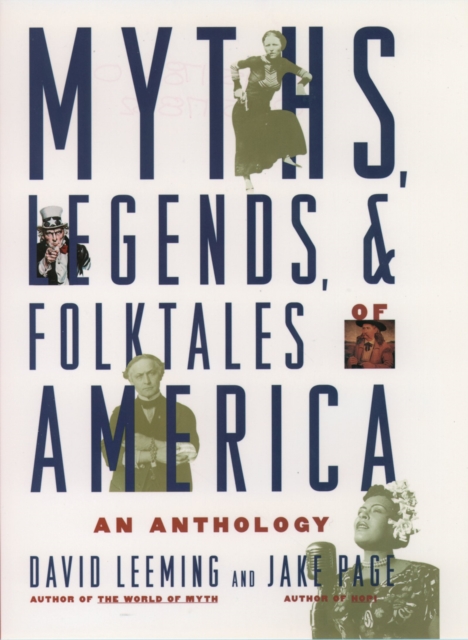
Myths, Legends, and Folktales of America
In this marvelous collection, David Leeming and Jake Page have gathered together the great myths and legends of America, ranging from the creation stories of the first inhabitants, to the tall-tales of the Western frontier, to the legendary outlaws of the 1920s.
eBook