
Catalogue Search | MBRL


Are you sure you want to remove the book from the shelf?

{{itemTitle}}
408
result(s) for
"Leiss, William"
Sort by:

A global decarbonisation bond
The 2018 IPCC Special Report, Global Warming of 1.5 °C, calls attention to the inadequacy of 'the current nationally stated mitigation ambitions as submitted under the Paris Agreement' to control global warming within acceptable parameters. A strategy of decarbonisation is urgently required in this context, and where that strategy is most needed is in developing countries, which are, however, constrained by a shortage of capital to carry it out. This paper proposes that developed countries implement their promised $100 billion annual assistance to developing nations by issuing, by 2023, a $2.5 trillion Global Decarbonization Bond that will front-load the provision of appropriate technologies for this purpose.
Journal Article
Mad Cows and Mother's Milk, Second Edition
Communicating the nature and consequences of environmental and health risks is still one of the most problematic areas of public policy in Western democracies. \"Mad Cows and Mother's Milk\" outlines the crucial role of risk management in dealing with public controversies and analyses risk communication practice and malpractice to provide a set of lessons for risk managers and communicators. This second edition adds new case studies on mad cow disease in North America, climate change, and genetics technologies. The first of the new case studies brings the story of the Bovine Spongiform Encephalopathy (BSE) outbreak in the United Kingdom in the 1980s up-to-date. Mad cow disease is still being discovered in UK herds and cases of mad cow disease have been found in twenty countries across the European continent and as far away as Japan with devastating consequences for the food industry. BSE has now been discovered on the North American continent in two cows born in Canada. The original cause of these two new cases is almost certainly importation of infected cattle, cattle feed, or both from Britain. Canadian government regulators and those in the cattle industry have failed to correctly assess the risks of the disease in the Canadian herd, take the precautionary measures needed to prevent the spread of disease, and communicate risks and precautionary measures to the public. The second new study deals with global warming. Not only is every aspect of this risk debate both contentious and difficult for the public to understand but the potential consequences of the risks extend all the way to global catastrophe for human civilization. A new chapter outlines the many dimensions of risk debate in the context of the need for effective and sustained dialogue by an informed public. The last new case study provides an introduction to genomic science, which is placed in the context of both the health benefits expected from genetic manipulation and some of the risk factors associated with it. One example is gene therapy, which can be used to eliminate inherited genetic diseases (i.e. cystic fibrosis), enhance human traits (i.e. athletic performance), and perhaps double life-spans. Gene technologies are relevant to some of the most fundamental human values. This new chapter suggests that we must think about the range of new risks introduced by these technologies as well as the potential benefits - and that we should do this collective thinking soon, since, given the furious pace of genomics discoveries, the possibilities will be with us sooner than we imagine. All of the case studies emphasize the need for effective communication about risks to allow effective dialogue by informed publics on health and environmental risks.
eBook
Limits to Satisfaction
Consumerism and capitalist and socialist industry have reached the point where state power is legitimatized by its ability to increase the number of commodities. A unique culture has been created in which marketing is the main social bond. Values no longer shape and condition needs, wants, desires, or preferences. Leiss draws on economics, psychology, sociology, and anthropology to show the vagueness of our thought on the relation between nature and culture, desire and reason, needs and commodities. This book raises serious, vital questions for all those concerned about the future of our present society.
eBook
The Domination of Nature
In Part One Leiss traces the idea of the domination of nature from the Renaissance to the nineteenth century. Francis Bacon's seminal work provides the pivotal point for this discussion and, through an original interpretation of Bacon's thought, Leiss shows how momentous ambiguities in the idea were incorporated into modern thought. By the beginning of the twentieth century the concept had become firmly identified with scientific and technological progress. This fact defines the task of Part Two. Using important contributions by European sociologists and philosophers, Leiss critically analyses the role of science and technology in the modern world. In the concluding chapter he puts the idea of mastery over nature into historical perspective and explores a new approach, based on the possibilities of the \"liberation of nature.\" Originally published in 1972, The Domination of Nature was part of the first wave of widespread interest in environmental issues. These issues have reemerged in many industrialized countries, reinforced by planetary dynamics such as threats of global warming (or cooling) and ozone depletion. In an extensive new preface Leiss explains why his study is as relevant as ever.
eBook

Under Technology's Thumb
From the introduction: \"Standing at the threshold of modern times, Francis Bacon saw in experimental science and technological innovation the keys to humanity's future. Human history to that point, he thought, was an endlessly repeated cycle of despair and false hopes. The false hopes were fed by the old illusion that a few cheap tricks and the right magical formulas would unlock nature's treasury where unlimited wealth and power lay. The despair arose from humanity's seeming inability to escape from subjection to the natural forces that periodically visited famine, disease, pestilence, and destruction upon it.\"
eBook
In the Chamber of Risks
The essential problem is the failure to recognize that controversies over risks are \"normal events\" in modern society and as such will be with us for the foreseeable future. Three key propositions define these events: risk management decisions are inherently disputable; public perceptions of risk are legitimate and should be treated as such; the public needs to be intensively involved in the processes of risk evaluation and management. Leiss and his collaborators chronicle these organizational risks in a set of detailed case studies on genetically modified foods, cellular telephones, the notorious fuel additive MMT, pulp mill effluent, nuclear power, toxic substances legislation, tobacco, and the new type of \"moral risks\" associated with genetics technologies such as cloning. Contributors include Debora L. Van Nijnatten (Sir Wilfred Laurier University), Michael D. Mehta (University of Saskatchewan), Stephen Hill (University of Calgary), Éric Darier (Greenpeace), Greg Paoli (Decisionalysis Risk Consultants, Inc.), and Peter V. Hodson (Queen's University).
eBook
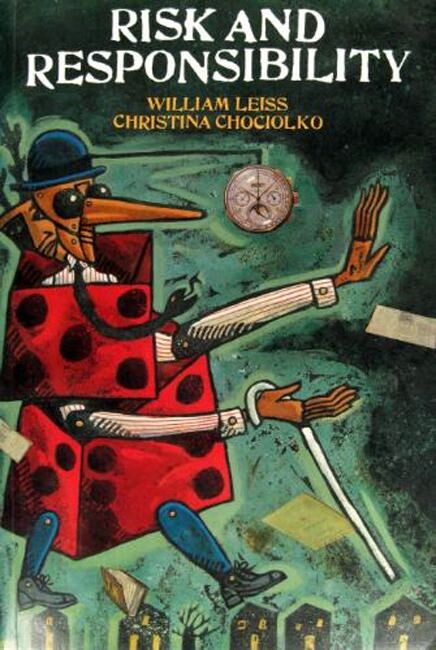
Risk and Responsibility
William Leiss and Christina Chociolko explain that controversies arise in part because many participants try to avoid assuming full responsibility for the consequences of the risk-taking they advocate. For example, one can indulge in the pleasure of nicotine addiction despite an awareness of the health risks and count on a publicly funded health care system to assume the responsibility for dealing with the resulting illnesses. They provide detailed case studies of the controversies over the effects of exposure to power frequency electric and magnetic fields and to the chemical pesticides alar and antisapstains. Shorter studies of exposure to tobacco, formaldehyde, and the pesticide alachlor are also presented. The authors address the difficulties of arriving at reliable scientific estimates of risk in such controversial areas, and the impact of this uncertainty on disagreements among different interest groups over how to manage those risks responsibly. In conclusion they attempt to delineate conditions under which consensus on the assessment and management of environmental health risks might be achieved among a wide range of interest groups. Risk and Responsibility will be of specific interest to policymakers and analysts, activists, and environmentalists, and of general interest to those working in relevant industries and members of the legal profession.
eBook
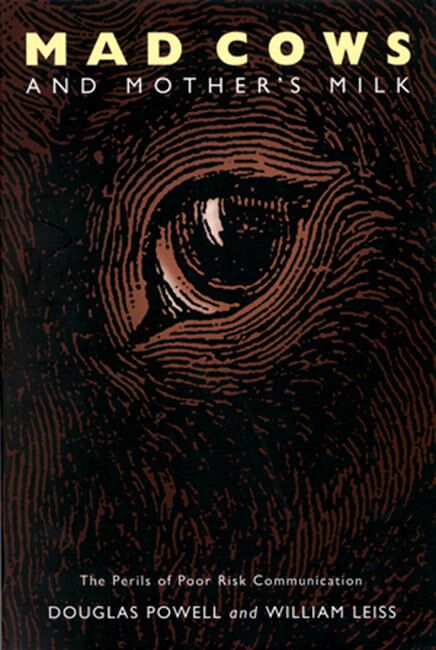
Mad Cows and Mother's Milk
The first case study deals with the mad cow fiasco of 1996, one of the most expensive and tragic examples of poor risk management in the last twenty-five years. For ten years the British government failed to acknowledge the possibility of a link between mad cow disease and Creuzfeldt-Jakob disease, the human equivalent, until increased scientific evidence and public pressure forced them to take action, resulting in the slaughter of more than one million cattle. The second study looks at what is commonly known as hamburger disease, caused by a virulent form of the E. coli bacterium, which has struck thousands and killed over thirty people in the last few years. Despite its widespread effects, it is unclear whether scientific knowledge on preventing the disease is reaching the public. Other case studies include the use of a genetically engineered hormone to increase milk production in cows, health risks associated with silicone breast implants, public controversies surrounding dioxins and PCBs, and the introduction of agricultural biotechnology. These case studies show that institutions routinely fail to communicate the scientific basis of various high-profile risks. These failures to inform the public make it difficult for governments, industry, and society to manage risk controversies sensibly and often result in massive costs. With its detailed analyses of specific risk management controversies, Mad Cows and Mother's Milk will help us avoid future mistakes.
eBook

Three Phases in the Evolution of Risk Communication Practice
Effective communication between interested parties is widely held to be a vital element in health and environmental risk management decision making. There have been three phases in the evolution of risk communication during the last twenty years. Phase I emphasized risk: in a modern industrial economy, we must have the capacity to manage risks at a very exacting level of detail. Phase II stresses communication: statements about risk situations are best regarded as acts of persuasive communication, that is, as messages intended to persuade a listener of the correctness of a point of view. Now, in Phase III, public and private sector institutions increasingly are recognizing their responsibility to deal adequately with both dimensions and to carry out sound risk communication as a matter of good business practice.
Journal Article

Risk Management and Precaution: Insights on the Cautious Use of Evidence
Risk management, done well, should be inherently precautionary. Adopting an appropriate degree of precaution with respect to feared health and environmental hazards is fundamental to risk management. The real problem is in deciding how precautionary to be in the face of inevitable uncertainties, demanding that we understand the equally inevitable false positives and false negatives from screening evidence. We consider a framework for detection and judgment of evidence of well characterized hazards, using the concepts of sensitivity, specificity, positive predictive value, and negative predictive value that are well established for medical diagnosis. Our confidence in predicting the likelihood of a true danger inevitably will be poor for rare hazards because of the predominance of false positives; failing to detect a true danger is less likely because false negatives must be rarer than the danger itself. Because most controversial environmental hazards arise infrequently, this truth poses a dilemma for risk management.
Journal Article