
Catalogue Search | MBRL


Are you sure you want to remove the book from the shelf?

{{itemTitle}}
311
result(s) for
"Li, Kefei"
Sort by:


Experimental Investigation on Transport Properties of Cement-Based Materials Incorporating 2D Crack Networks
This paper investigates the correlation between the geometry of crack networks and the altered transport properties of cement-based porous materials. Cracks were artificially introduced into slice specimens to obtain bidimensional (2D) crack networks, and the network was characterized by the crack density, orientation, connectivity and crack opening aperture. For the permeability, the water vapor sorption isotherms were measured and an algorithm was established to solve the intrinsic permeability of cracked specimens with the help of moisture transport modeling and the data of drying tests. The electrical conductivity of cracked specimens was measured using an alternative current method. The study on the specimens with percolated cracks shows that: (1) the pertinent geometry parameters for altered transport properties include average-based crack density, crack opening and local crack connectivity; (2) the water permeability of cracked specimens is correlated to the combination
b
1.7
ρ
f
and electrical conductivity to
b
0.45
ρ
f
; (3) the different exponents on the crack opening/length ratio reflect the resistance of tortuosity of crack paths to the water and current flow and this resistance is stronger for current flow.
Journal Article

Durability design of concrete structures : phenomena, modeling and practice
Comprehensive coverage of durability of concrete at both material and structural levels, with design related issues Links two active fields in materials science and structural engineering: the durability processes of concrete materials and design methods of concrete structures Facilitates communication between the two communities, helping to.
eBook

Quasi-Liquid Layer on Ice and Its Effect on the Confined Freezing of Porous Materials
Freezing of the water confined in thin pores can be destructive to the porous frame, but the effect of the quasi-liquid layer (QLL) between the confined ice and the pore walls remains still far from being fully understood. In the present study, the physical origins of the intermediate phase of QLL were discussed by thermodynamic analyses. Different interactions on QLL bring different models to estimate its thickness, which generally decays with temperature decreasing. Four representative models of QLL thickness were selected to unveil its effect on the growing rates and extents of ice in a concrete. The engineering consequences of the confined freezing were then discussed in the aspects of effective pore pressures built from the confined ice growth and deformations framed by a poro-elastic model. Overall, thickening QLL depresses ice growing rates and contents and, consequentially, decreases pore pressures and material deformations during freezing. The QLL corrections also narrow the gaps between the predicted and measured freezing deformations. The findings of this study contribute to profound understandings of confined freezing that may bridge over physical principles and engineering observations.
Journal Article
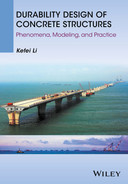
Durability Design of Concrete Structures
Comprehensive coverage of durability of concrete at both material and structural levels, with design related issues Links two active fields in materials science and structural engineering: the durability processes of concrete materials and design methods of concrete structures Facilitates communication between the two communities, helping to implement life-cycle concepts into future design methods of concrete structures Presents state-of-the-art information on the deterioration mechanism and performance evolution of structural concrete under environmental actions and the design methods for durability of concrete structures Provides efficient support and practical tools for life-cycle oriented structural design which has been widely recognized as a new generation of design philosophy for engineering structures The author has long experience working with the topic and the materials presented have been part of the author's current teaching course of Durability and Assessment of Engineering Structures for graduate students at Tsinghua University The design methods and approaches for durability of concrete structures are developed from newly finished high level research projects and have been employed as recommended provisions in design code including Chinese Code and Eurocode 2
eBook

HCAR2 Modulates the Crosstalk between Mammary Epithelial Cells and Macrophages to Mitigate Staphylococcus aureus Infection in the Mouse Mammary Gland
Staphylococcus aureus (S. aureus) is a major zoonotic pathogen, with mammary gland infections contributing to mastitis, a condition that poses significant health risks to lactating women and adversely affects the dairy industry. Therefore, understanding the immune mechanisms underlying mammary infections caused by S. aureus is essential for developing targeted therapeutic strategies against mastitis. This study identified hydroxycarboxylic acid receptor 2 (HCAR2) as a potential regulator of S. aureus infection in mammary glands. It is demonstrated that HCAR2 deficiency exacerbates the inflammatory response and disrupts the blood‐milk barrier in the mammary gland during S. aureus infection, with NLRP3 inflammasome‐mediated pyroptosis playing a central role. Activation of HCAR2, on the other hand, suppressed CMPK2 expression, thereby mitigating mitochondrial damage and pyroptosis in mouse mammary epithelial cells (mMECs) induced by S. aureus. Additionally, mitochondrial DNA (mtDNA) released from S. aureus‐infected mMECs activates the cGAS/STING signaling pathway in macrophages, impairing their bactericidal activity. In conclusion, this study highlights the critical role of HCAR2 in S. aureus infection of the mammary gland and provides a theoretical basis for identifying potential therapeutic targets for such infections. In the mammary gland infected with S. aureus, the activation of hydroxycarboxylic acid receptor 2 (HCAR2) in mammary epithelial cells (mMECs) leads to a reduction in CMPK2 expression, which in turn mitigates cell pyroptosis. The attenuation of pyroptosis in mMECs reduces the release of mitochondrial DNA (mtDNA) into the extracellular space, thereby alleviating the suppression of macrophage activity induced by S. aureus via the cGAS/STING‐dependent pathway.
Journal Article

Alk1 acts in non-endothelial VE-cadherin+ perineurial cells to maintain nerve branching during hair homeostasis
Vascular endothelial (VE)-cadherin is a well-recognized endothelial cell marker. One of its interacting partners, the TGF-β receptor Alk1, is essential in endothelial cells for adult skin vasculature remodeling during hair homeostasis. Using single-cell transcriptomics, lineage tracing and gene targeting in mice, we characterize the cellular and molecular dynamics of skin VE-cadherin
+
cells during hair homeostasis. We describe dynamic changes of VE-cadherin
+
endothelial cells specific to blood and lymphatic vessels and uncover an atypical VE-cadherin
+
cell population. The latter is not a predicted adult endovascular progenitor, but rather a non-endothelial mesenchymal perineurial cell type, which forms nerve encapsulating tubular structures that undergo remodeling during hair homeostasis. Alk1 acts in the VE-cadherin
+
perineurial cells to maintain proper homeostatic nerve branching by enforcing basement membrane and extracellular matrix molecular signatures. Our work implicates the VE-cadherin/Alk1 duo, classically known as endothelial-vascular specific, in perineurial-nerve homeostasis. This has broad implications in vascular and nerve disease.
Vascular endothelial (VE)-cadherin is a well-recognized endothelial cell marker. Here, the authors unveil unexpected heterogeneity in the skin VE-cadherin lineage, identifying a dynamic, non-endothelial VE-cadherin
+
perineurial cell population.
Journal Article

The carbon sinking-corrosion dilemma in concrete: insights from early-age CSA-PC mortar
Early-age enforced carbonation of cementitious materials presents a promising pathway for CO
2
sequestration and potential microstructural enhancement. However, its impact on the durability of reinforced concrete, particularly the risk of steel corrosion, remains a critical and unresolved dilemma. This study investigates the corrosion behavior of steel bars in a hybrid calcium sulfoaluminate-Portland cement (CSA-PC) mortar subjected to deep enforced carbonation at early ages (4, 24, and 72 h). Through a combined approach of electrochemical monitoring (OCP, PR, CCD) during 43 weeks of chloride exposure, and multi-scale characterization (XCT, BSE/EDS, XPS, TGA, NAD), we unravel the conflicting effects of carbonation. Results demonstrate that carbonation significantly accelerates steel corrosion, with the mean corrosion cluster volume doubling from 0.5 mm
3
to 1 mm
3
after just 4 h of carbonation at early age. While carbonation refined the pore structure of the mortar matrix, it also neutralized the alkaline environment, leading to the depassivation of steel and a one-order-of-magnitude increase in corrosion current density. Corrosion products extensively migrated into the mortar, with invasion distances up to 2 mm. These findings highlight a critical trade-off: although early-age carbonation densifies the microstructure, it concurrently creates a corrosive environment that severely compromises the passivation and long-term durability of embedded steel. Therefore, cautions should be alerted when early-age enforced carbonation is used to treat reinforced concrete.
Journal Article

Semiconducting Behaviour and Corrosion Resistance of Passive Film on Corrosion-Resistant Steel Rebars
Chloride-induced corrosion of steel rebars is one of the major causes of the premature failures of reinforced concrete structures served in different environments. This paper investigates the semiconducting behaviour and corrosion resistance of the passive film formed on the corrosion-resistant rebars exposed to simulated concrete pore solutions with different pH values and chloride concentrations. The electronic properties of the passive film were studied using potentiodynamic measurements and capacitance measurements (Mott–Schottky analysis). The results indicate that, firstly, the passive film of corrosion-resistant steel rebar shows n-type semiconducting behaviour with shallow and deep donor states in the band gap during passivation, and the deep donor energy level of corrosion-resistant steel rebar passive film is not sensitive to the decreasing pH value; secondly, under the same conditions, the passive film of corrosion-resistant rebars has a larger negative flat-band potential and thicker space charge layer than hot-ribbed rebars; thirdly, n-type semi-conductivity at a higher potential disappears once the chloride concentration at the rebar surface attains the chloride threshold value; and finally, a reverse charge layer forms on the surface of CR rebar at 0.50 V potential.
Journal Article

Skin vasculature and hair follicle cross-talking associated with stem cell activation and tissue homeostasis
Skin vasculature cross-talking with hair follicle stem cells (HFSCs) is poorly understood. Skin vasculature undergoes dramatic remodeling during adult mouse hair cycle. Specifically, a horizontal plexus under the secondary hair germ (HPuHG) transiently neighbors the HFSC activation zone during the quiescence phase (telogen). Increased density of HPuHG can be induced by reciprocal mutations in the epithelium (Runx1) and endothelium (Alk1) in adult mice, and is accompanied by prolonged HFSC quiescence and by delayed entry and progression into the hair growth phase (anagen). Suggestively, skin vasculature produces BMP4, a well-established HFSC quiescence-inducing factor, thus contributing to a proliferation-inhibitory environment near the HFSC. Conversely, the HFSC activator Runx1 regulates secreted proteins with previously demonstrated roles in vasculature remodeling. We suggest a working model in which coordinated remodeling and molecular cross-talking of the adult epithelial and endothelial skin compartments modulate timing of HFSC activation from quiescence for proper tissue homeostasis of adult skin.
Journal Article