
Catalogue Search | MBRL


Are you sure you want to remove the book from the shelf?

{{itemTitle}}
1,069
result(s) for
"Li, Li-Guan"
Sort by:

المتاحف الصينية /
يتناول كتاب (المتاحف الصينية) والذي قام بتأليفه (لي شيا نياو، لوه تشهون) في حوالي (195) صفحة من القطع المتوسط موضوع (المتاحف) مستعرضا المحتويات التالية : قراءة حضارة الأمة الصينية من المتاحف-الكنوز في الوطن-المساهمات من الأقليات القومية في الصين-البحث عن أصل التاريخ-كنوز الكهوف الحجرية الصينية-القصورتحت الأرض-الحضارة الصينية-البلوارت الإنسانية-أم الحدائق-موطن الأسلاف-السماء السوداء والأرض الصفراء.
Book

An omics-based framework for assessing the health risk of antimicrobial resistance genes
Antibiotic resistance genes (ARGs) are widespread among bacteria. However, not all ARGs pose serious threats to public health, highlighting the importance of identifying those that are high-risk. Here, we developed an ‘omics-based’ framework to evaluate ARG risk considering human-associated-enrichment, gene mobility, and host pathogenicity. Our framework classifies human-associated, mobile ARGs (3.6% of all ARGs) as the highest risk, which we further differentiate as ‘current threats’ (Rank I; 3%) - already present among pathogens - and ‘future threats’ (Rank II; 0.6%) - novel resistance emerging from non-pathogens. Our framework identified 73 ‘current threat’ ARG families. Of these, 35 were among the 37 high-risk ARGs proposed by the World Health Organization and other literature; the remaining 38 were significantly enriched in hospital plasmids. By evaluating all pathogen genomes released since framework construction, we confirmed that ARGs that recently transferred into pathogens were significantly enriched in Rank II (‘future threats’). Lastly, we applied the framework to gut microbiome genomes from fecal microbiota transplantation donors. We found that although ARGs were widespread (73% of genomes), only 8.9% of genomes contained high-risk ARGs. Our framework provides an easy-to-implement approach to identify current and future antimicrobial resistance threats, with potential clinical applications including reducing risk of microbiome-based interventions.
Antibiotic resistance genes are common but not all are of high risk to human health. Here, the authors develop an omics-based framework for ranking genes by risk that incorporates level of enrichment in human associated environments, gene mobility, and host pathogenicity.
Journal Article

إدارة الأزمات في زمن الأوبئة : مقالات لـ 56 عالما في الإدارة
يضم هذا الكتاب خلاصة تجارب وعصارة أفكار 56 عالما، هم من أبرز علماء الإدارة في الصين، وقد حملوا على عاتقهم مسؤولية قيادة المؤسسات الصينية لسنوات عديدة، وهو كتاب مرجعي لكل المؤسسات على المستوى العالمي والتي إن حدث لها ضرر في فترات الأزمات أو الأوبئة، فلن يتوقف هذا الضرر عند ملاكها أو المنتفعين منها، بل سيمتد أثره إلى قطاعات عريضة من العمالة، وسيضرب القوة الإنتاجية ولا سيما الصادرات والواردات وغيرها من الموارد. ومن ثم فهم محاربون على الخطوط الأولى، مثلهم مثل الأطباء في أزمة انتشار فيروس كورونا المستجد، وإن كان مجال تخصص كل مختلفا منهم عن الآخر، ففريق منهم ينقذ حياة الناس، بينما الفريق الآخر ينقذ أقواتهم. ولغة الكتاب لغة سهلة وبسيطة، تنطلق أفكاره من مواقف عامة وليست من مواقف خاصة محددة، ومن هنا تعد أفكاره صالحة للتطبيق على المؤسسات الصغيرة والمتوسطة في كل مكان، والتي أصبح لزاما عليها أن تلجأ للابتكار والإبداع إن أرادت الاستمرار على قيد الحياة، وبات عليها أن تبحث وسط ركام الأزمة عن الإيجابيات التي يمكن أن تهب لها حياة جديدة وسبلا مبتكرة للخلاص.
Book

Co-occurrence of antibiotic and metal resistance genes revealed in complete genome collection
The high frequency of antibiotic resistance is a global public health concern. More seriously, widespread metal pressure in the environment may facilitate the proliferation of antibiotic resistance via coselection of antibiotic resistance genes (ARGs) and metal resistance genes (MRGs). Given the lack of comprehensive understanding of the ARG and MRG coselection, in this study both abundance relationship and genetic linkage between ARGs and MRGs were rigorously investigated by performing a genomic analysis of a large complete genome collection. Many more ARGs were enriched in human-associated bacteria compared with those subjected to less anthropogenic interference. The signatures of ARG and MRG co-occurrence were much more frequent and the distance linkages between ARGs and MRGs were much more intimate in human pathogens than those less human-associated bacteria. Moreover, the co-occurrence structures in the habitat divisions were significantly different, which could be attributed to their distinct gene transfer potentials. More exogenous ARGs and MRGs on the genomes of human pathogens indicated the importance of recent resistance acquisition in resistome development of human commensal flora. Overall, the study emphasizes the potential risk associated with ARG and MRG coselection of both environmental and medical relevance.
Journal Article
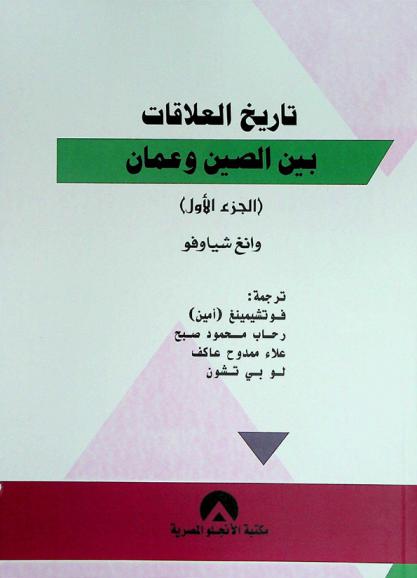
تاريخ العلاقات بين الصين وعمان
يستعرض هذا الكتاب الجوانب التاريخية والسياسية والثقافية للعلاقات بين الصين وسلطنة عمان، منذ العصور القديمة وحتى العصر الحديث، مع تركيز خاص على التبادل التجاري والبحري الذي ازدهر بين الجانبين عبر طريق الحرير البحري. يبرز الكتاب كيف شكل التواصل الحضاري بين الصين وعمان أحد أقدم النماذج للعلاقات السلمية في التاريخ، حيث ساهم البحارة العمانيون في نقل السلع والثقافات بين الشرق الأقصى والجزيرة العربية. كما يتناول العلاقات الدبلوماسية الحديثة بين البلدين، وتطورها في إطار الشراكات الاقتصادية ومبادرة الحزام والطريق، مؤكدا على الاحترام المتبادل والتعاون المتوازن بين البلدين عبر القرون.
BOOK

Tracking antibiotic resistance gene pollution from different sources using machine-learning classification
Background
Antimicrobial resistance (AMR) has been a worldwide public health concern. Current widespread AMR pollution has posed a big challenge in accurately disentangling source-sink relationship, which has been further confounded by point and non-point sources, as well as endogenous and exogenous cross-reactivity under complicated environmental conditions. Because of insufficient capability in identifying source-sink relationship within a quantitative framework, traditional antibiotic resistance gene (ARG) signatures-based source-tracking methods would hardly be a practical solution.
Results
By combining broad-spectrum ARG profiling with machine-learning classification SourceTracker, here we present a novel way to address the question in the era of high-throughput sequencing. Its potential in extensive application was firstly validated by 656 global-scale samples covering diverse environmental types (e.g., human/animal gut, wastewater, soil, ocean) and broad geographical regions (e.g., China, USA, Europe, Peru). Its potential and limitations in source prediction as well as effect of parameter adjustment were then rigorously evaluated by artificial configurations with representative source proportions. When applying SourceTracker in region-specific analysis, excellent performance was achieved by ARG profiles in two sample types with obvious different source compositions, i.e., influent and effluent of wastewater treatment plant. Two environmental metagenomic datasets of anthropogenic interference gradient further supported its potential in practical application. To complement general-profile-based source tracking in distinguishing continuous gradient pollution, a few generalist and specialist indicator ARGs across ecotypes were identified in this study.
Conclusion
We demonstrated for the first time that the developed source-tracking platform when coupling with proper experiment design and efficient metagenomic analysis tools will have significant implications for assessing AMR pollution. Following predicted source contribution status, risk ranking of different sources in ARG dissemination will be possible, thereby paving the way for establishing priority in mitigating ARG spread and designing effective control strategies.
Journal Article
Conserved phylogenetic distribution and limited antibiotic resistance of class 1 integrons revealed by assessing the bacterial genome and plasmid collection
Background
Integrons, especially the class 1 integrons, are major contributors to the acquisition and dissemination of antibiotic resistance genes (ARGs). However, comprehensive knowledge of the types, content, and distribution of integrons in bacterial taxa is lacking to evaluate their contribution.
Results
We have constructed a new integrase database and developed a pipeline that provides comprehensive recovery of class 1 integrons. Previous PCR-based techniques might only detect one fourth of the integron-integrases and integrons recovered in this study. By exploring the class 1 integrons in over 73,000 currently available complete and draft bacterial genomes, the contribution of class 1 integrons in spreading and acquiring ARGs was evaluated. Firstly, the host species of class 1 integrons are highly conserved within (96%) in class
Gammaproteobacteria
, dominated by four pathogenic species of “ESKAPE.” Secondly, more than half of class 1 integrons are embedded in chromosomes with less potential for horizontal gene transfer. Finally, ARGs that have been acquired by these integrons only cover 11% of all the ARG genotypes detected in bacterial genomes.
Conclusions
The above observations indicated that there are both biological and ecological limitations to class 1 integrons in acquiring and spreading ARGs across different classes of the domain
Bacteria
.
Journal Article

Online searching platform for the antibiotic resistome in bacterial tree of life and global habitats
ABSTRACT
Metagenomic analysis reveals that antibiotic-resistance genes (ARGs) are widely distributed in both human-associated and non-human-associated habitats. However, it is difficult to equally compare ARGs between samples without a standard method. Here, we constructed a comprehensive profile of the distribution of potential ARGs in bacterial tree of life and global habitats by investigating ARGs in 55 000 bacterial genomes, 16 000 bacterial plasmid sequences, 3000 bacterial integron sequences and 850 metagenomes using a standard pipeline. We found that >80% of all known ARGs are not carried by any plasmid or integron sequences. Among potential mobile ARGs, tetracycline and beta-lactam resistance genes (such as tetA, tetM and class A beta-lactamase gene) distribute in multiple pathogens across bacterial phyla, indicating their clinical relevance and importance. We showed that class 1 integrases (intI1) display a poor linear relationship with total ARGs in both non-human-associated and human-associated environments. Furthermore, both total ARGs and intI1 genes show little correlation with the degree of anthropogenicity. These observations highlight the need to differentiate ARGs of high clinical relevance. This profile is published on an online platform (ARGs-OSP, http://args-osp.herokuapp.com/) as a valuable resource for the most challenging topics in this field, i.e. the risk, evolution and emergence of ARGs.
Online searching platform for antibiotic resistome in bacterial tree of life and global habitats by big data mining into 54 718 bacterial genomes, 15 738 bacterial plasmids, 3000 bacterial integrons and 854 environmental metagenomes.
Journal Article

A Bias Correction Scheme for FY-3E/HIRAS-II Data Assimilation Based on EXtreme Gradient Boosting
More and more spaceborne infrared hyperspectral atmospheric observations are assimilated into data assimilation systems. The key to bias correction (BC) of these instruments depends on selecting predictors. However, it is difficult to find a set of predictors that are highly correlated with the O-B biases in all FY-3E/HIRAS-II channels, due to its multi-channel characteristics. A machine learning model XGBoost (EXtreme Gradient Boosting) BC scheme for FY-3E/HIRAS-II is established in this article. The selected predictors include model skin temperature, model total column water vapor, 1000–300 hPa thickness, 200–50 hPa thickness, scan position, observed brightness temperature (BT) and simulated BT. The method is also compared with the operational static BC and the variational BC, to validate its effect. The two-week data assimilation experiments show that the XGBoost BC is the most effective among the three BC schemes. The mean and standard deviation of O-B in all channels are the smallest after BC, and the effective observations through quality control are the largest, followed by the static BC. The static BC and variational BC are performed based on linear regression, which may lead to a small loss of valid observations in some channels that are weakly correlated with the predictor, whereas machine learning algorithms can search for the nonlinear correlation between biases and predictors. Compared with ERA5, both temperature- and humidity-analysis fields based on XGBoost BC are closest to ERA5 at all levels, and the root mean square errors do not change much over time.
Journal Article

YOLOv11-MFF: A multi-scale frequency-adaptive fusion network for enhanced CXR anomaly detection
Chest X-ray (CXR) represents one of the most widely utilized clinical diagnostic tools for thoracic diseases. Nevertheless, computer-aided diagnosis based on chest radiographs still faces considerable challenges in anomaly detection. Certain lesions in CXRs exhibit subtle radiographic characteristics with ambiguous boundaries, low pixel occupancy, and weak contrast. While existing studies primarily focus on improving multi-scale feature fusion, they frequently overlook complications arising from background noise and varied lesion morphology. This study introduces YOLOv11-MFF, an enhanced YOLOv11 network with three key innovations. Specifically, a novel Frequency-Adaptive Hybrid Gate (FAHG) is developed to improve contrast differentiation between lesions and background. A Multi Scale Parallel Large Convolution (MSPLC) block is designed and integrated with the original C3k2 module to expand receptive fields and enhance long-range modeling capacity. Furthermore, a Feature Fusion module (FF) is introduced to reinforce target-relevant feature representation through channel-wise modulation via weight recalibration mechanisms. Benefiting from these advancements, the network achieves significant improvements in detecting multi-scale and overlapping lesions. Experimental results on the public VinDr-CXR dataset demonstrate that YOLOv11-MFF outperforms state-of-the-art models, achieving a precision of 48.2%, recall of 42.5%, mAP@0.5 of 41.5%, and mAP@0.5:0.95 of 22.6%.
Journal Article