
Catalogue Search | MBRL


Are you sure you want to remove the book from the shelf?

{{itemTitle}}
8
result(s) for
"Lightman, Bernard V., 1950- editor"
Sort by:

A companion to the history of science
\"Over the last thirty-five years, the study of the history of science has undergone a shift in historiographical approach. While scholars previously focused on the history of abstract scientific discoveries by key figures like Galileo and Newton, contemporary science historians are turning to focus on richer, more descriptive studies within specific and local contexts. A Companion to the History of Science captures this move away from abstract theories and into more intimate analysis of science in its cultural, political, and social contexts. It aims to survey recent developments that have resulted from the effort to re-envision the field. The volume includes forty original essays written by experts in the field, structured around four analytical categories: the roles, places and spaces, communication, and tools of science. Contributors cut across traditional chronological and geographical boundaries to provide thematic analysis of these topics, including discussion of both Western and non-Western themes throughout the volume. These critical essays synthesize the major debates and issues that dominate current scholarly discussion, and point the way for future inquiry\"-- Provided by publisher.
Book
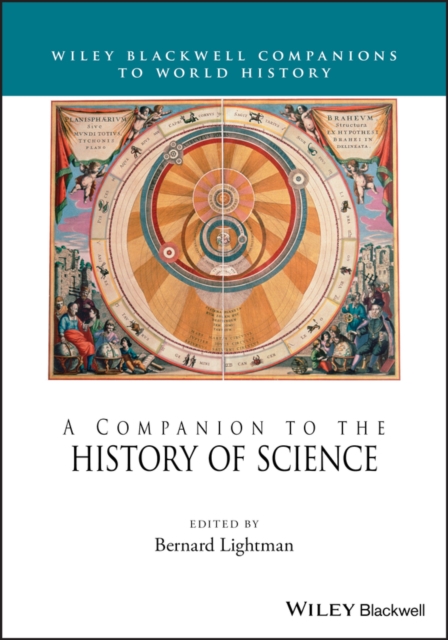
A companion to the history of science
The Wiley Blackwell Companion to the History of Science is a single volume companion that discusses the history of science as it is done today, providing a survey of the debates and issues that dominate current scholarly discussion, with contributions from leading international scholars.
* Provides a single-volume overview of current scholarship in the history of science edited by one of the leading figures in the field
* Features forty essays by leading international scholars providing an overview of the key debates and developments in the history of science
* Reflects the shift towards deeper historical contextualization within the field
* Helps communicate and integrate perspectives from the history of science with other areas of historical inquiry
* Includes discussion of non-Western themes which are integrated throughout the chapters
* Divided into four sections based on key analytic categories that reflect new approaches in the field
eBook

Victorian culture and the origin of disciplines
\"Current studies in disciplinarity range widely across philosophical and literary contexts, producing heated debate and entrenched divergences. Yet, despite their manifest significance for us today seldom have those studies engaged with the Victorian origins of modern disciplinarity. Victorian Culture and the Origin of Disciplines adds a crucial missing link in that history by asking and answering a series of deceptively simple questions: how did Victorians define a discipline; what factors impinged upon that definition; and how did they respond to disciplinary understanding? Structured around sections on professionalization, university curriculums, society journals, literary genres and interdisciplinarity, Victorian Culture and the Origin of Disciplines addresses the tangled bank of disciplinarity in the arts, humanities, social sciences and natural sciences including musicology, dance, literature, and art history; classics, history, archaeology, and theology; anthropology, psychology; and biology, mathematics and physics. Chapters examine the generative forces driving disciplinary formation, and gauge its success or failure against social, cultural, political, and economic environmental pressures. No other volume has focused specifically on the origin of Victorian disciplines in order to track the birth, death, and growth of the units into which knowledge was divided in this period, and no other volume has placed such a wide array of Victorian disciplines in their cultural context\"--Publisher.
Book

The circulation of knowledge between Britain, India and China : the early-modern world to the twentieth century
In The Circulation of Knowledge Between Britain, India and China, twelve scholars examine how knowledge, things and people moved within, and between, the East and the West from the early modern period to the twentieth century.
eBook

Victorian science in context
Victorians were fascinated by the flood of strange new worlds that science was opening to them. Exotic plants and animals poured into London from all corners of the Empire, while revolutionary theories such as the radical idea that humans might be descended from apes drew crowds to heated debates. Men and women of all social classes avidly collected scientific specimens for display in their homes and devoured literature about science and its practitioners. Victorian Science in Context captures the essence of this fascination, charting the many ways in which science influenced and was influenced by the larger Victorian culture. Contributions from leading scholars in history, literature, and the history of science explore questions such as: What did science mean to the Victorians? For whom was Victorian science written? What ideological messages did it convey? The contributors show how practical concerns interacted with contextual issues to mold Victorian science—which in turn shaped much of the relationship between modern science and culture.
eBook

