
Catalogue Search | MBRL


Are you sure you want to remove the book from the shelf?

{{itemTitle}}
73
result(s) for
"Lin, Sylvia Li-chun"
Sort by:


Representing Atrocity in Taiwan
In 1945, Taiwan was placed under the administrative control of the Republic of China, and after two years, accusations of corruption and a failing economy sparked a local protest that was brutally quashed by the Kuomintang government. The February Twenty-Eighth (or 2/28) Incident led to four decades of martial law that became known as the White Terror. During this period, talk of 2/28 was forbidden and all dissent violently suppressed, but since the lifting of martial law in 1987, this long-buried history has been revisited through commemoration and narrative, cinema and remembrance.
Drawing on a wealth of secondary theoretical material as well as her own original research, Sylvia Li-chun Lin conducts a close analysis of the political, narrative, and ideological structures involved in the fictional and cinematic representations of the 2/28 Incident and White Terror. She assesses the role of individual and collective memory and institutionalized forgetting, while underscoring the dangers of re-creating a historical past and the risks of trivialization. She also compares her findings with scholarly works on the Holocaust and the aftermath of the atomic bombings of Japan, questioning the politics of forming public and personal memories and the political teleology of \"closure.\" This is the first book to be published in English on the 2/28 Incident and White Terror and offers a valuable matrix of comparison for studying the portrayal of atrocity in a specific locale.
eBook


The lost garden
In this eloquent and atmospheric novel, Li Ang further cements her reputation as one of our most sophisticated contemporary Chinese-language writers.The Lost Gardenmoves along two parallel lines. In one, we relive the family saga of Zhu Yinghong, whose father, Zhu Zuyan, was a gentry intellectual imprisoned for dissent in the early days of Chiang Kai-shek's rule. After his release, Zhu Zuyan literally walled himself in his Lotus Garden, which he rebuilt according to his own desires.
Forever under suspicion, Zhu Zuyan indulged as much as he could in circumscribed pleasures, though they drained the family fortune. Eventually everything belonging to the household had to be sold, including the Lotus Garden. The second storyline picks up in modern-day Taipei as Zhu Yinghong meets Lin Xigeng, a real estate tycoon and playboy. Their cat-and-mouse courtship builds against the extravagant banquets and decadent entertainments of Taipei's wealthy businessmen. Though the two ultimately marry, their high-styled romance dulls over time, forcing them on a quest to rediscover enchantment in the Lotus Garden. An expansive narrative rich with intimate detail,The Lost Gardenis a moving portrait of the losses incurred as we struggle to hold on to our passions.
eBook


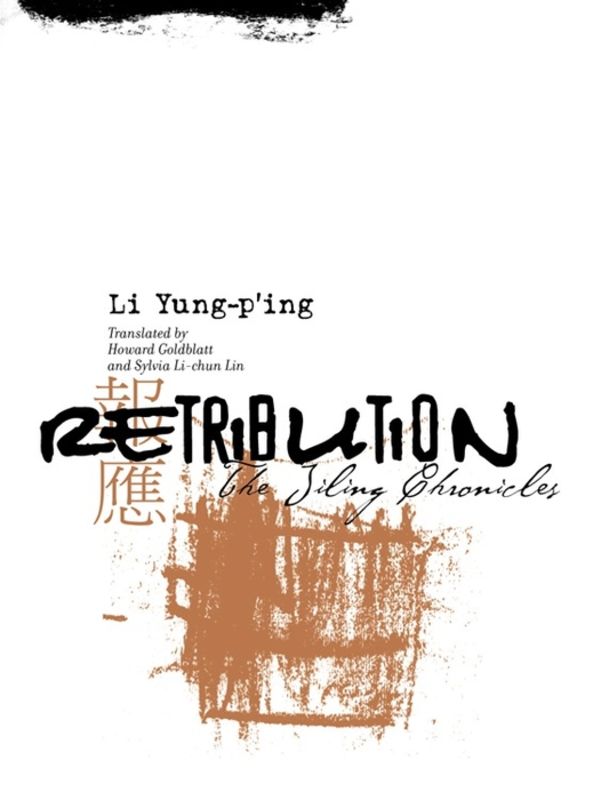
Retribution
Retribution opens with the raucous festivities surrounding the annual procession to honor the Bodhisattva Guanyin. Changsheng, the young wife of the local coffin maker Liu Laoshi, is raped while making an offering to Guanyin in the hope of increasing her chances of bearing a son. Changsheng hangs herself following the encounter, and Liu Laoshi exacts bloody vengeance on the rapist’s own wife and favorite prostitute. This act of sexual violence and its retribution provide the narrative pivot around which is woven a web of interconnecting stories, whose characters and events provide divergent perspectives on the rape and its aftermath. The result is an unforgettable exploration of the intersections of sexual desire, sadism, folk belief, and the inexorable cycles of karmic retribution.
eBook

Pink Pills and Black Hands: Women and Hygiene in Republican China
This essay investigates how the notion of hygiene was exploited for commercial and political agendas in the early Republican quest for modernity and national survival. Beginning with a study of advertisements for patent medicines by Western and Japanese pharmaceutical companies published in Funü zazhi (The Ladies' Journal), I examine the rhetorical and visual images that capitalized on, and contributed to, a general anxiety over women's health and the survival of the nation. In promoting their products, these companies were also selling a middleclass lifestyle that often deviated from patriotic concerns. In other words, the personal benefits of hygienic practices were sometimes seen as superseding national progress. This cultural agenda is further fortified in some of the contemporary fiction published in The Ladies Journal. Major writers in the subsequent decades also incorporated the notion of hygiene into their works, though some of them no longer displayed an unproblematized admiration for the power of hygiene. In the second half of the essay, I focus on Lu Xun's "Soap," Ling Shuhua's "Boredom" and Xiao Hong's "Hands" to illustrate how literary works revealed a certain degree of discontent and ambiguity as to what hygiene could contribute to the betterment of all strata of society.
Journal Article

