
Catalogue Search | MBRL


Are you sure you want to remove the book from the shelf?

{{itemTitle}}
205
result(s) for
"Linebaugh, Peter"
Sort by:

The Magna Carta manifesto : liberties and commons for all
This remarkable book shines a fierce light on the current state of liberty and shows how longstanding restraints against tyranny - and the rights of habeas corpus, trial by jury, and due process of law, and the prohibition of torture - are being abridged. In providing a sweeping history of Magna Carta, the source of these protections since 1215, this powerful book demonstrates how these ancient rights are repeatedly laid aside when the greed of privatization, the lust for power, and the ambition of empire seize a state. Peter Linebaugh draws on primary sources to construct a wholly original history of the Great Charter and its scarcely-known companion, the Charter of the Forest, which was created at the same time to protect the subsistence rights of the poor.
Book

The Magna Carta Manifesto
This remarkable book shines a fierce light on the current state of liberty and shows how longstanding restraints against tyranny—and the rights of habeas corpus, trial by jury, and due process of law, and the prohibition of torture—are being abridged. In providing a sweeping history of Magna Carta, the source of these protections since 1215, this powerful book demonstrates how these ancient rights are repeatedly laid aside when the greed of privatization, the lust for power, and the ambition of empire seize a state. Peter Linebaugh draws on primary sources to construct a wholly original history of the Great Charter and its scarcely-known companion, the Charter of the Forest, which was created at the same time to protect the subsistence rights of the poor.
eBook

Red round globe hot burning : A Tale at the Crossroads of the Commons and Closure, of Love and Terror, of Race and Class, and of Kate and Ned Despard
\"Red Round Globe Hot Burning tells the story of an Irish revolutionary, Edward Despard, and his wife, Catherine, an Afro-American abolitionist, in their efforts on both sides of the Atlantic to maintain the commons against attempts to enclose and privatize its land and resources. Their story takes the form of a quest, or two related searches for a woman and for the commons. The story begins in Ireland, joins them at first in Jamaica and then in central America, before returning to London and their final struggle on behalf of \"the principles of freedom, of humanity, and of justice.\" He attempted to organize an insurrection, she succeeded in halting the construction of the panopticon. His defeat at the gallows and hers in anonymous exile were part of a turning point in the history of the earth and the commencement of the anthropocene\"--Provided by publisher.
Book


The many-headed Hydra : sailors, slaves, commoners, and the hidden history of the revolutionary Atlantic
Using a decade of original research into the 17th and 18th century, this text unearths ideas and stories about liberty, democracy and freedom that terrified the ruling classes of the time and form the foundations of modern revolutions.

Albion's fatal tree : crime and society in eighteenth-century England
In the popular imagination, informed as it is by Hogarth, Swift, Defoe and Fielding, the eighteenth-century underworld is a place of bawdy knockabout, rife with colourful eccentrics. But the artistic portrayals we have only hint at the dark reality. In this new edition of a classic collection of essays, renowned social historians from Britain and America examine the gangs of criminals who tore apart English society, while a criminal law of unexampled savagery struggled to maintain stability. Douglas Hay deals with the legal system that maintained the propertied classes, and in another essay shows it in brutal action against poachers; John G. Rule and Cal Winslow tell of smugglers and wreckers, showing how these activities formed a natural part of the life of traditional communities. Together with Peter Linebaugh's piece on the riots against the surgeons at Tyburn, and E.P. Thompson's illuminating work on anonymous threatening letters, these essays form a powerful contribution to the study of social tensions at a transformative and vibrant stage in English history. -- Back cover.
Book
Palestine and the Commons 1 Or, Marx and the Musha'a
Linebaugh discusses the struggle for the liberation of Palestine and the concept of the commons, as well as the historical and geographical significance of Palestine. Palestine's planetary significance is threefold: first, there is its geography at the conjunction of three continents, Asia, Africa, and Europe, and the waters among them. Second, there are the extractions from the soil of Palestine, as well as from under it. And third, there is Palestine's significance concerning Christianity, Islam, and Judaism. Three big religions, three big continents, and original economies of cultivating the earth, mining the earth, and drilling the earth, making modes of production from the \"fertile crescent\" to the petroleum present with its terrible planetary perturbations. The struggle for the liberation of Palestine has geographic breadth and historical depth, which explains why it is considered the \"soul of the souls of all our struggles.\" The whole world has awakened to it.
Journal Article
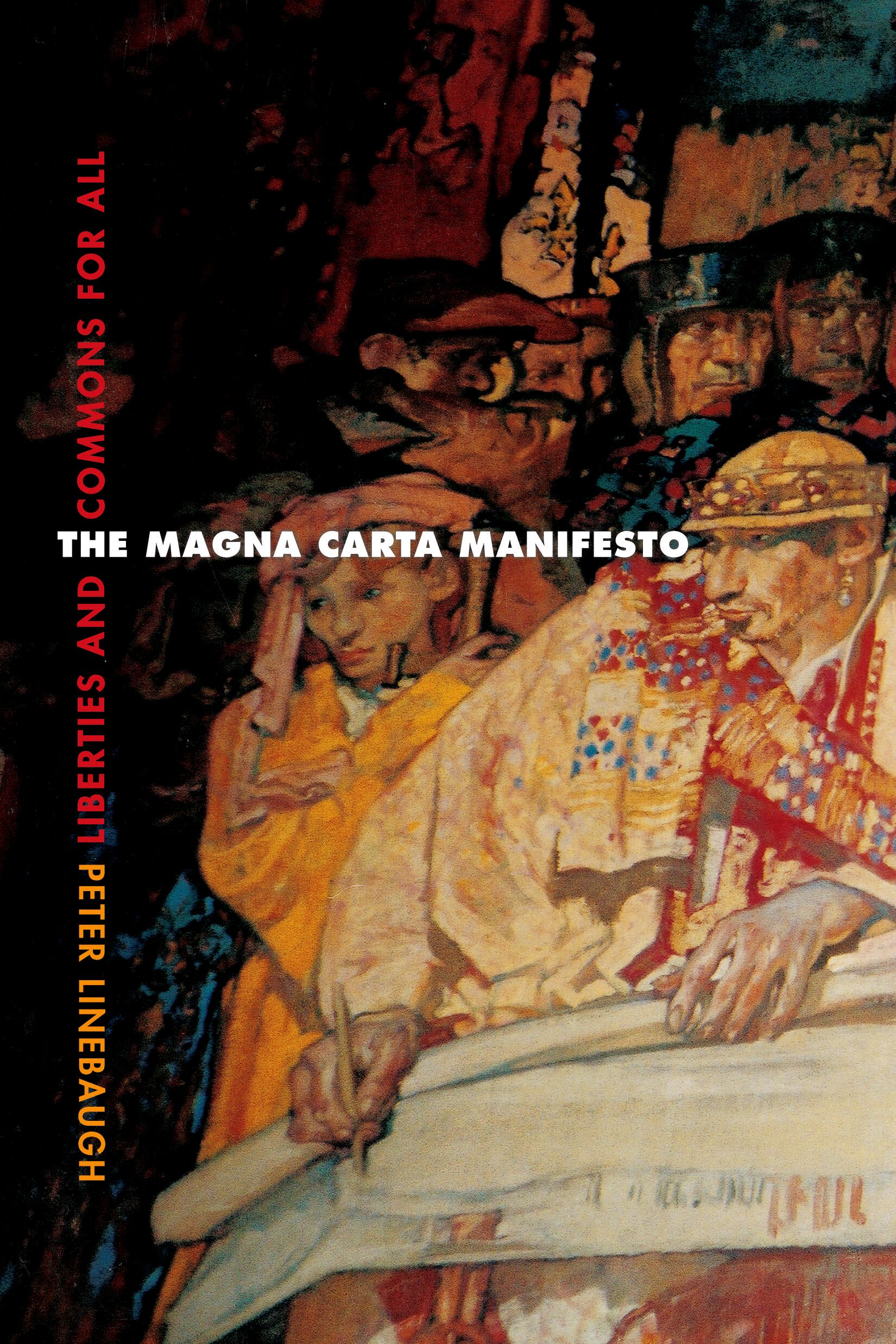
The Magna Carta Manifesto
This remarkable book shines a fierce light on the current state of liberty and shows how longstanding restraints against tyranny—and the rights of habeas corpus, trial by jury, and due process of law, and the prohibition of torture—are being abridged. In providing a sweeping history of Magna Carta, the source of these protections since 1215, this powerful book demonstrates how these ancient rights are repeatedly laid aside when the greed of privatization, the lust for power, and the ambition of empire seize a state. Peter Linebaugh draws on primary sources to construct a wholly original history of the Great Charter and its scarcely-known companion, the Charter of the Forest, which was created at the same time to protect the subsistence rights of the poor.
eBook

Karl Marx, the theft of wood, and working-class composition: a contribution to the current debate
The international working-class offensive of the 1960s sciences into a crisis from which they have not yet recovered. The offensive was launched in precisely those parts of the working class that capital had formerly attempted to contain within silent, often wageless reserves of the relative surplus population, that is, in North American ghettoes, in Caribbean islands, or in backward regions of the Mediterranean. As the political recomposition of the international working class threw into crisis the capitalist organization of labor markets, so that part of traditional social science, criminology, devoted to studying one of the corners in the labor market, criminal subcultures and street gangs, had to face a crisis of its own. In stating your own position, try to be as clear as possible even at the risk of overstatement. Everyone wishes to oppose the view that fossilizes particular compositions of the working class into eternal, even formulaic, patterns. Adapted from the source document.
Journal Article