
Catalogue Search | MBRL


Are you sure you want to remove the book from the shelf?

{{itemTitle}}
51
result(s) for
"Lippens, Ronnie"
Sort by:

Restoring Equilibrium (type II): Physiological Lessons for the 21st Century from Dr Guislain's (1797-1860) Art of Healing
There is, in this quite unsettled, 'atomising' or 'entropie' 21st century of ours (dixit Michel Houellebecq), an emerging and ongoing interest, in both fiction and non-fiction, in 19th and early 20th century psychiatry which, it too, had to find ways to deal with the mental or psychological fallout of massive social and cultural change. In this contribution an attempt will be made to explore the work of one pioneering alienist, i.e. Dr Joseph Guislain (1797-1860), whose work may, arguably, still hold relevance today. A visionary physician-cum-philosopher, as well as an amateur architect, Guislain himself drew up the plans for a Hospice (or asylum), a work of art in its own right, and a piece of technology for the purpose of healing or making whole again. Indeed, Guislain's biological and physiological insights, rooted in vitalist Naturphilosophie, held clues, and still do today, as to the art of healing, a notion that is not irrelevant in attempts to de-atomise communal life and culture.
Journal Article
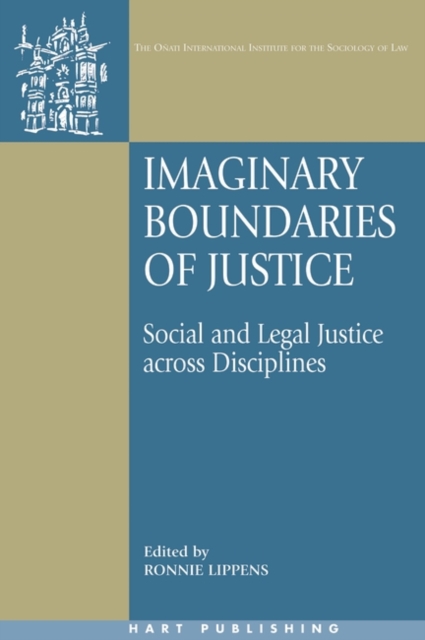
Imaginary Boundaries of Justice
It has become increasingly difficult to speak or even think social or legal justice in an age when words have left their moorings. Perhaps images are more stable than words; maybe images and imagery possess a certain viscosity,even a sensory quality, which prevents them from evaporating. This 'maybe' is what this book is about.
eBook

DEPTH IN 21ST-CENTURY CELLS? EUROPEAN SALAFI JIHADI TERRORISM AND PSYCHOANALYSIS IN THE LUCIFERIAN AGE
The psychoanalytic interpretation of Salafi jihadism and terrorism, or the application of psychoanalytic categories to said issues, are not very common. Indeed the mobilization of psychoanalysis in this context very often prompts accusations of orientalism and cultural imperialism. Both academic discourse and, to a lesser extent, policy, tend to “explain,” whether genuinely, strategically or tactically, or diplomatically, the emergence of “home-grown” Salafism by pointing to social, welfare, or educational deficits in the jihadists’ biographies. In this article we make an attempt to focus on psychoanalysis (or “depth psychology,” as it was sometimes called in a now-bygone age) to shed light on the phenomenon. Taking cues from Jan Hendrik van den Berg’s neo-Freudian and phenomenology-inspired critique of classical psychoanalysis on the one hand, and Peter Sloterdijk’s recent work on bastardy on the other, we offer a reading of European home-grown Salafi jihadist and terrorist inclination as reactions to failure, and as manifestations of a deep sense of inadequacy, in some of those who are unable to live up to what has become the predominant, imperative code in the cultural mainstream: to live one’s life in radical, complete, and total sovereignty, undetermined and in absolute omnipotence. This code, and the exigencies it imposes, we suggest, have become mainstream in the age which we have called Luciferian.
Journal Article
Connectivity, Ambivalence and Terror: Adlerian Speculations on the Great Refusal to Submit
To understand terrorism in this 'liquid' 21st century of ours (dixit the late Zygmunt Bauman) requires one to meticulously analyse individual biographies and corresponding life-worlds, meanings and intentions. In this contribution an attempt will be made to supplement -only supplement- such an endeavour by pointing to the undercurrent in the 'climate' of our contemporary age which, by most accounts, seems to be a deeply unsettling one. Starting from Zygmunt Bauman's reading -which he completed during the 1990s- of our time as the age in which it became clear that ambivalence is ineradicable, we will make an attempt here to paint the undercurrent, or 'climate' that resulted from this 'postmodern' awareness, as a Luciferian one, i.e. as one that thrives on, and is fuelled by, a radical desire for -or will to- absolute sovereignty. This desire -or will- aims, impossibly, and paradoxically, at superhuman non-submission. It imposes, however subtly, a Law that says: 'Thou Shalt never Submit. Never Ever! To Nothing and to No One!'. It is precisely in this undercurrent, or climate, that Alfred Adler's insights acquire a new import which they may, quite rightly perhaps, not have had when they were first written down. In an age of radicalised aspiring absolute sovereigns -Luciferians- the agony of frustration and feelings of inadequacy and inferiority are as inexhaustible as they are unbearable. It is here that Adler's Individualpsychologie (the depth psychology of 'in-dividual' social and interpersonal dynamics and relations) is able to shed some light at least on the farcically grotesque violence that mars our age.
Journal Article

Ambivalent Sovereigns and Restorative Justice: Exploring Conditions of Possibility and Impossibility for Restorative Justice in a Post-communicative Age
This contribution hopes to be able to contribute to answering the question:
whither restorative justice
? The restorative justice (RJ) movement has arrived at an existential crossroads. In this contribution an attempt is made to analyse how some of the origins of the RJ movement could be located in the emergence and crystallization of a new form of life (“control society”) in the wake of the Second World War. At the heart of this form of life one might be able to discern, on the one hand, a desire for and will to radical sovereignty, and, on the other, a resulting awareness of ambivalence. Whilst these aspects of post-war life have formed the backdrop of developments in RJ, and have therefore formed part of its conditions of possibility, one might now wonder if, in a post-communicative age such as ours, those very aspects have now become part of its conditions of impossibility. The argument explored in this contribution however holds that elements in the aforementioned form of life also hold potential for the re-thinking of restorative justice theory and practice.
Journal Article

Absolutely sovereign victims: rethinking the victim movement
The historical process that saw the gradual crystallization of this form of life started during and immediately after World War II. By the turn of the twenty-first century, the process was completed. This essay begins with reflections on events that took place in a small European country around that time that seem to be unrelated to the emergence and development of a victim culture. Yet a connection exists between the events there and the ultimate crystallitation, at about the same time, of a thoroughly pervasive victim culture throughout much of what used to be known as Western democracies. In the author's view, this form of life has had a crucial impact on the emergence and subsequent evolution of a victim culture, or even a victim movement. In what follows, he shall attempt to sketch the outlines of this process of emergence and evolution. The process, he believe, began during and immediately after the end of World War II.
Journal Article

Control Over Emergence: Images of Radical Sovereignty in Pollock, Rothko, and Rebeyrolle
The form of life which has the desire for or will to control over emergence at its core is, if not the dominant, then at least one of the more significant ones in late modern culture. To be in control over emergence requires a considerable degree of sovereignty. In this contribution I have made an attempt to outline and contrast three rather basic images or models of what might be called radical sovereignty, i.e., the vital-reflexive-transgressive one (which is referred to here as Nietzsche type 1), the existential-reflective-transcendent one (Nietzsche type 2), and the ambivalent-creative-transformative one (Nietzsche type 3). The analysis of paintings by post-war artists such as Jackson Pollock, Mark Rothko, and Paul Rebeyrolle is used to illustrate how the aforementioned types of radical sovereignty may have emerged, fully-fledged, in art, in the wake of the Second World War.
Journal Article