
Catalogue Search | MBRL


Are you sure you want to remove the book from the shelf?

{{itemTitle}}
200
result(s) for
"Lofton, Kathryn"
Sort by:
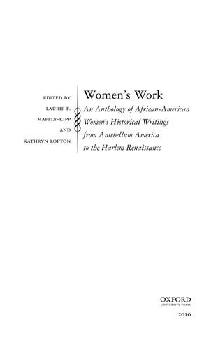
Women's work : an anthology of African-American women's historical writings from antebellum America to the Harlem Renaissance
\"This anthology aims to bring together writings by African-American women between 1832 and 1920, the period when they began to write for American audiences and to use history to comment on political and social issues of the day. The pieces are by more familiar nineteenth-century writers in Black America--like Maria Stewart, Francis E. W. Harper, and Alice Dunbar-Nelson--as well as lesser-known mothers and teachers whose participation in their local educational systems thrust them into national intellectual conversations. Each piece will have a headnote providing biographical information about its author as well as contextual information about its publication and the topic being discussed. The volume will contain a substantial introduction to the overall enterprise of Black women's historical writings. Because the editors are both trained in American studies and religious history, their introduction will particularly highlight religious themes and venues in which these writings were presented. This book should appeal to general readers of books like those in the Schomburg Library series, as well as those who work and teach American history, African American studies, women's studies, American literature, and American religious history\"--Provided by publisher.
Book

Oprah
“Today on Oprah,” intoned the TV announcer, and all over America viewers tuned in to learn, empathize, and celebrate. In this book, Kathryn Lofton investigates the Oprah phenomenon and finds in Winfrey’s empire—Harpo Productions, O Magazine, and her new television network—an uncanny reflection of religion in modern society. Lofton shows that when Oprah liked, needed, or believed something, she offered her audience nothing less than spiritual revolution, reinforced by practices that fuse consumer behavior, celebrity ambition, and religious idiom. In short, Oprah Winfrey is a media messiah for a secular age. Lofton’s unique approach also situates the Oprah enterprise culturally, illuminating how Winfrey reflects and continues historical patterns of American religions.
eBook

Can’t Help Lovin
This article examines the likability of hip-hop star Kanye West and The Voice champion Jordan Smith to explain the colonial terms for our pop culture taste. The writings of David Chidester establish the tie between religion and colonialism as an axiomatic one; he also argues that popular culture is a rich site for formations of religion. West and Smith offer an opportunity to argue the connection between these two strands of scholarly observance, showing the fractal effects of colonialism in Africa on the preferences of pop culture consumption in America. The attraction to West’s unlikability is the other side of the easy adoration for Jordan Smith: like those colonists who gave religion to those colonized subjects they dominated, pop consumers refuse to admit their intimate and needful connection to those idols who resist their control. Although organized by particular instances, this article seeks to encourage those in pop culture studies to see the erotic work of dislike; it seeks to encourage those in religious studies to see how pop subjects carry forward the classificatory imprints of colonial frontiers.
Journal Article

