
Catalogue Search | MBRL


Are you sure you want to remove the book from the shelf?

{{itemTitle}}
199
result(s) for
"London, April"
Sort by:

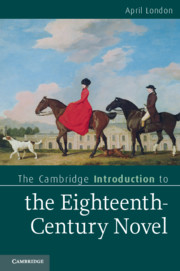
The Cambridge Introduction to the Eighteenth-Century Novel
In the eighteenth century, the novel became established as a popular literary form all over Europe. Britain proved an especially fertile ground, with Defoe, Fielding, Richardson and Burney as early exponents of the novel form. The Cambridge Introduction to the Eighteenth-Century Novel considers the development of the genre in its formative period in Britain. Rather than present its history as a linear progression, April London gives an original new structure to the field, organizing it through three broad thematic clusters – identity, community and history. Within each of these themes, she explores the central tensions of eighteenth-century fiction: between secrecy and communicativeness, independence and compliance, solitude and family, cosmopolitanism and nation-building. The reader will gain a thorough understanding of both prominent and lesser-known novels and novelists, key social and literary contexts, the tremendous formal variety of the early novel and its growth from a marginal to a culturally central genre.
eBook

The Cambridge introduction to the eighteenth-century novel
\"In the eighteenth century, the novel became established as a popular literary form all over Europe. Britain proved an especially fertile ground, with Defoe, Fielding, Richardson and Burney as early exponents of the novel form. The Cambridge Introduction to the Eighteenth-Century Novel considers the development of the genre in its formative period in Britain. Rather than present its history as a linear progression, April London gives an original new structure to the field, organizing it through three broad thematic clusters - identity, community and history. Within each of these themes, she explores the central tensions of eighteenth-century fiction: between secrecy and communicativeness, independence and compliance, solitude and family, cosmopolitanism and nation-building. The reader will gain a thorough understanding of both prominent and lesser-known novels and novelists, key social and literary contexts, the tremendous formal variety of the early novel and its growth from a marginal to a culturally central genre\"-- Provided by publisher.
Book
Women and Property in the Eighteenth-Century English Novel
This book investigates the critical importance of women to the eighteenth-century debate on property as conducted in the fiction of the period. April London argues that contemporary novels advanced several, often conflicting, interpretations of the relation of women to property, ranging from straightforward assertions of equivalence between women and things to subtle explorations of the self-possession open to those denied a full civic identity. Two contemporary models for the defining of selfhood through reference to property structure the book, one historical (classical republicanism and bourgeois individualism), and the other literary (pastoral and georgic). These paradigms offer a cultural context for the analysis of both canonical and less well-known writers, from Samuel Richardson and Henry Mackenzie to Clara Reeve and Jane West. While this study focuses on fiction from 1740–1800, it also draws on the historiography, literary criticism and philosophy of the period, and on recent feminist and cultural studies.
eBook
Women and property in the eighteenth-century English novel
This book investigates the critical importance of women to the eighteenth-century debate on property as conducted in the fiction of the period. April London argues that contemporary novels advanced several, often conflicting, interpretations of the relation of women to property, ranging from straightforward assertions of equivalence between women and things to subtle explorations of the self-possession open to those denied a full civic identity. Two contemporary models for the defining of selfhood through reference to property structure the book, one historical (classical republicanism and bourgeois individualism), and the other literary (pastoral and georgic). These paradigms offer a cultural context for the analysis of both canonical and less well-known writers, from Samuel Richardson and Henry Mackenzie to Clara Reeve and Jane West. While this study focuses on fiction from 1740-1800, it also draws on the historiography, literary criticism and philosophy of the period, and on recent feminist and cultural studies.
eBook


Clock time and utopia's time in novels of the 1970s
As utopian writing carved its niche, other genres were influenced by elements of structure and representational features of the utopian novel. London explores the way these influences were depicted across the lines of genre and politics in late eighteenth century novels.
Journal Article
