
Catalogue Search | MBRL


Are you sure you want to remove the book from the shelf?

{{itemTitle}}
4
result(s) for
"Lowenstein, Roger author"
Sort by:
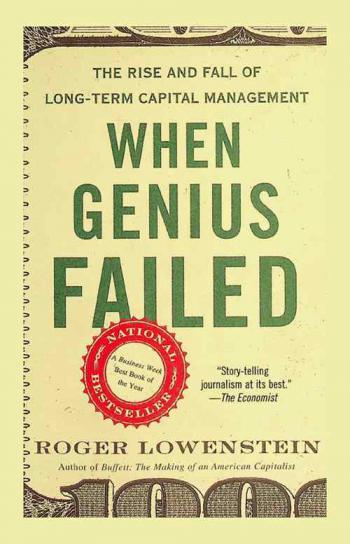
When genius failed : the rise and fall of Long-Term Capital Management
\"John Meriwether, a famously successful Wall Street trader, spent the 1980s as a partner at Salomon Brothers, establishing the best - and the brainiest - bond arbitrage group in the world. A mysterious and shy midwesterner, he knitted together a group of Ph. D.-certified arbitrageurs who rewarded him with filial devotion and fabulous profits. Then, in 1991, in the wake of a scandal involving one of his traders, Meriwether abruptly resigned. For two years, his fiercely loyal team - convinced that the chief had been unfairly victimized - plotted their boss's return. Then, in 1993, Meriwether made a historic offer. He gathered together his former disciples and a handful of supereconomists from academia and proposed that they become partners in a new hedge fund different from any Wall Street had ever seen. And so Long-Term Capital Management was born.\" \"When Genius Failed is the cautionary financial tale of our time, the saga of what happened when an elite group of investors believed they could actually deconstruct risk and use virtually limitless leverage to create limitless wealth.\"--Jacket.
Extinction Could Loom for Eisner
Exactly 20 years ago, Disney was a onetime corporate gem that had lost its luster. To fend off a pair of corporate raiders, the Disney family installed a new chief executive, a baby-faced former studio head named Michael Eisner. Then a 41-year-old corporate reformer, Eisner symbolized the rebirth of corporate America as it emerged from an era of stagnation. Today, as he and his lawyers try to marshal a defense against Comcast, a cable television giant, Eisner resembles an aging caudillo hanging onto power long past the flower of his youth. Whereas CEOs of the '70s had been criticized as bureaucrats, indifferent to their shareholders, the new executives were committed to raising their share price. And in his first decade or so, few chief executives delivered on this as well as Eisner. He not only re- energized the theme parks; he revived Disney's movie business and restored the magic in the Disney brand. Over his first 10 years, Disney stock rose by a phenomenal factor of 47. Academics, analysts and consultants praised this new breed of CEO for being committed to \"shareholder value.\" To enhance these executives' dedication even further, boards ladled out stock options, first by the barrel, then by the truckload. Disney was already in the reformers' sights before the Comcast bid. [Roy E. Disney] and a fellow director, Stanley Gold, had resigned from the board and were leading an insurgency to unseat the CEO they once had championed. They have planned a mass shareholder rally, sort of an anti-Eisner teach-in, for the day before the company's March 3 annual meeting in Philadelphia. By then, it may all be moot. The story of Michael Eisner, onetime corporate savior, has come full circle. Sounds like a Hollywood picture.
Newspaper Article

America's bank : the epic struggle to create the Federal Reserve
Chronicles the tumultuous era and remarkable personalities that created the Federal Reserve, tracing the financial panic and widespread distrust of bankers that prompted the landmark 1913 Federal Reserve Act and launched America's first steps onto the world financial stage.
Book

Reminiscences of a stock operator
\"Although Reminiscences...was first published some seventy years ago, its take on crowd psychology and market timing is a s timely as last summer's frenzy on the foreign exchange markets.\"-Worth magazine\"The most entertaining book written on investing is Reminiscences of a Stock Operator, by Edwin Lefèvre, first published in 1923.\"-The Seattle Times\"After twenty years and many re-reads, Reminiscences is still one of my all-time favorites.\"-Kenneth L. Fisher, Forbes\"A must-read classic for all investors, whether brand-new or experienced.\"-William O'Neil, founder and Chairman, Investor's Business Daily\"Whilst stock market tomes have come and gone, this remains popular and in print eighty years on.\"-GQ magazineFirst published in 1923, Reminiscences of a Stock Operator is the most widely read, highly recommended investment book ever. Generations of readers have found that it has more to teach them about markets and people than years of experience. This is a timeless tale that will enrich your life-and your portfolio.
eBook