
Catalogue Search | MBRL


Are you sure you want to remove the book from the shelf?

{{itemTitle}}
130
result(s) for
"Lugaro, Maria"
Sort by:

Presolar Grains as Probes of Supernova Nucleosynthesis
We provide an overview of the isotopic signatures of presolar supernova grains, specifically focusing on
44
Ti-containing grains with robustly inferred supernova origins and their implications for nucleosynthesis and mixing mechanisms in supernovae. Recent technique advancements have enabled the differentiation between radiogenic (from
44
Ti decay) and nonradiogenic
44
Ca excesses in presolar grains, made possible by enhanced spatial resolution of Ca-Ti isotope analyses with the Cameca NanoSIMS (Nano-scale Secondary Ion Mass Spectrometer) instrument. Within the context of presolar supernova grain data, we discuss (
i
) the production of
44
Ti in supernovae and the impact of interstellar medium heterogeneities on the galactic chemical evolution of
44
Ca/
40
Ca, (
ii
) the nucleosynthesis processes of neutron bursts and explosive H-burning in Type II supernovae, and (
iii
) challenges in identifying the progenitor supernovae for
54
Cr-rich presolar nanospinel grains. Drawing on constraints and insights derived from presolar supernova grain data, we also provide an overview of our current understanding of the roles played by various supernova types – including Type II, Type Ia, and electron capture supernovae – in accounting for the diverse array of nucleosynthetic isotopic variations identified in bulk meteorites and meteoritic components. We briefly overview the potential mechanisms that have been proposed to explain these nucleosynthetic variations by describing the transport and distribution of presolar dust carriers in the protoplanetary disk. We highlight existing controversies in the interpretation of presolar grain data and meteoritic nucleosynthetic isotopic variations, while also outlining potential directions for future research.
Journal Article

Neutron sources and neutron-capture paths in asymptotic giant branch stars
Roughly half of the abundances of the elements heavier than iron in the cosmos are produced by slow neutron captures (the s process) in hydrostatic conditions when the neutron density is below roughly 1013 n/cm-3. While it is observationally well confirmed that asymptotic giant branch (AGB) stars are the main site of the s process, we are still facing many problems in the theoretical models and nuclear inputs. Major current issues are the effect of stellar rotation and magnetic fields and the determination of the rate of the neutron source reactions. I will present these problems and discuss the observational constraints that can help us to solve them, including spectroscopically derived abundances, meteoritic stardust, and stellar seismology. Further, I will present evidence that the s process is not the only neutron-capture process to occur in AGB stars: an intermediate process is also required to explain recent observations of post-AGB stars.
Journal Article

The γ -process nucleosynthesis in core-collapse super-novae
Neutron-capture processes made most of the abundances of heavy elements in the Solar System, however they cannot produce a number of rare proton-rich stable isotopes ( p –nuclei) lying on the left side of the valley of stability. The γ –process, i.e., a chain of photodisintegrations starting on heavy nuclei, is recognized and generally accepted as a feasible process for the synthesis of p –nuclei in core collapse supernovae (CCSNe). However this scenario still leaves some puzzling discrepancies between theory and observations. We aim to explore in more detail the γ –process production from massive stars, using different sets of CCSNe models and the latest nuclear reaction rates. Here we show our preliminary analysis, by identifying the γ –process sites and focusing on progenitors of CCSNe that experience a C–O shell merger just before the collapse of the Fe core.
Journal Article

The Complex Behaviour of s-Process Element Abundances at Young Ages
Open clusters appear as simple objects in many respects, with a high degree of homogeneity in their (initial) chemical composition, and the typical solar-scaled abundance pattern that they exhibit for the majority of the chemical species. The striking singularity is represented by heavy elements produced from the slow process of the neutron-capture reactions. In particular, young open clusters (ages less than a few hundred Myr) give rise to the so-called barium puzzle: that is an extreme enhancement in their [Be/Fe] ratios, up to a factor of four of the solar value, which is not followed by other nearby s-process elements (e.g., lanthanum and cerium). The definite explanation for such a peculiar trend is still wanting, as many different solutions have been envisaged. We review the status of this field and present our new results on young open clusters and the pre-main sequence star RZ Piscium.
Journal Article
Origin of Plutonium-244 in the Early Solar System
We investigate the origin in the early Solar System of the short-lived radionuclide 244Pu (with a half life of 80 Myr) produced by the rapid (r) neutron-capture process. We consider two large sets of r-process nucleosynthesis models and analyse if the origin of 244Pu in the ESS is consistent with that of the other r and slow (s) neutron-capture process radioactive nuclei. Uncertainties on the r-process models come from both the nuclear physics input and the astrophysical site. The former strongly affects the ratios of isotopes of close mass (129I/127I, 244Pu/238U, and 247Pu/235U). The 129I/247Cm ratio, instead, which involves isotopes of a very different mass, is much more variable than those listed above and is more affected by the physics of the astrophysical site. We consider possible scenarios for the evolution of the abundances of these radioactive nuclei in the galactic interstellar medium and verify under which scenarios and conditions solutions can be found for the origin of 244Pu that are consistent with the origin of the other isotopes. Solutions are generally found for all the possible different regimes controlled by the interval (δ) between additions from the source to the parcel of interstellar medium gas that ended up in the Solar System, relative to decay timescales. If r-process ejecta in interstellar medium are mixed within a relatively small area (leading to a long δ), we derive that the last event that explains the 129I and 247Cm abundances in the early Solar System can also account for the abundance of 244Pu. Due to its longer half life, however, 244Pu may have originated from a few events instead of one only. If r-process ejecta in interstellar medium are mixed within a relatively large area (leading to a short δ), we derive that the time elapsed from the formation of the molecular cloud to the formation of the Sun was 9-16 Myr.
Journal Article
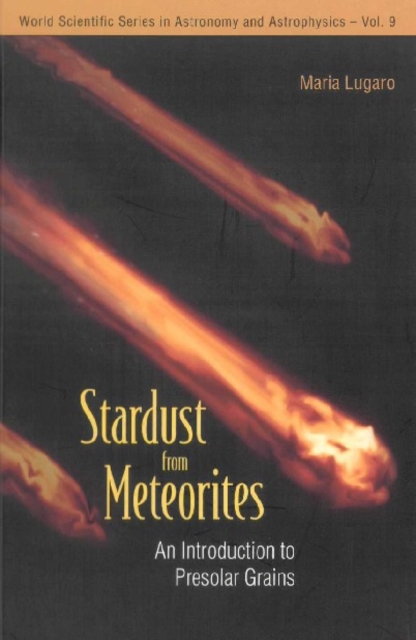
Stardust from meteorites
The study of presolar meteoritic grains is a new inter-disciplinary field that brings together topics from nuclear physics to astronomy and chemistry. Traditionally, most of the information about the cosmos has been gathered by observing light through telescopes. However, with the recent discovery that some dust grains extracted from primitive meteorites were produced in stellar environments, we now have the opportunity to gather information about stars and our Galaxy from the laboratory analysis of tiny pieces of stardust. Stellar grains represent a unique and fascinating subject of study. Their analysis is a breakthrough in research on stellar nucleosynthesis and the origin of the elements. While a number of specialized reviews exist on the topic, this book is the first work that brings together in a unified and accessible manner the background knowledge necessary for the study of presolar grains together with up-to-date discoveries in the field. The book includes exercise questions and answers, an extensive glossary for easy reference, and more than 40 figures and tables — from schematic diagrams to electron microscope images and graphs of results from stellar grain measurements and theoretical stellar models.
eBook
The RADIOSTAR Project
Radioactive nuclei are the key to understanding the circumstances of the birth of our Sun because meteoritic analysis has proven that many of them were present at that time. Their origin, however, has been so far elusive. The ERC-CoG-2016 RADIOSTAR project is dedicated to investigating the production of radioactive nuclei by nuclear reactions inside stars, their evolution in the Milky Way Galaxy, and their presence in molecular clouds. So far, we have discovered that: (i) radioactive nuclei produced by slow (107Pd and 182Hf) and rapid (129I and 247Cm) neutron captures originated from stellar sources —asymptotic giant branch (AGB) stars and compact binary mergers, respectively—within the galactic environment that predated the formation of the molecular cloud where the Sun was born; (ii) the time that elapsed from the birth of the cloud to the birth of the Sun was of the order of 107 years, and (iii) the abundances of the very short-lived nuclei 26Al, 36Cl, and 41Ca can be explained by massive star winds in single or binary systems, if these winds directly polluted the early Solar System. Our current and future work, as required to finalise the picture of the origin of radioactive nuclei in the Solar System, involves studying the possible origin of radioactive nuclei in the early Solar System from core-collapse supernovae, investigating the production of 107Pd in massive star winds, modelling the transport and mixing of radioactive nuclei in the galactic and molecular cloud medium, and calculating the galactic chemical evolution of 53Mn and 60Fe and of the p-process isotopes 92Nb and 146Sm.
Journal Article

The origin of s-process isotope heterogeneity in the solar protoplanetary disk
Rocky asteroids and planets display nucleosynthetic isotope variations that are attributed to the heterogeneous distribution of stardust from different stellar sources in the solar protoplanetary disk. Here we report new high-precision palladium isotope data for six iron meteorite groups. The palladium data display smaller nucleosynthetic isotope variations than the more refractory neighbouring elements. Based on this observation, we present a model in which thermal destruction of interstellar dust in the inner Solar System results in an enrichment of
s
-process-dominated stardust in regions closer to the Sun. We propose that stardust is depleted in volatile elements due to incomplete condensation of these elements into dust around asymptotic giant branch stars. This led to the smaller nucleosynthetic variations for Pd reported here and the lack of such variations for more volatile elements. The smaller magnitude variations measured in heavier refractory elements suggest that material from high-metallicity asymptotic giant branch stars is the dominant source of stardust in the Solar System. These stars produce fewer heavy
s
-process elements (proton number
Z
≥ 56) compared with the bulk Solar System composition.
Dust in the Solar System originates primarily in two locations: the interstellar medium and stellar outflows. On the basis of measurements of palladium isotopes in iron meteorites, Ek et al. suggest that the interstellar component was destroyed in the inner Solar System, revealing an enhancement of
s
-process isotopes from stardust.
Journal Article

From reactors to stars
This
Eur. Phys. J. A
volume
58
is dedicated to the life and work of Dr. Franz Käppeler from Karlsruhe Institute for Technology (KIT) who died on 20 November 2021, after a short illness. He was one of the leading experimentalists in the field of experimental nuclear astrophysics in Germany and worldwide for decades. Many of the authors of this volume knew Franz personally and many others were directly or indirectly inspired by his work and personality. All references in this introductory article refer to publications in this volume, not necessary to actual work by Dr. Käppeler.
Journal Article

Underground nuclear astrophysics experiment JUNA in China
Underground Nuclear Astrophysics in China (JUNA) will take the advantage of the ultra-low background in Jinping underground lab. High current accelerator with an ECR source and detectors were commissioned. JUNA plans to study directly a number of nuclear reactions important to hydrostatic stellar evolution at their relevant stellar energies. At the first period, JUNA aims at the direct measurements of 25Mg(p,γ)26 Al, 19F(p,α) 16 O, 13C(α, n) 16O and 12C(α,γ) 16O near the Gamow window. The current progress of JUNA will be given.
Journal Article