
Catalogue Search | MBRL


Are you sure you want to remove the book from the shelf?

{{itemTitle}}
38
result(s) for
"Lundstrom, Catrin"
Sort by:


“We Foreigners Lived In Our Foreign Bubble”: Understanding Colorblind Ideology In Expatriate Narratives1
Racial colorblindness—the desire to not “see color”—or avoiding any use of the term “race” itself, has been an antiracist imperative in post‐WWII Sweden in order to leave behind the prior era of eugenics and racial thinking. Through a multi‐sited linguistic ethnographic study, this article examines how 46 returning Swedish expatriate women talk about race and whiteness in race‐related experiences and interactions, using colorblind language. By analyzing the implicit contextual associations and dissociations made between race, language, subjectivity, and nation, a system of ideas and cognitive structures mapping perceptions and constructions of the world is exposed; of national belonging, racialized bodies, racial hierarchies, and perceptions of the West itself. In their migrant narratives, however, the categories used could be ascribed opposite meanings, depending on subjectivity and context. In this logic, language and nationality becomes “visible” or “hidden” depending on time and place, while “visible whiteness” can be associated with either an undesirable sense of difference or a set of unspoken privileges.
Journal Article

THE WHITE SIDE OF MIGRATION
‘The migrant’ tends to be imagined as a non-privileged, non-white, non-western subject in search of a better future in Europe or the United States and as such is a pre-constituted subject shaped by notions of marginalization and poverty. What kinds of stories are obscured by this recurrent image of ‘the migrant’ and how do such categorizations hamper the analysis of privilege, belonging and white normativity within studies of migration? Why are some individuals not regarded as migrants despite their migrant status? Why are other individuals seen as migrants and thus denied their national belonging in spite of their formal status as national citizens? The article develops analytical tools on migration, belonging and citizenship, with particular attention to (a) autochthony and belonging, (b) race and citizenship and (c) white capital.
Journal Article

We Foreigners Lived In Our Foreign Bubble
Racial colorblindness—the desire to not “see color”—or avoiding any use of the term “race” itself, has been an antiracist imperative in post-WWII Sweden in order to leave behind the prior era of eugenics and racial thinking. Through a multi-sited linguistic ethnographic study, this article examines how 46 returning Swedish expatriate women talk about race and whiteness in race-related experiences and interactions, using colorblind language. By analyzing the implicit contextual associations and dissociations made between race, language, subjectivity, and nation, a system of ideas and cognitive structures mapping perceptions and constructions of the world is exposed; of national belonging, racialized bodies, racial hierarchies, and perceptions of the West itself. In their migrant narratives, however, the categories used could be ascribed opposite meanings, depending on subjectivity and context. In this logic, language and nationality becomes “visible” or “hidden” depending on time and place, while “visible whiteness” can be associated with either an undesirable sense of difference or a set of unspoken privileges.
Journal Article
I DIDN’T COME HERE TO DO HOUSEWORK
On the basis of 13 in-depth interviews with Swedish women and one month of ethnographic work in the Swedish community in Singapore in 2009, this article examines how Swedish women, travelling from Sweden to Singapore as “expatriate wives” in the wake of their Swedish husbands, navigate gendered and racialised transnational spaces of domestic work and negotiating their changed identities as both housewives and employers of live-in maids in the household. How do the women justify their current division of labour in the light of Swedish national ideologies of work and Swedish ideals of gender and class equality?
Journal Article
“We Foreigners Lived In Our Foreign Bubble”: Understanding Colorblind Ideology In Expatriate Narratives 1
Racial colorblindness—the desire to not “see color”—or avoiding any use of the term “race” itself, has been an antiracist imperative in post‐WWII Sweden in order to leave behind the prior era of eugenics and racial thinking. Through a multi‐sited linguistic ethnographic study, this article examines how 46 returning Swedish expatriate women talk about race and whiteness in race‐related experiences and interactions, using colorblind language. By analyzing the implicit contextual associations and dissociations made between race, language, subjectivity, and nation, a system of ideas and cognitive structures mapping perceptions and constructions of the world is exposed; of national belonging, racialized bodies, racial hierarchies, and perceptions of the West itself. In their migrant narratives, however, the categories used could be ascribed opposite meanings, depending on subjectivity and context. In this logic, language and nationality becomes “visible” or “hidden” depending on time and place, while “visible whiteness” can be associated with either an undesirable sense of difference or a set of unspoken privileges.
Journal Article
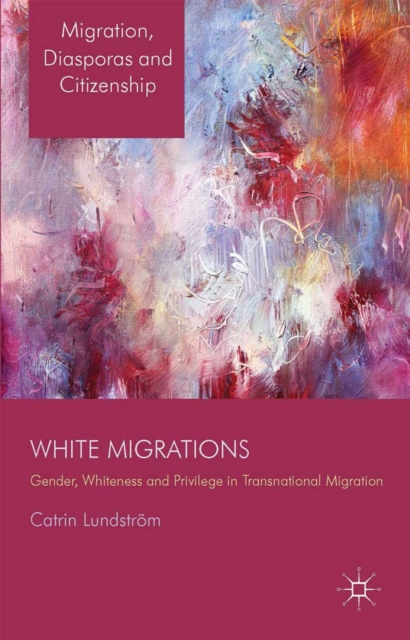
White Migrations
From a multi-sited ethnography with Swedish migrant women in the United States, Singapore and Spain, the book explores gender vulnerabilities and racial and class privilege in contemporary feminized migration, filling a gap in literature on race and migration.
eBook