
Catalogue Search | MBRL


Are you sure you want to remove the book from the shelf?

{{itemTitle}}
1,373
result(s) for
"Luttwak, Edward"
Sort by:

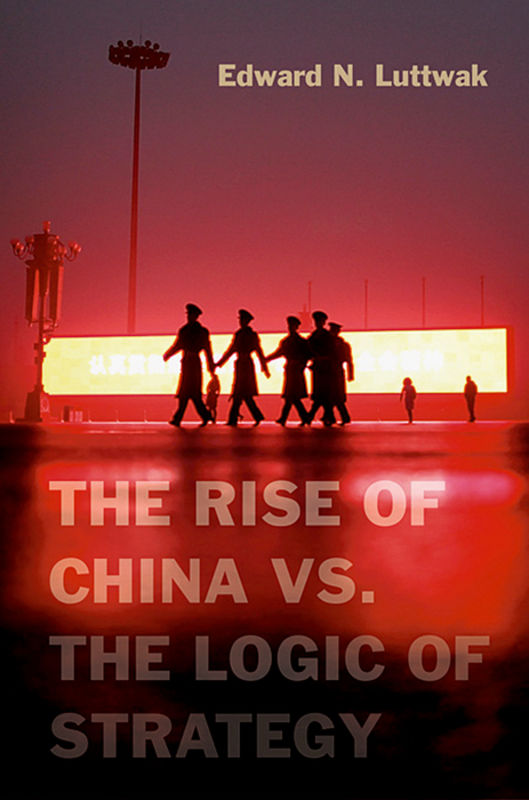
The Rise of China vs. the Logic of Strategy
As the rest of the world worries about what a future might look like under Chinese supremacy, Luttwak worries about China’s own future prospects. Applying the logic of strategy for which he is well known, he argues that the world’s second largest economy may be headed for a fall unless China’s leaders check their military ambitions.
eBook

The Rise of China vs. the Logic of Strategy
As the rest of the world worries about what a future might look like under Chinese supremacy, Edward Luttwak worries about China's own future prospects. Applying the logic of strategy for which he is well known, Luttwak argues that the most populous nation on Earth—and its second largest economy—may be headed for a fall.
For any country whose rising strength cannot go unnoticed, the universal logic of strategy allows only military or economic growth. But China is pursuing both goals simultaneously. Its military buildup and assertive foreign policy have already stirred up resistance among its neighbors, just three of whom—India, Japan, and Vietnam—together exceed China in population and wealth. Unless China's leaders check their own ambitions, a host of countries, which are already forming tacit military coalitions, will start to impose economic restrictions as well.
Chinese leaders will find it difficult to choose between pursuing economic prosperity and increasing China's military strength. Such a change would be hard to explain to public opinion. Moreover, Chinese leaders would have to end their reliance on ancient strategic texts such as Sun Tzu's Art of War. While these guides might have helped in diplomatic and military conflicts within China itself, their tactics—such as deliberately provoking crises to force negotiations—turned China's neighbors into foes. To avoid arousing the world's enmity further, Luttwak advises, Chinese leaders would be wise to pursue a more sustainable course of economic growth combined with increasing military and diplomatic restraint.
eBook

The grand strategy of the Roman Empire : from the first century CE to the third
\"At the height of its power, the Roman Empire encompassed the entire Mediterranean basin, extending much beyond it from Britain to Mesopotamia, from the Rhine to the Black Sea. Rome prospered for centuries while successfully resisting attack, fending off everything from overnight robbery raids to full-scale invasion attempts by entire nations on the move. How were troops able to defend the Empire's vast territories from constant attacks? And how did they do so at such moderate cost that their treasury could pay for an immensity of highways, aqueducts, amphitheaters, city baths, and magnificent temples? In The Grand Strategy of the Roman Empire, seasoned defense analyst Edward N. Luttwak reveals how the Romans were able to combine military strength, diplomacy, and fortifications to effectively respond to changing threats. Rome's secret was not ceaseless fighting, but comprehensive strategies that unified force, diplomacy, and an immense infrastructure of roads, forts, walls, and barriers. Initially relying on client states to buffer attacks, Rome moved to a permanent frontier defense around 117 CE. Finally, as barbarians began to penetrate the empire, Rome filed large armies in a strategy of \"defense-in-depth,\" allowing invaders to pierce Rome's borders. This updated edition has been extensively revised to incorporate recent scholarship and archeological findings. A new preface explores Roman imperial statecraft. This illuminating book remains essential to both ancient historians and students of modern strategy\"-- Provided by publisher.
Book


Coup d'âetat : a practical handbook
\"A book that aids understanding how governments and states really work. That aim is pursued by presenting in full detail how a coup d'âetat would be planned and executed, from the first approach to fellow-conspirators, to the post-coup announcements promising a new era of progress and stability. Coup d' âEtat has continued to find readers around the world----it has appeared in sixteen foreign languages--but with the passage of time, this fully revised new edition became necessary. Even readers who do not plan to use it as a practical handbook will find it interesting, as well as instructive.\"--Provided by publisher.
Book

Towards Affordable Weapons
Most current military equipment is produced in limited series, making them more expensive. They try to fit technological innovations into almost unchanged World War II platforms. New multirole platforms should be invented (UAV, versatile aircraft, etc.), allowing the integration of the greatest number of new technologies and mass-production.
Journal Article
