
Catalogue Search | MBRL


Are you sure you want to remove the book from the shelf?

{{itemTitle}}
361
result(s) for
"Lynch, Gerald"
Sort by:
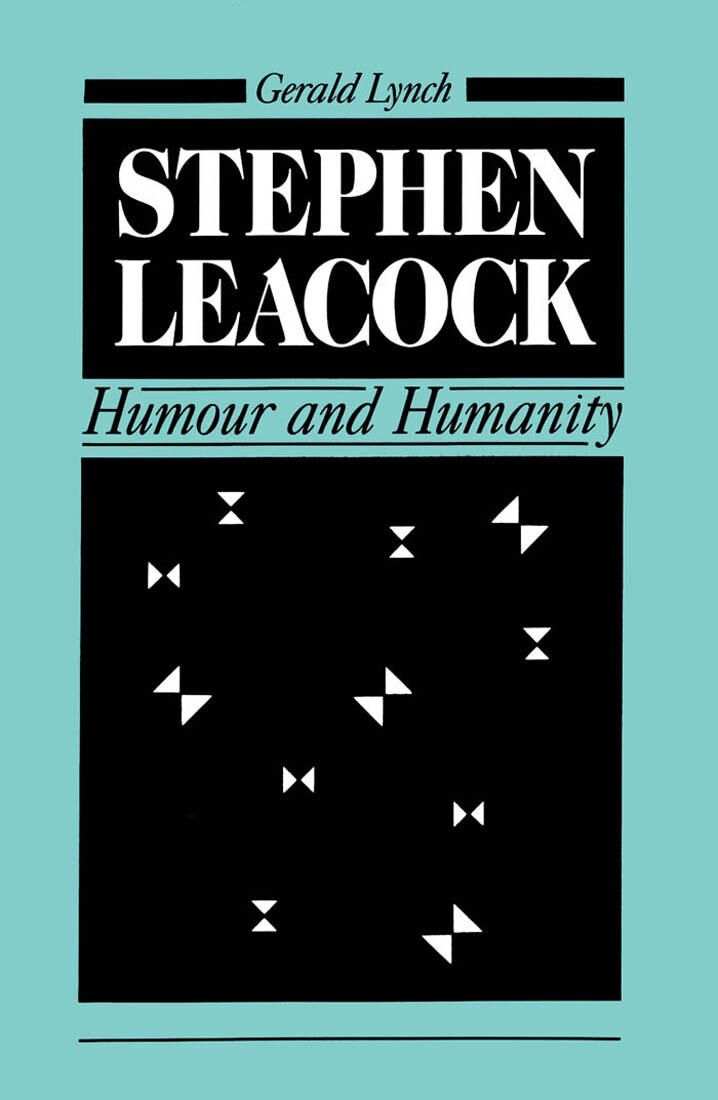
Stephen Leacock
From the preface: \"Stephen Leacock is still often regarded as a writer of lightweight amusements and unchallenging satire, as an author without an imaginative centre who lacked a vision of sufficient power and clarity to sustain a lifetime of serious writing. According to this view, which has been too easily received, Leacock squandered an early, promising talent (though he was in fact, middle-aged when he published Sunshine Sketches of a Little Town in 1912), and consequently his writings, like his legendary Lord Ronald, \"rode madly off in all directions.\" After years of chasing down Leacock's numerous literary mounts, I can assert that none of this is true. Leacock's writing emerges from a centre that is the confluence of the two traditions of humanism and toryism, traditions that found in Leacock fertile ground for the propagation of such qualities as tolerance of human fallibility and acceptance of social responsibility. What is remarkable with respect to Leacock's literary output is that even his furthest-flung, seemingly inconsequential humourous pieces move in relation to this tory-humanist centre.\" Lynch invites us to accompany him on an odyssey through Leacock's two main works, Sunshine Sketches and Arcadian Adventures of the Idle Rich ... He aspires to enlighten the open-minded reader, and is highly successful in doing so.\" Elspeth Cameron, Coordinator of Canadian Literature and Language Program, New College, University of Toronto
eBook

The One and the Many
Lynch maintains that a version of the ?Great Canadian Novel? may already have been written ? as a great Canadian short story cycle, the literary form that occupies the middle ground between short stories and novels
eBook
Stephen Leacock
From the preface: \"Stephen Leacock is still often regarded as a writer of lightweight amusements and unchallenging satire, as an author without an imaginative centre who lacked a vision of sufficient power and clarity to sustain a lifetime of serious writing. According to this view, which has been too easily received, Leacock squandered an early, promising talent (though he was in fact, middle-aged when he published Sunshine Sketches of a Little Town in 1912), and consequently his writings, like his legendary Lord Ronald, \"rode madly off in all directions.\" After years of chasing down Leacock's numerous literary mounts, I can assert that none of this is true. Leacock's writing emerges from a centre that is the confluence of the two traditions of humanism and toryism, traditions that found in Leacock fertile ground for the propagation of such qualities as tolerance of human fallibility and acceptance of social responsibility. What is remarkable with respect to Leacock's literary output is that even his furthest-flung, seemingly inconsequential humourous pieces move in relation to this tory-humanist centre.\" Lynch invites us to accompany him on an odyssey through Leacock's two main works, Sunshine Sketches and Arcadian Adventures of the Idle Rich ... He aspires to enlighten the open-minded reader, and is highly successful in doing so.\" Elspeth Cameron, Coordinator of Canadian Literature and Language Program, New College, University of Toronto
eBook

STARRY-EYED
True, for modem and then postmodern me the medium of romance's promise had degenerated somewhat, from troubadour vows and love sonnets to trashy novels, trashier movies, the miracle of music videos, YouTube, Facebook, Instagram, smart phones, sexting, the multiverse of internet pom, and of course web-dating services (Tinder, Twitter, Titter, Bumble, Bumfuck, whatever; what a nightmare, been there- that place where horny romantic die-hards go to lie and die hard-done that). For Julia in July I was a joker-haha!-a John Lennonish fol sage spraying a verbal fusillade of bad puns and double entendres that would have made a half-wit puke. Because women love a man who makes them laugh, right? Is there an emoticon to signal irony? Because I am too short for a man: 4'11¾\", As that asshole Sam Blank, my titular \"best friend,\" once brutally answered my rhetorical query after I'd mistakenly-that is, drunkenly-spilled my romantic beans one late night at the Hibou Jam (though Blank spoke nowhere near this eloquently): Women, in accommodating themselves to the reality principle, will compromise the tall-dark-and-handsome ideal of male beauty. If I hadn't been standing right there at the end of the line at that moment (lunchtime it was), and she hadn't been in the habit of getting a pot of hot water for the strange brew she had every day, the foreordained meeting would never have occurred.
Journal Article

Brian Moore’s Unsettling Irish Immigrant: The Luck of Ginger Coffey
This essay recuperates Brian Moore’s mostly forgotten classic of Canadian immigrant fiction, The Luck of Ginger Coffey (1960), in a reading of its protagonist as a study in the necessary self-renovation of a new Canadian. Employing the scholarly work that has been done on the Irish in Canada over the past few decades, this essay contextualizes its reading of Moore’s mid-century novel in a mildly corrective history of Irish immigration to that point. Ginger Coffey will also be seen to prefigure—on the eve of Canada’s officially becoming the much-admired multicultural nation it is today—the central question facing Canadians respecting immigration. The unaccommodating setting of Ginger Coffey, its historical contexts, and its compromising immigrant’s (Ginger Coffey’s) hard-won promise of eventual integration into Canadian society challenge readers to entertain questions about the extent of Canada’s tolerance of immigrants’ tenaciously mistaken dreams.
Journal Article
Oliver Goldsmith
Oliver Goldsmith, poet, civil servant (b at St Andrews, NB 6 July 1794; d at Liverpool, Eng 23 June 1861). The son of Loyalists and grandnephew of Irish poet Oliver Goldsmith, he was employed for most of his life in the commissariat of the British army at Halifax.
Reference
Brian Moore
Brian Moore, writer, journalist (b at Belfast, N Ire 25 Aug 1921; d at Malibu, Cal 10 Jan 1999). Twice winner of the Governor General's Award for fiction, Brian Moore was one of the most accomplished and venturesome of 20th-century novelists.
Reference

Leacock on Life
Stephen Leacock's views on life provide a uniquely Canadian take on the world, an ironic perspective which continues to delight and instruct readers around the globe. An anthology of Leacock?s wit and wisdom.
eBook

Pancreatic Pseudocysts in Pregnancy: A Case Report and Review of the Literature
Pancreatic pseudocyst in pregnancy is a rare condition whose management is not standardized.
We combine one case report with nine others published in the literature since 1980. The cases are compiled to provide a descriptive review of this condition.
The natural history of pancreatic pseudocysts in pregnancy appears similar to that in nongravid patients. Hyperlipidemia is overrepresented as a cause of pancreatic pseudocysts in pregnancy, causing more cases than alcoholic and biliary pancreatitis combined. Seventy-five percent of cases of known parity was primaparous. While in some cases percutaneous or endoscopic drainage was performed antepartum, most patients were conservatively managed until delivery. Despite two cases of successful vaginal delivery, cesarian section may be preferable for large pseudocysts to avert rupture.
Journal Article

Norman Duncan's First Short Story Cycle, The Soul of the Street: Correlated Stories of the New York Syrian Quarter
Norman Duncan (1871-1916) is best known as the Canadian expatriate author of adventure stories set in the fishing ports of Newfoundland at the turn of the last century. But Duncan, who was at the time a journalist in New York, began his career as a fiction writer in quite different territory. His first book was the mostly forgotten short story cycle The Soul of the Street: Correlated Stories of the New York Syrian Quarter (1900). In providing analysis of that book's cyclical structure and sociopolitical themes, the present essay shows that The Soul of the Street deserves to be better known for comprehensive literary-historical, political-cultural, and aesthetic reasons that should continue, some hundred years after its publication, to have an engaging, and indeed an increasing, relevance for our multicultural urban world.
Journal Article