
Catalogue Search | MBRL


Are you sure you want to remove the book from the shelf?

{{itemTitle}}
6,483
result(s) for
"Müller, Thomas"
Sort by:

A Survey on the Synthesis of Variolins, Meridianins, and Meriolins—Naturally Occurring Marine (aza)Indole Alkaloids and Their Semisynthetic Derivatives
Marine natural products are a source of essential significance due to a plethora of highly diverse biological properties. The naturally occurring (aza)indole alkaloids variolin B (1), meridianins (2), and their synthetic hybrids meriolins (3) exhibit potent kinase inhibitory activities and have aroused considerable interest in the past two decades. Therefore, the immense demand for versatile synthetic accesses to these structures has considerably increased. This review surveys the synthetic pathways to these naturally occurring alkaloids and their semisynthetic derivatives.
Journal Article
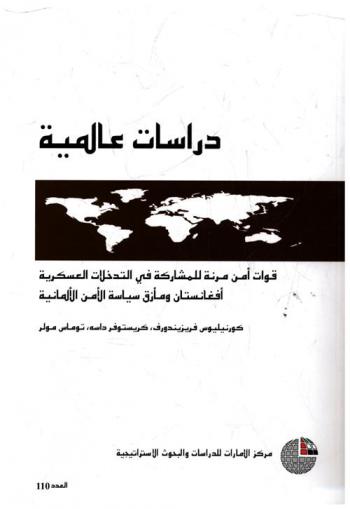
قوات أمن مرنة للمشاركة في التدخلات العسكرية : أفغانستان ومأزق سياسة الأمن الألمانية
يسعى هذا الكتاب أن يقدم وصفا مستمدا من أرض الواقع للمعضلات التي تواجه مساعي ألمانيا لتحديد المقدار السليم من استخدام وسائل القوة والإكراه في أفغانستان كما ترصد الجانبين العملياتي والتكتيكي وتحللهما وهنا تصبح قوات التدخل الدولية مطالبة ليس بخوض الحرب مع خصوم مسلحين فقط بل يتعين عليها أن تكون قادرة على التخفيف من شدة التوترات ومؤهلة لتنفيذ واجبات أيضا مثل مكافحة الجماعات الإرهابية والجريمة المنظمة وعلى العمل ضمن وحدات محدودة العدد وصغيرة الحجم فالمرونة تقتضي منها الاضطلاع بالمهمات التي تنهض بها عادة وحدات الشـرطة المحلية أيضا من أجل التكيف مع الشـروط السائدة في مناطق الصـراع والحروب الأهلية.
Book

The complexometric behavior of selected aroyl-S,N-ketene acetals shows that they are more than AIEgens
Using the established synthetic methods, aroyl-
S
,
N
-ketene acetals and subsequent bi- and multichromophores can be readily synthesized. Aside from pronounced AIE (aggregation induced emission) properties, these selected examples possess distinct complexometric behavior for various metals purely based on the underlying structural motifs. This affects the fluorescence properties of the materials which can be readily exploited for metal ion detection and for the formation of different metal-aroyl-
S
,
N
-ketene acetal complexes that were confirmed by Job plot analysis. In particular, gold(I), iron(III), and ruthenium (III) ions reveal complexation enhanced or quenched emission. For most dyes, weakly coodinating complexes were observed, only in case of a phenanthroline aroyl-
S
,
N
-ketene acetal multichromophore, measurements indicate the formation of a strongly coordinating complex. For this multichromophore, the complexation results in a loss of fluorescence intensity whereas for dimethylamino-aroyl-
S
,
N
-ketene acetals and bipyridine bichromophores, the observed quantum yield is nearly tripled upon complexation. Even if no stable complexes are formed, changes in absorption and emission properties allow for a simple ion detection.
Journal Article

Susceptibility of Raccoon Dogs for Experimental SARS-CoV-2 Infection
Raccoon dogs might have been intermediate hosts for severe acute respiratory syndrome-associated coronavirus in 2002-2004. We demonstrated susceptibility of raccoon dogs to severe acute respiratory syndrome coronavirus 2 infection and transmission to in-contact animals. Infected animals had no signs of illness. Virus replication and tissue lesions occurred in the nasal conchae.
Journal Article

Spatio-temporal Use of Oral Rabies Vaccines in Fox Rabies Elimination Programmes in Europe
In Europe, the elimination of wildlife rabies using oral rabies vaccination [ORV] of foxes for more than 30 years has been a success story. Since a comprehensive review on the scope of the different oral rabies vaccine baits distributed across Europe has not been available yet, we evaluated the use of different vaccine baits over the entire period of ORV [1978-2014]. Our findings provide valuable insights into the complexity of ORV programs in terms of vaccine related issues. More than 10 oral vaccines against rabies were used over the past four decades. Depending on many factors, the extent to which oral rabies virus vaccines were used varied considerably resulting in huge differences in the number of vaccine doses disseminated in ORV campaigns as well as in large spatial and temporal overlaps. Although vaccine virus strains derived from the SAD rabies virus isolate were the most widely used, the success of ORV campaigns in Europe cannot be assigned to a single oral rabies virus vaccine alone. Rather, the successful elimination of fox rabies is the result of an interaction of different key components of ORV campaigns, i.e. vaccine strain, vaccine bait and strategy of distribution.
Journal Article

Ancestral SARS-CoV-2-specific T cells cross-recognize the Omicron variant
The emergence of the severe acute respiratory syndrome coronavirus 2 (SARS-CoV-2) Omicron (B.1.1.529) variant of concern (VOC) has destabilized global efforts to control the impact of coronavirus disease 2019 (COVID-19). Recent data have suggested that B.1.1.529 can readily infect people with naturally acquired or vaccine-induced immunity, facilitated in some cases by viral escape from antibodies that neutralize ancestral SARS-CoV-2. However, severe disease appears to be relatively uncommon in such individuals, highlighting a potential role for other components of the adaptive immune system. We report here that SARS-CoV-2 spike-specific CD4
+
and CD8
+
T cells induced by prior infection or BNT162b2 vaccination provide extensive immune coverage against B.1.1.529. The median relative frequencies of SARS-CoV-2 spike-specific CD4
+
T cells that cross-recognized B.1.1.529 in previously infected or BNT162b2-vaccinated individuals were 84% and 91%, respectively, and the corresponding median relative frequencies for SARS-CoV-2 spike-specific CD8
+
T cells were 70% and 92%, respectively. Pairwise comparisons across groups further revealed that SARS-CoV-2 spike-reactive CD4
+
and CD8
+
T cells were functionally and phenotypically similar in response to the ancestral strain or B.1.1.529. Collectively, our data indicate that established SARS-CoV-2 spike-specific CD4
+
and CD8
+
T cell responses, especially after BNT162b2 vaccination, remain largely intact against B.1.1.529.
Peripheral ancestral SARS-CoV-2 spike-specific CD4
+
and CD8
+
T cells induced by BNT162b2 vaccination cross-react to the Omicron variant at higher levels than those induced by prior SARS-CoV-2 infection.
Journal Article
Correction: Kornet, M.M.; Müller, T.J.J. Recent Advances in Sequentially Pd-Catalyzed One-Pot Syntheses of Heterocycles. Molecules 2024, 29, 5265
In the original publication [...]
Journal Article

Narratives, Knowledge Objects, and the Making of Great Power Competition
What makes great power relations more (or less) competitive? One key argument in International Relations (IR) is that interpretations matter and shape how competitive great power relations are. This article seeks to further develop this argument. Drawing on objectual IR and the sociology of expectations, it proposes a constructivist framework that unpacks two crucial, yet surprisingly little studied aspects of the making of great power competition: (i) the constitution and organization of great power relations as a contest over scarce goods and (ii) the interplay of narratives and knowledge objects that underpins it. To illustrate the framework and contribute to theory development, the article reconstructs the dynamics of two prominent dimensions of great power competition in the past decade: The tensions between NATO and Russia in Europe and the economic competition between the United States and China. It shows that the making of great power competition involves three interrelated elements: the framing of relations among powerful states as contests over some valued goods, the production of knowledge about the distribution of these goods, and governance arrangements stipulating rules for the contests. What underpins the three elements is an interplay of narratives and knowledge objects: General narratives of what the competition is about and what is at stake preconfigure which knowledge objects are regarded as pertinent. The pertinent knowledge objects, in turn, shape the specific narratives that are told about how the competition unfolds.
Journal Article
Alkynylated and triazole-linked aroyl-S,N-ketene acetals: one-pot synthesis of solid-state emissive dyes with aggregation-induced enhanced emission characteristics
Alkynylated aroyl-
S
,
N
-ketene acetals are readily synthesized in mostly excellent yields by a Sonogashira reaction resulting in a substance library of more than 20 examples. Upon expansion of the reaction sequence by deprotection and concatenating of the copper-click reaction in a one-pot fashion, a library of 11 triazole-ligated aroyl-
S
,
N
-ketene acetals is readily accessible. All derivatives show pronounced solid-state emission and aggregation-induced emission properties depending on the nature of the alkynyl or the triazole substituents.
Journal Article