
Catalogue Search | MBRL


Are you sure you want to remove the book from the shelf?

{{itemTitle}}
5,793
result(s) for
"MARK HUNTER"
Sort by:


Love in the Time of AIDS
In some parts of South Africa, more than one in three people are HIV positive. Love in the Time of AIDS explores transformations in notions of gender and intimacy to try to understand the roots of this virulent epidemic. By living in an informal settlement and collecting love letters, cell phone text messages, oral histories, and archival materials, Mark Hunter details the everyday social inequalities that have resulted in untimely deaths. Hunter shows how first apartheid and then chronic unemployment have become entangled with ideas about femininity, masculinity, love, and sex and have created an economy of exchange that perpetuates the transmission of HIV/AIDS. This sobering ethnography challenges conventional understandings of HIV/AIDS in South Africa.
eBook

Race for education : gender, white tone, and schooling in South Africa
\"This book adds to existing research exposing continued inequalities in South Africa's education facilities and exam results. However, it rethinks South Africa's political transition by revealing how the prestige of whiteness, or what it calls \"white tone,\" became reformulated in the everyday workings of a marketised education system. It shows how \"white\" phenotypic traits retain value in society even if some better-off \"black\" people can now buy prestigious cultural dispositions\"-- Provided by publisher.
Book

Self-Medication in Animals
Animal self-medication against parasites is more widespread than previously thought, with profound implications for host-parasite biology. The concept of antiparasite self-medication in animals typically evokes images of chimpanzees seeking out medicinal herbs to treat their diseases ( 1 , 2 ). These images stem partly from the belief that animals can medicate themselves only when they have high cognitive abilities that allow them to observe, learn, and make conscious decisions ( 3 ). However, any concept of self-medication based solely on learning is inadequate. Many animals can use medication through innate rather than learned responses. The growing list of animal pharmacists includes moths ( 4 ), ants ( 5 ), and fruit flies ( 6 ). The fact that these animals self-medicate has profound implications for the ecology and evolution of animal hosts and their parasites.
Journal Article
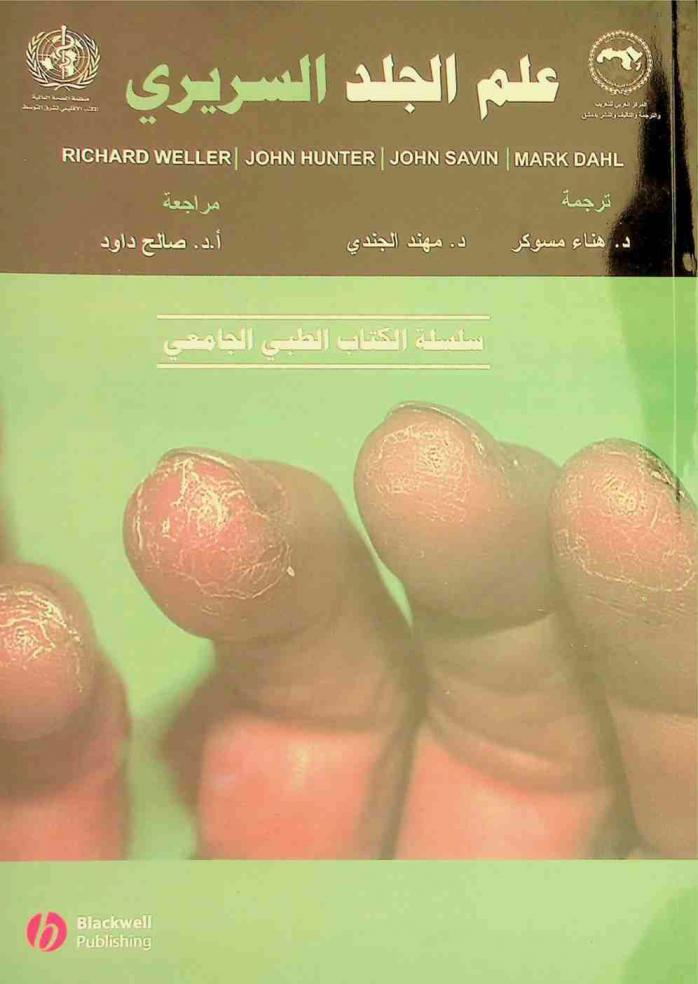
علم الجلد السريري
جاءت الطبعة الإنجليزية الرابعة من هذا الكتاب، وهو الأكثر مبيعا، بعد مراجعة وتجديد شاملين، يحتوي هذا الكتاب على أكثر من 500 من الصور والمخططات فائقة الجودة والمرفقة بعبارات متعددة الألوان، فتوضح الأفكار وتجعل من تدريسه متعة. لقد اشتهر هذا الكتاب بكونه \"وسيلة للتعلم\"، فهو يرشد القارئ عبر المتاهة التي تمتد بين الشكوى الجلدية المستعلنة وتشخيصها النهائي ومعالجتها، وهي كثيرة المصادفة في أمراض الجلد. لقد أعد المؤلفون كتابا سهل القراءة مع تفاصيل كافية لإيضاح الموضوع.
Book

Structural basis for selectivity and diversity in angiotensin II receptors
The angiotensin II receptors AT
1
R and AT
2
R serve as key components of the renin–angiotensin–aldosterone system. AT
1
R has a central role in the regulation of blood pressure, but the function of AT
2
R is unclear and it has a variety of reported effects. To identify the mechanisms that underlie the differences in function and ligand selectivity between these receptors, here we report crystal structures of human AT
2
R bound to an AT
2
R-selective ligand and to an AT
1
R/AT
2
R dual ligand, capturing the receptor in an active-like conformation. Unexpectedly, helix VIII was found in a non-canonical position, stabilizing the active-like state, but at the same time preventing the recruitment of G proteins or β-arrestins, in agreement with the lack of signalling responses in standard cellular assays. Structure–activity relationship, docking and mutagenesis studies revealed the crucial interactions for ligand binding and selectivity. Our results thus provide insights into the structural basis of the distinct functions of the angiotensin receptors, and may guide the design of new selective ligands.
Crystal structures of two complexes of the angiotensin II receptor AT
2
R with distinct tightly bound ligands reveal an active-like state of the receptor, in which helix VIII adopts a non-canonical position that blocks binding of G proteins and β-arrestins.
A new state for GPCRs
The angiotensin receptors AT
1
R and AT
2
R are G-protein-coupled receptors (GPCRs) with important roles in blood pressure regulation. Although AT
2
R is an important drug target for cardioprotection and for treating neuropathic pain and is believed to counteract several effects mediated by AT
1
R, its structure and function are not well understood. In this work, the authors report several crystal structures of AT
2
R in complex with two tightly bound ligands. These structures show a significant conformational rearrangement of the transmembrane helices to an active-like state that is similar to other class A GPCRs, save for one remarkable difference. In the active-like conformation, helix VIII adopts a non-canonical position, which not only stabilizes the state but also blocks the canonical signalling pathway of GPCRs by preventing binding of the G protein and β-arrestin. This challenges the notion of differentiating these ligands as 'agonists' or 'antagonists', or terming the state as 'active', as it precludes signalling partner interactions.
Journal Article

Climate change and an invasive, tropical milkweed
While it is well established that climate change affects species distributions and abundances, the impacts of climate change on species interactions has not been extensively studied. This is particularly important for specialists whose interactions are tightly linked, such as between the monarch butterfly (Danaus plexippus) and the plant genus Asclepias, on which it depends. We used open-top chambers (OTCs) to increase temperatures in experimental plots and placed either nonnative Asclepias curassavica or native A. incarnata in each plot along with monarch larvae. We found, under current climatic conditions, adult monarchs had higher survival and mass when feeding on A. curassavica. However, under future conditions, monarchs fared much worse on A. curassavica. The decrease in adult survival and mass was associated with increasing cardenolide concentrations under warmer temperatures. Increased temperatures alone reduced monarch forewing length. Cardenolide concentrations in A. curassavica may have transitioned from beneficial to detrimental as temperature increased. Thus, the increasing cardenolide concentrations may have pushed the larvae over a tipping point into an ecological trap; whereby past environmental cues associated with increased fitness give misleading information. Given the ubiquity of specialist plant–herbivore interactions, the potential for such ecological traps to emerge as temperatures increase may have far-reaching consequences.
Journal Article
Structure of the essential inner membrane lipopolysaccharide–PbgA complex
Lipopolysaccharide (LPS) resides in the outer membrane of Gram-negative bacteria where it is responsible for barrier function
1
,
2
. LPS can cause death as a result of septic shock, and its lipid A core is the target of polymyxin antibiotics
3
,
4
. Despite the clinical importance of polymyxins and the emergence of multidrug resistant strains
5
, our understanding of the bacterial factors that regulate LPS biogenesis is incomplete. Here we characterize the inner membrane protein PbgA and report that its depletion attenuates the virulence of
Escherichia coli
by reducing levels of LPS and outer membrane integrity. In contrast to previous claims that PbgA functions as a cardiolipin transporter
6
–
9
, our structural analyses and physiological studies identify a lipid A-binding motif along the periplasmic leaflet of the inner membrane. Synthetic PbgA-derived peptides selectively bind to LPS in vitro and inhibit the growth of diverse Gram-negative bacteria, including polymyxin-resistant strains. Proteomic, genetic and pharmacological experiments uncover a model in which direct periplasmic sensing of LPS by PbgA coordinates the biosynthesis of lipid A by regulating the stability of LpxC, a key cytoplasmic biosynthetic enzyme
10
–
12
. In summary, we find that PbgA has an unexpected but essential role in the regulation of LPS biogenesis, presents a new structural basis for the selective recognition of lipids, and provides opportunities for future antibiotic discovery.
Structural and physiological studies show that the inner membrane protein PbgA is a crucial sensor of lipopolysaccharide (LPS) and regulates the activity of the LPS biosynthesis enzyme LpxC.
Journal Article

Mycorrhizae Alter Constitutive and Herbivore-Induced Volatile Emissions by Milkweeds
Plants use volatile organic compounds (VOCs) to cue natural enemies to their herbivore prey on plants. Simultaneously, herbivores utilize volatile cues to identify appropriate hosts. Despite extensive efforts to understand sources of variation in plant communication by VOCs, we lack an understanding of how ubiquitous belowground mutualists, such as arbuscular mycorrhizal fungi (AMF), influence plant VOC emissions. In a full factorial experiment, we subjected plants of two milkweed (Asclepias) species under three levels of AMF availability to damage by aphids (Aphis nerii). We then measured plant headspace volatiles and chemical defenses (cardenolides) and compared these to VOCs emitted and cardenolides produced by plants without herbivores. We found that AMF have plant species-specific effects on constitutive and aphid-induced VOC emissions. High AMF availability increased emissions of total VOCs, two green leaf volatiles (3-hexenyl acetate and hexyl acetate), and methyl salicylate in A. curassavica, but did not affect emissions in A. incarnata. In contrast, aphids consistently increased emissions of 6-methyl-5-hepten-2-one and benzeneacetaldehyde in both species, independent of AMF availability. Both high AMF availability and aphids alone suppressed emissions of individual terpenes. However, aphid damage on plants under high AMF availability increased, or did not affect, emissions of those terpenes. Lastly, aphid feeding suppressed cardenolide concentrations only in A. curassavica, and AMF did not affect cardenolides in either plant species. Our findings suggest that by altering milkweed VOC profiles, AMF may affect both herbivore performance and natural enemy attraction.
Journal Article

Mix-and-inject XFEL crystallography reveals gated conformational dynamics during enzyme catalysis
How changes in enzyme structure and dynamics facilitate passage along the reaction coordinate is a fundamental unanswered question. Here, we use time-resolved mix-and-inject serial crystallography (MISC) at an X-ray free electron laser (XFEL), ambient-temperature X-ray crystallography, computer simulations, and enzyme kinetics to characterize how covalent catalysis modulates isocyanide hydratase (ICH) conformational dynamics throughout its catalytic cycle. We visualize this previously hypothetical reaction mechanism, directly observing formation of a thioimidate covalent intermediate in ICH microcrystals during catalysis. ICH exhibits a concerted helical displacement upon active-site cysteine modification that is gated by changes in hydrogen bond strength between the cysteine thiolate and the backbone amide of the highly strained Ile152 residue. These catalysis-activated motions permit water entry into the ICH active site for intermediate hydrolysis. Mutations at a Gly residue (Gly150) that modulate helical mobility reduce ICH catalytic turnover and alter its pre-steady-state kinetic behavior, establishing that helical mobility is important for ICH catalytic efficiency. These results demonstrate that MISC can capture otherwise elusive aspects of enzyme mechanism and dynamics in microcrystalline samples, resolving long-standing questions about the connection between nonequilibrium protein motions and enzyme catalysis.
Journal Article